Meet the Legend: Built Like a Living Tank
Among all the whip-tailed giants of Late Jurassic North America, Apatosaurus ajax stood out as the undisputed heavyweight powerhouse! Stretching seventy to seventy-five feet from snout to tail tip, it measured roughly fifteen feet shorter than graceful Diplodocus, yet packed twenty to twenty-five tons of dense muscle and bone onto its thick-set frame.
When Yale paleontologist Othniel Charles Marsh examined the first vertebrae excavated near Morrison, Colorado, in 1877, the chevron bones beneath the tail looked so much like those of ocean-going mosasaurs that he named the creature Apatosaurus—Greek for 'deceptive lizard.'
Comparing skeletal across diplodocids reveals just how robustly built Apatosaurus truly was. Its upper arm and thigh bones grew dramatically thicker in circumference, while its neck flared outward into a muscular wedge nearly as wide as its ribcage!
Despite that brawny exterior, internal air pockets connected to bird-style lungs hollowed out its spinal centra so twenty-three tons moved smoothly and efficiently across ancient river floodplains.
Even standing beside its newly restored sister genus Brontosaurus, stocky Apatosaurus wins the crown for sheer barrel-chested bulk, heavy limb columns, and raw forequarter strength.
Lost World Habitat: Gallery Forests & Waterholes
Roughly 152 to 150 million years ago, Apatosaurus inhabited the upper Morrison ecosystem across Colorado, Utah, Wyoming, and Oklahoma. Geological clues in floodplain mudstones and limestone lenses show a warm, seasonal climate where sunny dry spells alternated with drenching monsoon floods pouring off western mountain highlands.
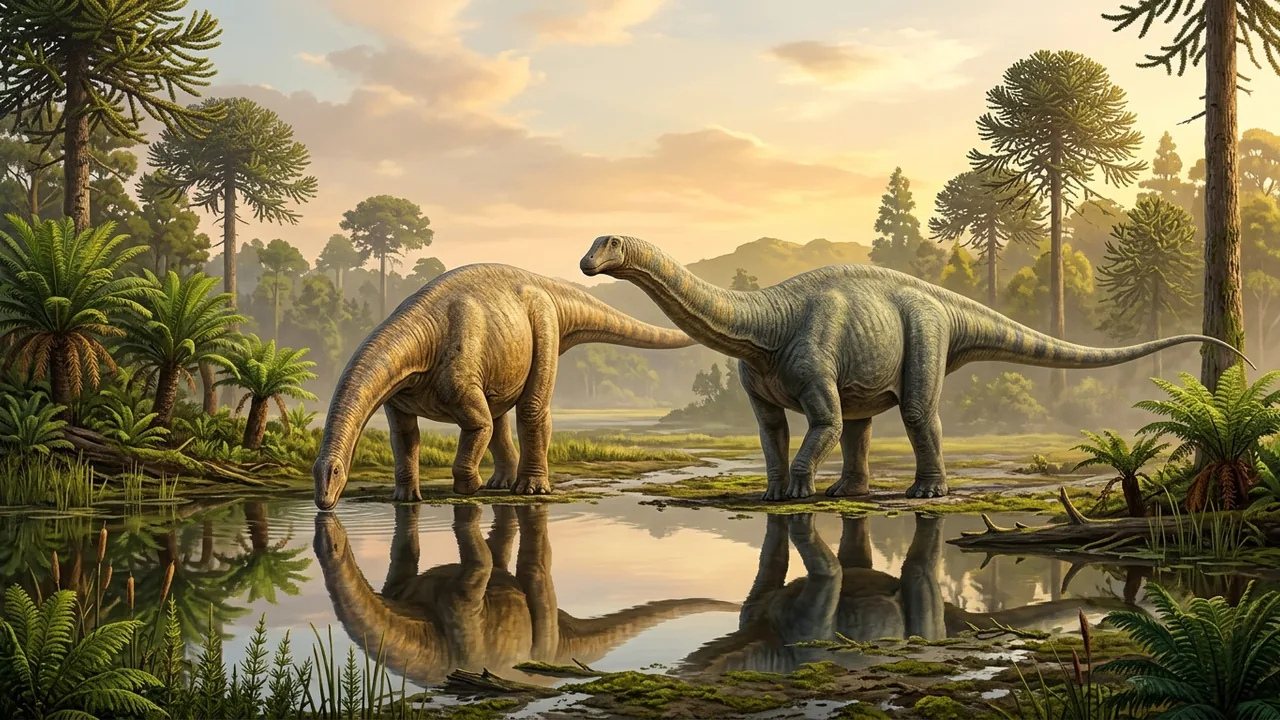
Along permanent meandering rivers and oxbow watering holes flourished dense gallery forests of araucaria conifers, ginkgoes, tree ferns, horsetails, and stiff, pineapple-trunked cycads. Within that crowded herbivore community, Apatosaurus carved out a versatile riverside browsing distinct from open-savanna Diplodocus and forty-foot canopy specialist Brachiosaurus.
Isotopic chemistry locked inside fossil tooth enamel suggests apatosaurines frequented shady woodland margins and lush wetland edges where coarse cycadophytes and moisture-loving ferns grew thick year-round even during dry summer seasons.
Applying limb to deep floodplain footprints proves Apatosaurus strode confidently across firm ground and muddy river point bars rather than floating helplessly in deep lakes.
Whenever family herds gathered at dusk beside mirror-smooth watering holes, their massive footsteps sculpted shallow clay basins that sheltered lungfish, frogs, crayfish, snails, and freshwater turtles throughout dry months until seasonal rains returned.
What's on the Prehistoric Menu?
Fueling a twenty-three-ton herbivore required harvesting around eight hundred to a thousand pounds of tough cycads, ferns, horsetails, and conifer shoots every day! Positioned at the front of its rounded, low-slung snout sat rows of sturdy cylindrical peg teeth slightly thicker than those of Diplodocus, allowing Apatosaurus to crop coarser riverside stems within its woodland .
Because chewing fibrous foliage would have required heavy molar batteries impossible to balance at the end of a twenty-foot neck, Apatosaurus swallowed whole mouthfuls unchewed. For years, textbooks claimed sauropods ground up plants inside muscular gizzards filled with swallowed river stones—each polished stone known as a !
Modern experiments by paleontologist Oliver Wings tested that idea carefully: whereas seed-eating ostriches carry stones equaling one percent of their body weight, polished gastrolith pebbles found near sauropod skeletons represent less than one-thousandth of their mass—likely swallowed accidentally with gritty roots or minerals!
Instead, multi-day microbial inside a colossal hindgut chamber served as the true digestive engine.
Billions of specialized bacteria broke down stubborn plant cellulose into rich fatty acids that powered Apatosaurus day and night.
Superpowers, Senses & Anatomy
What turned the neck of Apatosaurus into one of the most extraordinary structures in dinosaur anatomy? Viewed from the front or underside, its fifteen cervical vertebrae carried sweeping, V-braced cervical ribs that projected far downward and outward, giving the neck a deep triangular cross-section packed with heavy flexor and side-swinging muscles!
To prevent that muscular beam from overloading the shoulders, avian-like air sacs carved intricate cavities throughout the upper vertebral arches and centra, while deeply forked neural spines cradled a thick elastic ligament cable running smoothly along the midline.
In 2015, researchers Mike Taylor, Matt Wedel, and Darren Naish noted that Apatosaurus's wide, thick-walled neck ribs—reinforced with rough cartilage-capped bone bosses—far exceeded what quiet leaf plucking ever required!
Just as modern bull giraffes and elephant seals slam muscular necks in dominance contests, Apatosaurus was anatomically engineered to deliver thunderous downward and sideways neck blows against rivals or prowling predators.
Below its cavernous gut stood four pillar legs cushioned by elastic heel pads, each forefoot sporting a single stout, curved inner thumb claw nearly eight inches long for traction and close defense.
Flight vs. Fight Arena: Gallery Forest Brawler
Shady gallery woodlands along Morrison rivers were favorite hunting grounds for Ceratosaurus nasicornis—a lithe, twenty-foot predator armed with blade-like teeth and a prominent nasal horn—alongside larger Allosaurus and Torvosaurus! Hatchling Apatosaurus hatched weighing just a few pounds and relied on dense fern cover inside a cautious juvenile while packing on thousands of pounds per year.
Once an adult reached twenty to twenty-five tons, limb prevented fast running, placing Apatosaurus squarely on Team Fight as a living tank! Outweighing a one-ton Ceratosaurus more than twenty times over, a healthy adult controlled every single angle of an encounter.
Behind its broad pelvis extended a forty-foot whip tail of roughly eighty tapering vertebrae capable of lashing laterally past seventy miles per hour, threatening bone-bruising strikes and startling cracks across riverside clearings.
Up front, any predator foolish enough to lunge toward its chest faced a devastating downward blow from its bossed, muscular neck or a raking strike from its curved forefoot thumb claw!
Grouped closely together around dusk watering holes, adult Apatosaurus formed an impenetrable defensive perimeter around younger herd mates until predators backed off.
Fossil Detective Secrets: Skulls & Stones
No quarry on Earth showcases Apatosaurus better than Utah's Dinosaur National Monument, launched on August 17, 1909, when Carnegie paleontologist Earl Douglass spotted eight articulated tail bones jutting out of tilted Morrison sandstone! Excavating into that ancient sandbar uncovered CM 3018, the magnificent holotype skeleton of Apatosaurus louisae.
Just feet away lay a delicate, elongated diplodocid skull (CM 11162), yet influential museum authorities doubted such a brawny neck carried a slender head—leaving Apatosaurus mounts headless or topped with boxy Camarasaurus skulls until John McIntosh and David Berman proved Douglass right in 1978!
Modern fossil detectives also use scanning electron microscopes to test polished quartz pebbles found in Morrison quarries, separating genuine digestive stones from river-tumbled gravel while confirming air sacs ventilated the massive skeleton.
Finally, Emanuel Tschopp's landmark 2015 study measured 477 anatomical traits to confirm stocky Apatosaurus and trimmer-necked Brontosaurus stand side by side as distinct sister genera!
From Utah's tilted sandstone cliff wall to Pittsburgh's famous museum hall, Apatosaurus remains an enduring icon of Late Jurassic strength, careful archival detective work, and exciting scientific discovery for young paleontologists everywhere.