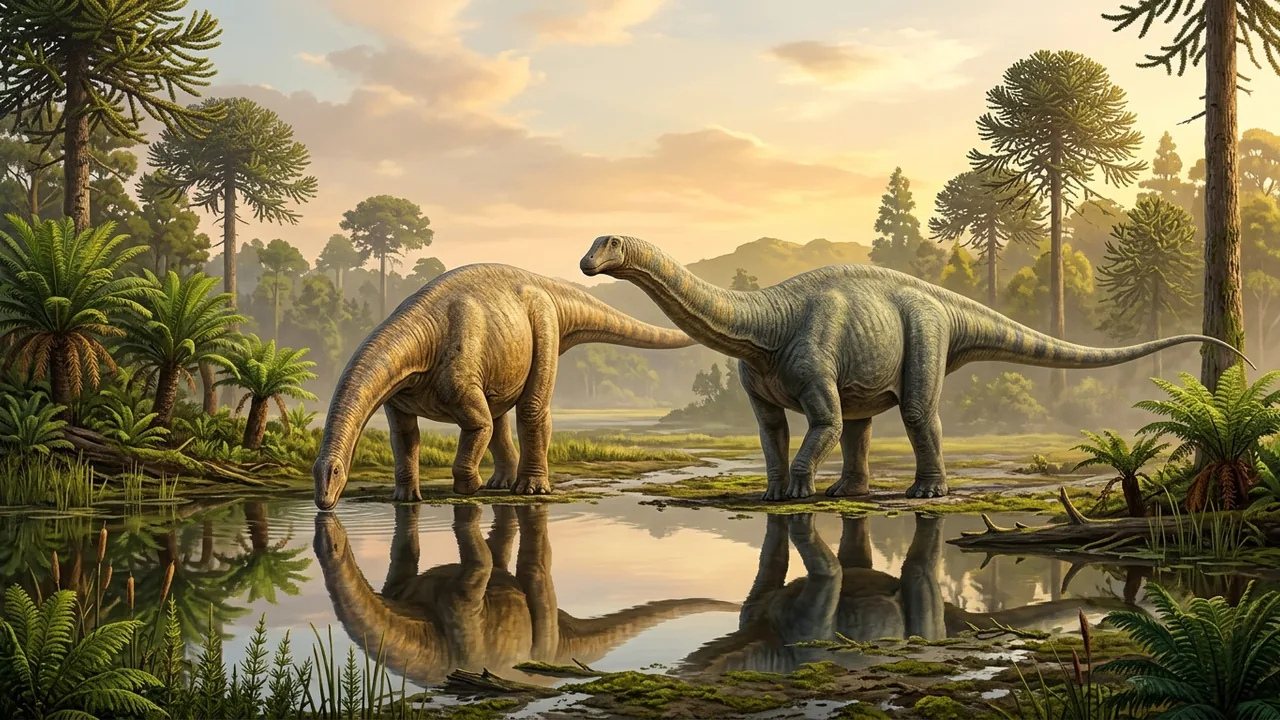
Meet the Legend: Heavyweight of the West
Meet Apatosaurus ajax, the brawniest member of the whip-tailed sauropod family! Named deceptive lizard by paleontologist Othniel Charles Marsh in 1877 from rocky foothills near Morrison, Colorado, this Late Jurassic stretched over seventy feet long while tipping the scales between twenty and twenty-five tons.
Although roughly fifteen feet shorter than slender Diplodocus, Apatosaurus weighed several tons more! Thick, stocky leg bones and an extraordinarily wide, muscular neck gave it a powerhouse frame built for steady strength rather than sprinting speed.
Every heavy bone and cushioned joint in its sturdy skeleton served as a physical for carrying immense weight across seasonal western river valleys without tiring.
When family herds of Apatosaurus marched together toward evening watering holes, their round, elephant-like feet pressed dinner-table-sized tracks deep into damp floodplain mud that later hardened into solid stone.
Lost World Habitat: Gallery Forests & Floods
Between 152 and 150 million years ago, Apatosaurus roamed warm, seasonally dry plains across ancient Colorado, Utah, Wyoming, and Oklahoma. Whenever summer monsoons arrived, swollen rivers spilled nutrient-rich mud across wide floodplains, watering lush ribbons of riverside woodland called gallery forests.
Inside those shady green corridors grew stiff cycads, fan-leafed ginkgoes, tree ferns, horsetails, and towering conifers that fed every hungry throughout the year. Over millions of years, river sand and floodplain mud hardened into colorful rock layers that locked skeletons safely in stone.
Geologists compare those western floodplain rocks with older Mesozoic sedimentary basins right in Virginia—such as the Culpeper Basin, where ancient lakeside mudstones preserved real dinosaur footprints along North America's eastern side!
Sharing shady Morrison watering holes with Apatosaurus were plated Stegosaurus, burrowing lungfish, freshwater turtles, and watchful river predators waiting among tall reeds.
What's on the Prehistoric Menu?
In the Late Jurassic river food chain, tough cycads, ferns, and conifers captured warm sunlight as green producers, while Apatosaurus acted as a giant primary consumer. Fueling twenty-three tons of active required cropping hundreds of pounds of coarse stems and fronds every single day!
Positioned along the rounded front of its slender skull sat rows of chisel-tipped peg teeth built for nipping and stripping branches clean. Because chewing mouthfuls would have demanded heavy cheek molars too bulky for a twenty-foot neck to lift, Apatosaurus swallowed every leafy mouthful whole.
Once foliage reached its cavernous torso, billions of helpful microbes went to work through hindgut , slowly breaking fibrous plant cell walls into steady chemical energy over several days.
Paleontologists also study smooth, rounded quartz pebbles—each called a —occasionally buried beside sauropod ribs from swallowed riverbed grit along ancient streams!
Superpowers, Senses & Anatomy
What gave Apatosaurus such astonishing upper-body power? Underneath each neck bone jutted V-shaped cervical ribs thickened with rough bony knobs. This specialized skeletal anchored massive muscle bundles that let Apatosaurus swing its wide neck sideways or downward with tremendous force!
To keep that muscular neck from tipping the animal forward onto its nose, internal air-sac chambers hollowed out the upper spine like lightweight honeycomb, while forked neural spines held an elastic suspension ligament along its back.
Meanwhile, its barrel-shaped ribcage housed a huge digestive chamber alongside bird-style air sacs and lungs that cooled its core during sunny marches across open floodplains.
Up front, four weight-bearing toes stood straight inside a spongy heel pad while a large, curved inner thumb claw gripped slick mud along steep, slippery riverbanks and deterred curious predators.
Flight vs. Fight Arena: Unmovable Fortress
Along wooded river bends prowled Ceratosaurus nasicornis—a fast, twenty-foot carnivore armed with dagger-like teeth and a prominent nasal horn—as well as hungry packs of Allosaurus! Because twenty-three-ton legs were built as straight weight-bearing columns rather than sprinting springs, adult Apatosaurus stood squarely on Team Fight.
Outweighing Ceratosaurus more than twenty times over, this full-grown relied on a triple-threat defense ! Behind its muscular hips tapered a forty-foot whip tail capable of lashing sideways at stinging highway speeds to clear predators right out of range.
Up front, a powerful downward neck slam or swift swipe from its curved inner thumb claw could send any bold attacker scrambling backward into the riverside ferns!
Behavioral herd defense also protected smaller youngsters inside a circle of watchful adults until rapid yearly growth carried them safely into heavyweight adulthood.
Fossil Detective Secrets: Cliff of a Thousand Bones
In August 1909, Carnegie Museum fossil hunter Earl Douglass climbed sunlit ridges in northeastern Utah and spotted eight articulated tail bones of Apatosaurus sticking straight out of tilted sandstone! Excavating inward revealed a nearly complete skeleton named Apatosaurus louisae alongside hundreds of neighbor dinosaurs washed onto an ancient river sandbar.
Right near that skeleton rested an elongated, peg-toothed skull—plus an occasional smooth pebble! Ironically, experts hesitated for decades to attach that slender skull, mounting boxy heads instead until researchers Jack McIntosh and David Berman proved in 1978 that Douglass had been right all along!
Later, Emanuel Tschopp's landmark 2015 study confirmed stocky Apatosaurus and trimmer-necked Brontosaurus stand side by side as distinct sister genera.
Protected since 1915 as Dinosaur National Monument, Douglass's quarry wall still inspires young fossil detectives visiting from every state!