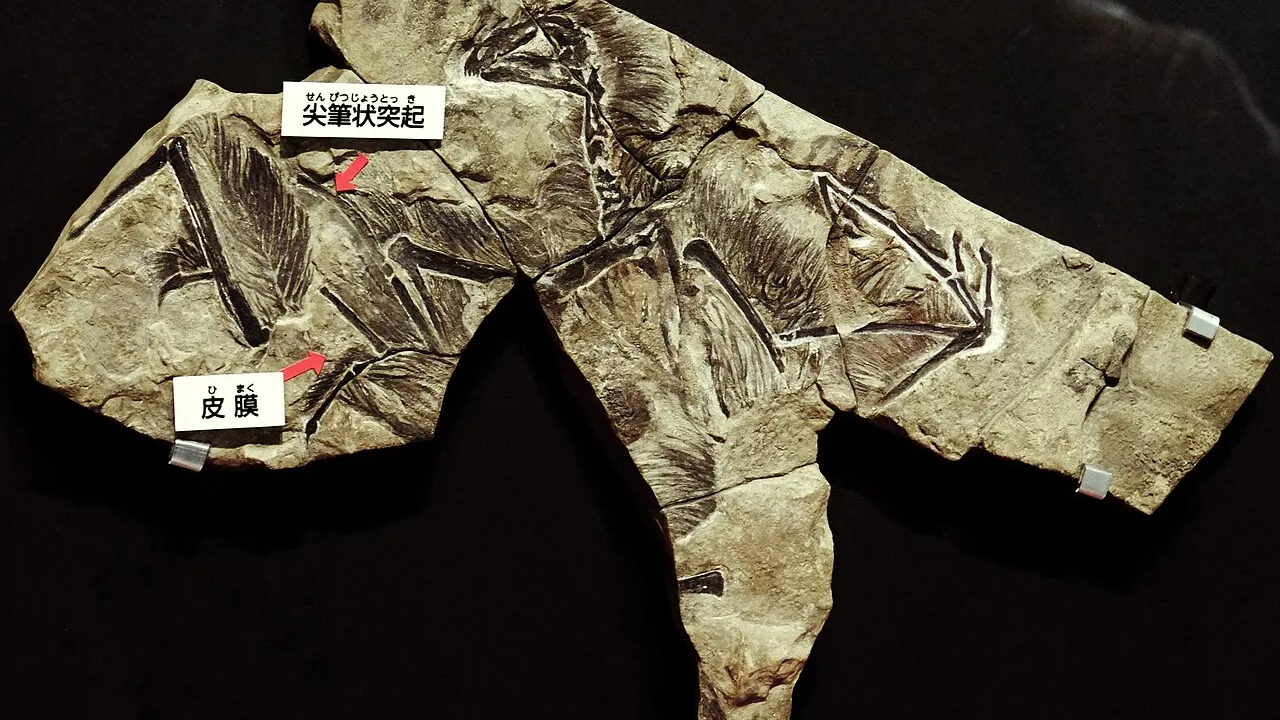
1. What does the Mandarin name Yi qi translate to in English?
2. What made Yi Qi's wings different from a modern bird's wings?
🤯 Mind-Blowing Fact • Grade 2
The curved rod bone growing from Yi Qi's wrist was slightly longer than its entire lower arm bone!
✨ Word Sparks (Grade 2 Glossary)
Tap 🔊 to hear
Canopy
High leafy roof formed by forest trees
Brace
To hold something steady and strong
Iridescent
Shining with shifting rainbow-like colors
🪝
How did a dinosaur the weight of a soup can grow an extra bone in its wrist?
1
High in the Forest Canopy
Look high into the misty treetops of China 159 million years ago! Perched on a mossy branch sits Yi Qi, a tiny tree-climbing dinosaur weighing less than a pound. Stiff paintbrush-shaped feathers covered its head, neck, and arms.
2
The Mystery Wrist Rod
When farmer Wang Jianrong found its fossil in 2007, scientists spotted a curved five-inch rod sticking out from each wrist! At first no one knew what that rod was. Closer study showed it braced a wide sheet of skin alongside a super-long third finger.
3
Gliding for Bugs
Spreading its bat-like wings, Yi Qi swooped silently from tree to tree, snatching beetles, lizards, and seeds.
1. What unusual bone grew outward from each of Yi Qi's wrists?
2. Who first discovered the fossil slab holding Yi Qi in China?
🤯 Mind-Blowing Fact • Grade 3
Microscopic fossil pigment capsules called melanosomes reveal that Yi Qi had glossy black body feathers accented with warm yellow-brown tones on its head and wings!
✨ Word Sparks (Grade 3 Glossary)
Tap 🔊 to hear
Styliform
Rod-shaped bone or cartilage supporting a wing
Melanosome
Microscopic cell packet holding natural pigment color
Arboreal
Adapted for living up inside trees
🪝
Did dinosaurs experiment with more than one way of taking to the air before modern birds ruled the skies?
1
Nature's Flight Experiments
During the Jurassic Period 159 million years ago, small feathered dinosaurs were evolving all sorts of tree-climbing tricks. Some grew stiff bird feathers on their arms and legs. Then, in the ancient forests of northeastern China, tiny Yi qi tried something completely unexpected: bat-style membrane wings!
2
The Styliform Wrist Bone
Yi qi belonged to the scansoriopterygids, a family of tiny climbing dinosaurs with an extra-long third finger. Extending backward from each wrist was a 13-centimeter (5-inch) curved rod called a element. Fossilized patches of crinkled skin still clung between this wrist rod and the long fingers!
3
Paintbrush Feathers in Living Color
Although Yi qi used skin to glide, it was still a feathered dinosaur! Strange, wispy feathers shaped like tiny paintbrushes covered its body. Microscopic color capsules called show its plumage gleamed glossy black with touches of reddish-brown and yellow.
4
Swooping Between Branches
Because its chest muscles were small, Yi qi probably glided from high trunks like a modern flying squirrel rather than flapping across wide valleys.
1. How do scientists know what colors Yi Qi's fuzzy feathers were?
2. How did Yi Qi most likely travel through the forest?
🤯 Mind-Blowing Fact • Grade 4
Four years after Yi qi was named, paleontologists discovered a second bat-winged dinosaur cousin in China named Ambopteryx, proving Yi qi's strange wings were no fluke!
✨ Word Sparks (Grade 4 Glossary)
Tap 🔊 to hear
Airfoil
Wing shape that creates lift in air
Fluorescence
Glowing under laser light to reveal details
Paravian
Group uniting birds and closest dinosaur cousins
🪝
Why did one branch of feathered Jurassic dinosaurs evolve bat-like skin wings instead of feathered bird wings?
1
An Evolutionary Surprise in Hebei
Step into the humid Tiaojishan forest of Jurassic China 159 million years ago, where volcanic ash occasionally dusted lakes surrounded by ginkgos, cycads, and giant tree ferns. Clinging to high bark with sharp curved claws was Yi qi—a 380-gram (13-ounce) dinosaur with a 60-centimeter (2-foot) wingspan. When paleontologist Xu Xing and colleagues described it in 2015, it stunned experts worldwide.
2
Architecture of a Membrane Wing
Unlike Archaeopteryx and modern birds, which generate lift using overlapping pennaceous flight feathers, Yi qi possessed zero stiff flight vanes on its arms. Instead, its hugely elongated third finger teamed up with a 13-centimeter ossified rod—the styliform element—protruding from its wrist. Preserved patches of membranous tissue stretched across this bony frame, echoing modern bats and colugos.
3
Convergent Solutions to Tree Life
Modern flying squirrels and scaly-tailed gliders independently evolved smaller cartilage wrist rods to spread gliding skin! Yi qi represents a remarkable dinosaurian parallel: an evolutionary side-branch that experimented with membranous right alongside early feathered birds.
4
Aerodynamics in Dense Woodlands
Laser-stimulated scans and wind-tunnel models conducted in 2020 confirmed that Yi qi lacked the broad pectoral muscle attachments required for sustained powered flight. Instead, short glides from tall tree trunks saved energy while foraging for insects, small vertebrates, and soft forest seeds.
1. Which modern mammals have independently evolved wrist rods somewhat similar to Yi Qi's styliform element?
2. What did 2020 laser scans and aerodynamic models reveal about how Yi Qi flew?
🤯 Mind-Blowing Fact • Grade 5
Under International Code of Zoological Nomenclature rules, Yi is the shortest possible genus name at two letters, making the four-letter binomial Yi qi tied with the modern great evening bat Ia io as the shortest scientific name in zoology!
✨ Word Sparks (Grade 5 Glossary)
Tap 🔊 to hear
Patagium
Stretchy skin membrane used for gliding or flight
Filamentous
Made of fine hair-like or brush-like strands
Biota
All plant and animal life of a region
🪝
What does Yi qi reveal about the messy, creative burst of evolutionary flight experiments near the origin of birds?
1
A Forgotten Experiment in the Yanliao Biota
One hundred fifty-nine million years ago during the Oxfordian stage of the Late Jurassic, northeastern China hosted the Yanliao —a temperate wetland-forest ecosystem preserved in exquisite volcanic lake shales of the Tiaojishan Formation. Amid early feathered paravians like Anchiornis, a diminutive scansoriopterygid theropod named Yi qi ('strange wing' in Mandarin) charted a radically different path into the air.
2
The Styliform Element and Patagium
Described in Nature in 2015 by Xu Xing, Zheng Xiaoting, Corwin Sullivan, and colleagues, the holotype preserved a curved, 13-centimeter rod of calcified cartilage or bone articulating directly with the ulnar wrist. Combined with a hyper-elongated manual digit III—a signature trait of Scansoriopterygidae—this styliform element supported an aerodynamic skin membrane () completely devoid of pennaceous flight feathers.
3
Filamentous Plumage and Melanosome Reconstruction
Even with bat-like wings, Yi qi remained unmistakably theropodan. Dense, non-branching feathers resembling stiff paintbrushes insulated its head, neck, and limbs. Scanning electron microscopy of fossilized melanosomes revealed eumelanin-rich rodlets indicating glossy black body plumage alongside spherical phaeomelanosomes producing warm yellow-brown hues across its crown and wing margins.
4
Biomechanical Testing via Laser Fluorescence
In 2020, T. Alexander Dececchi and collaborators applied laser-stimulated fluorescence (LSF) to map soft-tissue outlines and reconstructed several wing shapes to test lift, glide ratio, and flap stability. Their analyses demonstrated that scansoriopterygids lacked supracoracoideus pulley systems and large sternal keels, restricting Yi qi to short, controlled glides between canopy trunks—an evolutionary dead end eventually outcompeted by feathered avian wings.
5
Confirmed by Ambopteryx
Any lingering doubt about Yi qi's anatomy vanished in 2019 with the discovery of Ambopteryx longibrachium, a second scansoriopterygid preserving both a styliform wrist rod and gut contents—proving membranous gliding evolved across an entire clade of Jurassic dinosaurs.