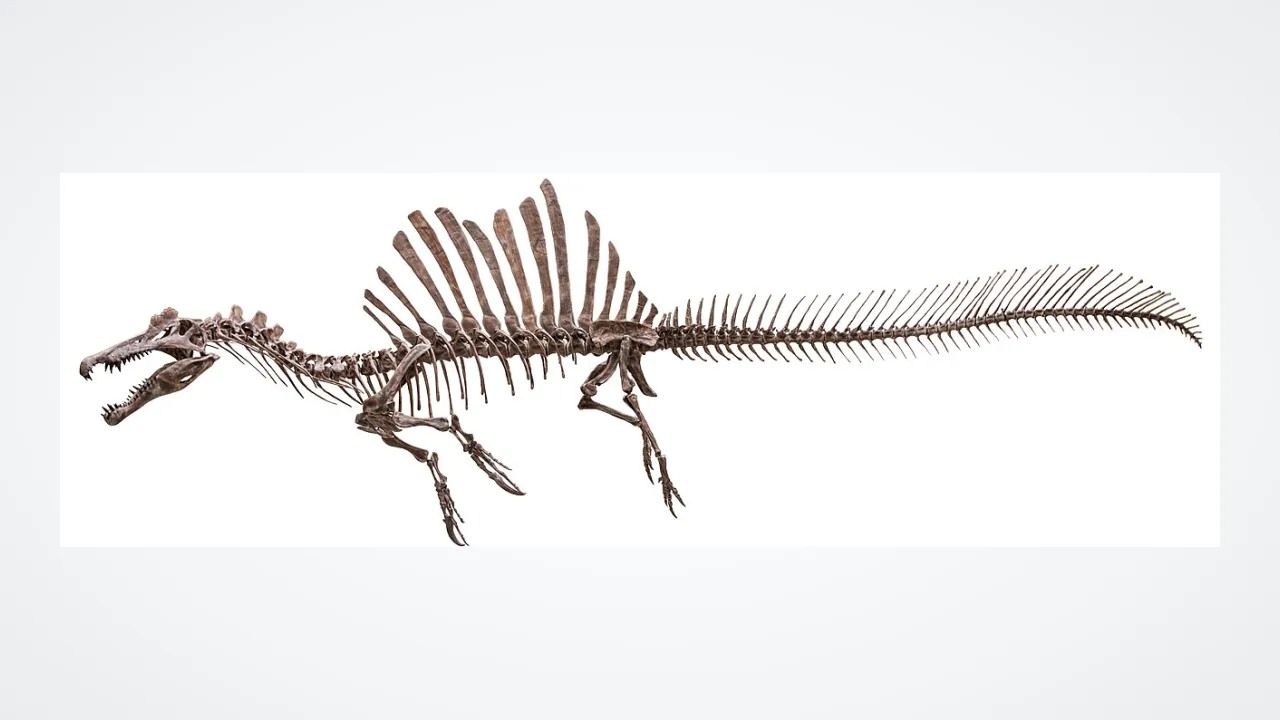
⚡ Survival SuperpowerSix-foot back sail, crocodile snout with water-pressure sensors, and paddle tail
🤯 Mind-Blowing Fact • Grade 1
Spinosaurus grew longer than Tyrannosaurus Rex, stretching almost fifty feet from snout tip to paddle tail!
✨ Word Sparks (Grade 1 Glossary)
Tap 🔊 to hear
Sail
Tall fin of skin and bone on a back
Snout
Long narrow nose and jaws of an animal
Paddle
Flat wide tail or foot used in water
🪝
What giant meat-eating dinosaur loved to wade in rivers and catch huge fish?
1
Splash in the Wide River!
Splash, ripple! Warm muddy river water swirls around two sturdy legs. Up rises a giant six-foot on a scaly back! Meet the amazing river hunter, Spinosaurus.
2
Jaws Like a Crocodile
Look at its long, narrow ! Pointed cone teeth line its jaws like a crocodile's mouth. Those straight teeth gripped slippery giant fish so they could not wiggle free.
3
Built for Water
Its flat, wide tail swished side to side like an oar. Big hooked thumb claws helped scoop up dinner along the riverbank!
2. What rose six feet tall along the back of Spinosaurus?
🤯 Mind-Blowing Fact • Grade 2
Tiny pits on the tip of a Spinosaurus snout felt underwater ripples just like modern alligators and crocodiles do!
✨ Word Sparks (Grade 2 Glossary)
Tap 🔊 to hear
Mangrove
Tangled swamp trees growing beside warm water
Sawfish
Huge ancient fish with a tooth-lined snout
Spines
Tall upright bones rising from the backbone
🪝
How could Spinosaurus sense fish swimming in murky water without even seeing them?
1
Giant of Ancient African Rivers
Imagine today's dry Sahara Desert covered in lush swamps and winding rivers! Ninety-seven million years ago, Spinosaurus patrolled those waterways across Egypt and Morocco. Stretching nearly fifty feet long, it was the longest meat-eating dinosaur ever discovered.
2
A Built-In Fish Radar
Tiny pits dotted the tip of its crocodile-like snout. Inside those pits sat special nerves that felt tiny ripples in muddy water! Even with its eyes above the surface, Spinosaurus could dip its snout in and snap up giant .
3
Towering Back Sail and Fin Tail
Bony taller than a grown-up supported a dramatic back sail that warned rivals from far across the river.
1. What looked totally different about North Africa when Spinosaurus lived there?
2. How did tiny pits on the tip of its snout help Spinosaurus hunt?
🤯 Mind-Blowing Fact • Grade 3
Unlike almost every other meat-eating dinosaur, Spinosaurus had dense, solid leg bones like penguins and hippos to help control buoyancy in water!
✨ Word Sparks (Grade 3 Glossary)
Tap 🔊 to hear
Piscivore
An animal whose diet consists mostly of fish
Buoyancy
Upward force of water that makes things float
Submerged
Completely covered underneath the surface of water
🪝
Why did Spinosaurus have heavy solid bones like a penguin instead of hollow bones like other theropods?
1
Master of the Kem Kem Waterways
Travel back ninety-five million years to the Kem Kem river system of ancient Morocco, where car-sized coelacanths and twenty-foot sawfish cruised murky channels. Wading and swimming through this watery world was Spinosaurus aegyptiacus, a seven-ton —meaning fish-eater—built unlike any other dinosaur.
2
Penguin-Dense Bones and High Nostrils
Almost all meat-eating theropods had hollow, air-filled leg bones to run lightly on land. Spinosaurus evolved thick, solid-walled bones that acted like a scuba diver's weight belt, helping it stay steady in water! Its nostrils sat partway up its snout so it could breathe while keeping its jaws .
3
The 2020 Paddle-Tail Surprise
In 2020, paleontologists unearthed an intact tail in Morocco lined with tall vertical spines, turning the entire tail into a flexible ribbon-like paddle similar to a giant newt.
4
Display Sail Above the Waterline
Rising nearly six feet high, its dorsal sail stayed visible above the river surface, advertising territory without forcing two giants to fight.
1. Why were dense, solid leg bones helpful for Spinosaurus?
2. What major Spinosaurus body part did paleontologists discover in Morocco in 2020?
🤯 Mind-Blowing Fact • Grade 4
For seventy years after 1944, scientists only had black-and-white photos and sketches of the first Spinosaurus skeleton until new bones were found in Morocco!
✨ Word Sparks (Grade 4 Glossary)
Tap 🔊 to hear
Semiaquatic
Spending major time both in water and ashore
Rosette
Spoon-shaped cluster of large teeth at jaw tips
Niche
Specific food and habitat role in an ecosystem
🪝
How was the lost mystery of Spinosaurus solved seventy years after its original skeleton vanished?
1
Lost Bones and a Rediscovered Giant
German paleontologist Ernst Stromer named Spinosaurus aegyptiacus in 1915 after studying giant six-foot spine bones excavated in Egypt's Bahariya Oasis. Sadly, in 1944, wartime bombing destroyed the Munich museum housing Stromer's only skeleton, leaving only his careful drawings and photographs behind! For seventy years, Spinosaurus remained paleontology's greatest puzzle until paleontologist Nizar Ibrahim and colleagues unearthed a new partial skeleton in Morocco's Kem Kem Beds in 2014.
2
Surprising Short Hind Legs
The Moroccan fossils stunned researchers: relative to its forty-eight-foot body, Spinosaurus had remarkably short hind legs and wide, flat-clawed feet resembling a heron's! Coupled with a forward center of mass, it walked more carefully on land than long-legged land predators like Carcharodontosaurus.
3
Niche Partitioning Among Giant Carnivores
Ancient North Africa supported multiple giant theropods at once—a puzzle called Stromer's Riddle. Spinosaurus solved that riddle by specializing in giant aquatic prey like Onchopristis sawfish and lungfish, leaving land-dwelling sauropods to dry-land hunters.
4
Conical Teeth Built like Fish Traps
Instead of flat, serrated steak-knife teeth, Spinosaurus carried smooth, fluted, interlocking cones arranged in a spoon-shaped terminal at the tip of its jaws. Paired with long, muscular forelimbs and curved thumb claws, those specialized jaws trapped slippery river fish before they could dart away into murky currents.
1. How did Spinosaurus coexist in North Africa alongside other giant meat-eaters like Carcharodontosaurus?
2. Why were Spinosaurus teeth shaped like smooth cones rather than serrated blades?
🤯 Mind-Blowing Fact • Grade 5
CT scans of the Spinosaurus snout revealed branching nerve tunnels inside the bone that worked as an underwater motion detector!
✨ Word Sparks (Grade 5 Glossary)
Tap 🔊 to hear
Osteosclerosis
Extra-dense bone growth that reduces floating in water
Foramina
Tiny openings in bone for nerves and vessels
Neotype
Replacement reference fossil chosen when original is lost
🪝
Was Spinosaurus a deep-water pursuit swimmer or a giant wading heron—and why do scientists still test both ideas?
1
From Stromer's Egypt to Morocco's Kem Kem Beds
In 1912, fossil collector Richard Markgraf excavated massive neural spines up to 1.65 meters (5.4 feet) tall from Cenomanian sandstone in western Egypt for paleontologist Ernst Stromer. After the 1944 destruction of Stromer's holotype in Munich, generations relied on archival plates until 2014 and 2020 expeditions in southeastern Morocco recovered an associated skeleton—including hind limbs, pelvic girdle, phalanges, and eighty percent of a remarkable finned caudal series.
2
Neurovascular Snout and Piscivorous Mechanics
Reaching fourteen to fifteen meters (46–50 feet) in length and roughly seven to eight metric tons, Spinosaurus possessed an elongated, laterally compressed rostrum. High-resolution CT scans reveal branching internal canals linking hundreds of external directly to the trigeminal nerve, creating a hydrodynamic pressure sensor capable of detecting fish movements in turbid river deltas.
3
Osteosclerosis and Buoyancy Physics
Cross-sectional bone histology published in 2022 confirmed extreme —thickened cortical bone filling the medullary cavities—paralleling modern penguins, manatees, and hippopotamuses that forage beneath the water surface.
4
Active Scientific Debate: Swimmer or Wader?
Science thrives on testing competing hypotheses! Robotic tail-flume experiments by Nizar Ibrahim's team showed the tall caudal fin generated eight times more thrust than terrestrial theropod tails, whereas biomechanical buoyancy models by Paul Sereno and Donald Henderson argue the tall dorsal sail created drag and tipping instability if fully submerged, favoring a giant wading ambush style along deep channel edges.
5
A Uniquely Specialized Dinosaur Clade
Whether wading chest-deep like a colossal heron along delta sandbars or undulating through deeper river channels, Spinosaurus demonstrates that non-avian theropod dinosaurs conquered rich freshwater ecosystems with astonishing anatomical specialization, bridging terrestrial and aquatic habitats across Mid-Cretaceous Gondwana for millions of years.