🦴 PREHISTORIC
🦴 Tyrannosaurus rex • Tyrannosauridae
VA Science SOL 2.5, 3.4, 3.5, 5.8 (Fossils, Adaptations & Earth History)
Tyrannosaurus Rex
Bone-Crushing Ruler of the Late Cretaceous
Grade 4 • Expanding • 198 words
🌋 Geologic Period & RegionLate Cretaceous (68–66 MYA) • Western North America
📏 Size & Weight40 ft (12.3 m) long • 8–9 tons
🦴 Diet & FossilsApex Carnivore • Hell Creek Formation skeletons
⚡ Survival SuperpowerSix-ton bone-crushing bite paired with eagle-sharp binocular vision
🤯 Mind-Blowing Fact • Grade 1
One Tyrannosaurus Rex tooth could grow as long as a big yellow banana, root and all!
✨ Word Sparks (Grade 1 Glossary)
Tap 🔊 to hear
Fossil
Ancient bone or footprint turned into stone
Snout
The long nose and jaws of an animal
Balance
Staying steady on your feet without falling
🪝
What dinosaur had teeth as big as bananas?
1
Heavy Steps in the Forest
Thump, thump! The ground shakes in the ancient forest. Giant three-toed feet press into the soft mud. Out steps the mighty Tyrannosaurus Rex! It lived millions of years ago.
2
Big Jaws, Tiny Arms
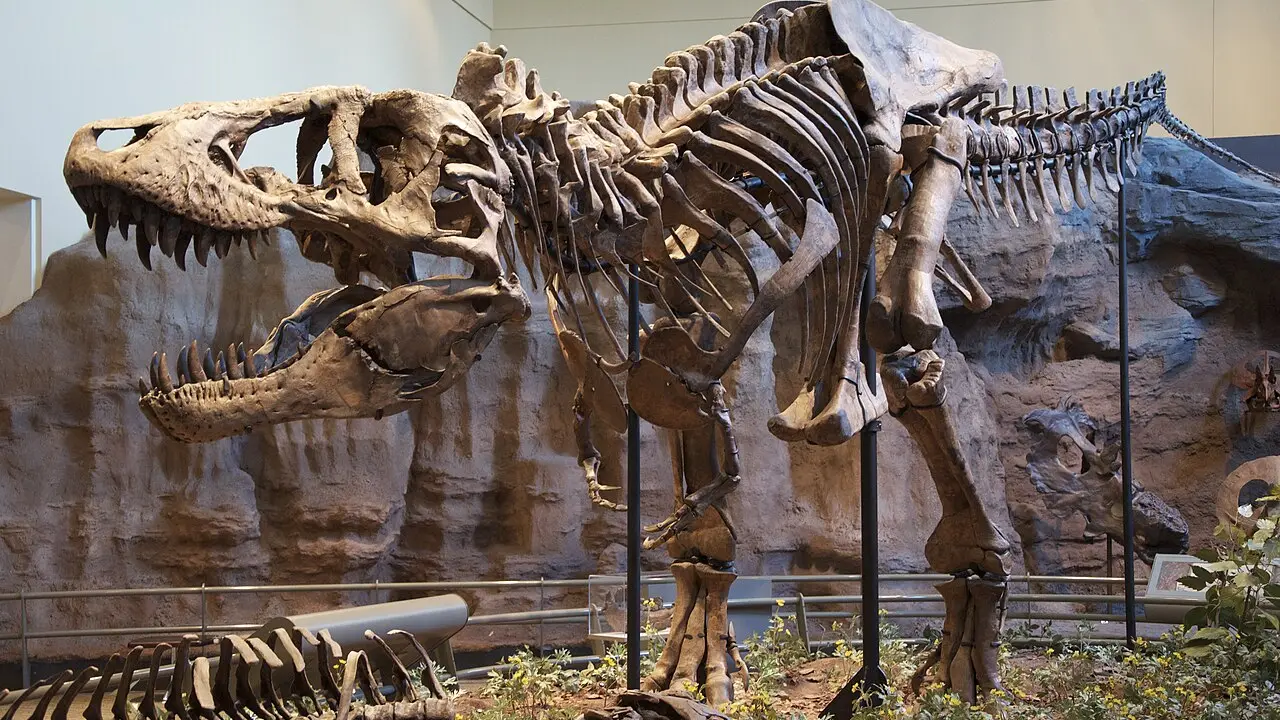
Look at its huge head! Its jaws hold thick teeth as big as bananas. Yet its front arms are very short. Each little hand has just two sharp claws.
3
Super Eyes and Nose
This giant hunter could see far across the trees. Its big nose could sniff dinner from miles away. Long heavy tail muscles helped it as it walked.
1. How many claws did Tyrannosaurus Rex have on each hand?
2. What helped Tyrannosaurus Rex stay balanced while walking?
🤯 Mind-Blowing Fact • Grade 2
If Tyrannosaurus Rex lost a tooth during lunch, a brand-new tooth grew right back in its place!
✨ Word Sparks (Grade 2 Glossary)
Tap 🔊 to hear
Carnivore
An animal that eats meat for food
Floodplain
Flat, green land beside a winding river
Tyrant
A powerful ruler that others respect or fear
🪝
How could a giant dinosaur sneak through the woods so quietly?
1
King of the Ancient Floodplains
Imagine standing beside a dinosaur as long as a yellow school bus! About sixty-six million years ago, Tyrannosaurus Rex ruled lush river valleys in western North America. Its name means lizard king.
2
Built for Power
Unlike thin, slicing teeth in other meat-eaters, its sixty thick teeth were shaped like sturdy spikes. When those huge jaws snapped shut, they could crunch right through solid dinosaur bone! Even its short arms had thick muscles.
3
Sharp Senses on Cushioned Feet
Both eyes faced forward like a hawk's, helping it judge distance clearly. Soft pads on the bottoms of its giant feet cushioned every step so it could walk surprisingly quietly through fern forests.
Teenage Tyrannosaurus Rex went through a huge growth spurt, gaining almost five pounds a day for several years!
✨ Word Sparks (Grade 3 Glossary)
Tap 🔊 to hear
Serrated
Notched along the edge like a steak knife
Binocular
Using two forward eyes to judge distance
Olfactory
Connected to the body's sense of smell
🪝
Why did Tyrannosaurus Rex have the strongest bite of any land animal ever?
1
A Giant of Late Cretaceous Rivers
Picture warm coastal swamps buzzing with dragonflies sixty-seven million years ago. Moving silently between cypress trees comes Tyrannosaurus Rex, an eight-ton predator forty feet long. It patrolled western North America right at the end of the Age of Dinosaurs.
2
Nature's Strongest Jaws
Most meat-eating dinosaurs had narrow skulls and flat, blade-like teeth. Tyrannosaurus Rex evolved a wide, reinforced skull powered by massive jaw muscles. Its , cone-shaped teeth delivered six tons of bite force—enough pressure to crush the weight of a pickup truck!
3
Super-Powered Senses
Fossil braincases scanned with X-rays reveal giant bulbs, the brain parts that process smell. Combined with vision sharper than an eagle's, this hunter could track meals across miles of forest.
4
Growing Up Fast
Young tyrannosaurs started life sleek, leggy, and covered in wispy downy feathers. During their teenage years, they packed on nearly five pounds every single day until becoming heavy-bodied adults.
1. How were Tyrannosaurus Rex teeth different from most other meat-eating dinosaurs' teeth?
2. What did X-ray scans of fossil braincases reveal about Tyrannosaurus Rex?
🤯 Mind-Blowing Fact • Grade 4
Fossilized Tyrannosaurus Rex droppings, called coprolites, are packed with crushed bone fragments that prove it digested solid skeletons!
✨ Word Sparks (Grade 4 Glossary)
Tap 🔊 to hear
Apex Predator
Top hunter with no natural predators as an adult
Coprolite
Fossilized prehistoric animal droppings turned to stone
Marrow
Nutrient-rich tissue inside the center of bones
🪝
How did paleontologists figure out that Tyrannosaurus Rex was a marathon walker instead of a roaring sprinter?
1
Ruler of Ancient Laramidia
Step back sixty-eight million years to Laramidia, an island continent that once formed western North America alongside a shallow inland sea. Across lush floodplains roamed Tyrannosaurus Rex, an measuring forty feet long and weighing up to nine tons. Rather than stomping loudly and roaring, scientists think it moved with quiet, efficient strides.
2
Engineering a Six-Ton Bite
Computer models of the five-foot-long skull show why its bite was unmatched on land. Fused nasal bones along the snout acted like a shock absorber, preventing the skull from twisting while biting armored herbivores like Triceratops. Its serrated teeth gripped and fractured hard bone, unlocking mineral-rich that smaller carnivores left behind.
3
Why Such Short Forelimbs?
Although its three-foot arms looked tiny beside its massive head, the arm bones show thick muscle scars capable of curling four hundred pounds. Shrinking the forelimbs kept weight off the front of the body so the neck and jaws could grow gigantic without tipping the dinosaur forward.
4
Built for Endurance
Look closely at tyrannosaur foot bones and you find an arctometatarsus—a pinched middle ankle bone that acted like a springy shock absorber. Running forty miles per hour would have shattered nine-ton leg bones, so adults power-walked at twelve miles per hour, outlasting slower prey.
1. How did fused nasal bones help Tyrannosaurus Rex feed?
2. Why did shrinking the front arms help Tyrannosaurus Rex evolve?
🤯 Mind-Blowing Fact • Grade 5
By counting microscopic annual growth rings inside fossilized leg bones, scientists learned that even the largest Tyrannosaurus Rex skeletons were only about twenty-eight to thirty years old!
✨ Word Sparks (Grade 5 Glossary)
Tap 🔊 to hear
Osteophagy
The specialized feeding ability to crush and eat bones
Ontogeny
How an organism changes shape as it grows up
Stereoscopic
Three-dimensional depth vision from two overlapping eyes
🪝
How do CT scans and bone growth rings reveal the secret life story of Tyrannosaurus Rex?
1
Discovery in the Hell Creek Badlands
Wind-carved sandstone buttes across Montana and South Dakota hold clues to the final two million years of the Mesozoic Era. In 1902, fossil hunter Barnum Brown excavated giant hip and skull bones from Montana's Hell Creek Formation. Three years later, museum president Henry Fairfield Osborn named the species Tyrannosaurus rex—Latin and Greek for 'tyrant lizard king'—launching more than a century of paleontological discovery.
2
Cranial Biomechanics and Osteophagy
Measuring up to 12.3 meters (40 feet) long and weighing roughly eight to nine metric tons, an adult Tyrannosaurus rex possessed extraordinary cranial mechanics. Unlike blade-toothed theropods that sliced flesh, it practiced —crushing and consuming bone. Finite-element computer simulations calculate a posterior bite force exceeding 35,000 newtons (nearly six tons), concentrated onto stout, D-shaped teeth with microscopic serrations that resisted shattering.
3
Sensory Neuroanatomy
High-resolution CT scans of fossilized braincases show an animal wired for precision tracking. Enlarged olfactory bulbs rivaled those of modern vultures, detecting faint scents across wide coastal floodplains. Forward-tilted eye sockets provided a 55-degree overlap for depth perception, while elongated inner-ear canals tuned its hearing to low-frequency footsteps.
4
Ontogeny and Ecological Niche Shift
By slicing thin sections of leg bones and counting annual growth rings—much like tree rings—histologists discovered that Tyrannosaurus rex lived fast and rarely passed age thirty. Fleet-footed juveniles hunted small, swift prey, while heavy adults occupied the top predator niche, leaving virtually no room for medium-sized carnivores in the same ecosystem.
5
Famous Specimens: Sue and Scotty
Complete skeletons such as 'Sue' in Chicago and 'Scotty' in Saskatchewan preserve healed rib fractures, tail arthritis, and bite marks from rival tyrannosaurs, transforming stony fossils into vivid biographies of survival.