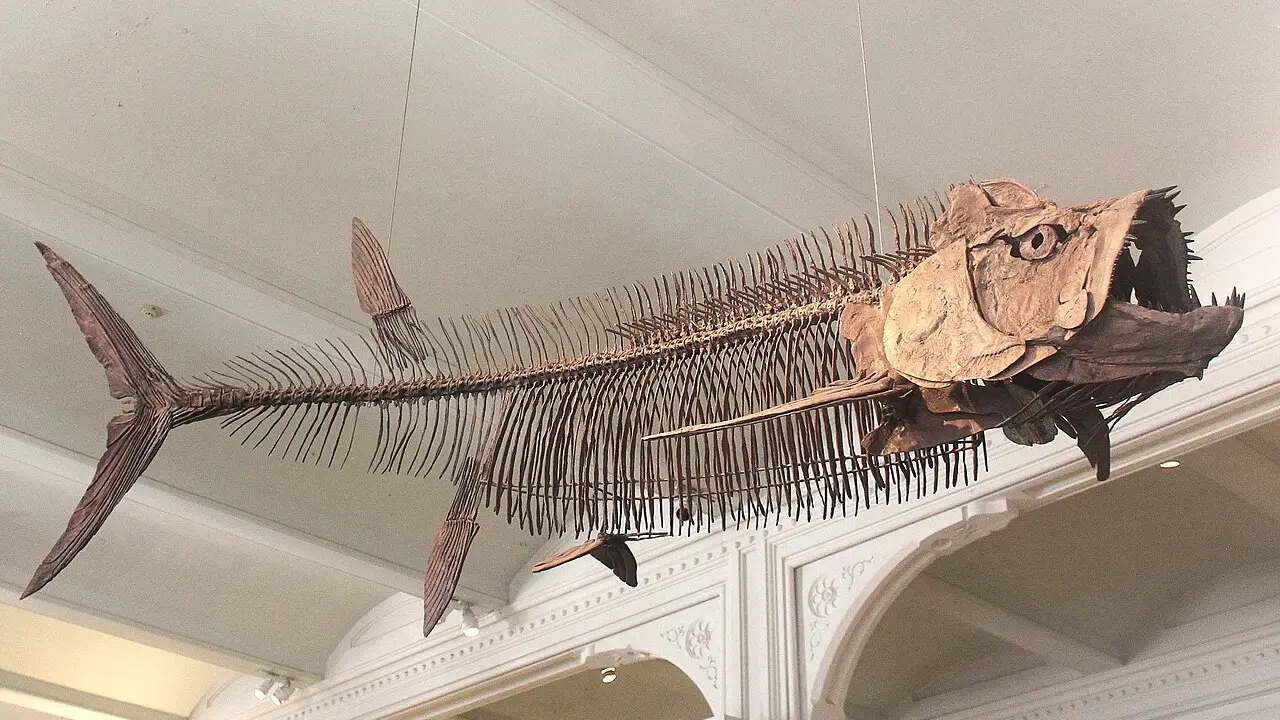
1. Why do people nickname Xiphactinus the 'bulldog fish'?
2. What astonishing clue rests inside the famous Kansas 'Fish-Within-a-Fish' fossil?
🤯 Mind-Blowing Fact • Grade 2
Leaping high into the air may have helped Xiphactinus shake pesky ocean parasites right off its shiny silver scales!
✨ Word Sparks (Grade 2 Glossary)
Tap 🔊 to hear
tarpon
Large, silvery modern ocean fish that leaps
forked
Split into two sharp, pointed tail tips
parasites
Tiny hitchhikers clinging onto a bigger animal
🪝
How fast could a twenty-foot bony fish sprint across North America's inland ocean?
1
Silver Lightning in the Seaway
Picture warm turquoise waves rolling over Kansas during the Late Cretaceous Period! Shooting beneath the surface like a giant silver comes Xiphactinus audax—whose name means 'bold sword-ray' after the long, blade-like bony rays supporting its front fins.
2
Built for Thirty-five-Mile-Per-Hour Sprints
Stretching fifteen to twenty feet long and weighing nearly a thousand pounds, Xiphactinus had a deeply tail fin powered by thick side muscles. Scientists estimate it could sprint faster than thirty miles per hour and leap clean out of the water!
3
Swallowing Prey Headfirst
Because its three-inch fangs couldn't chew or slice, Xiphactinus opened its stretchy jaws wide and gulped large fish, squid, and diving birds whole!
1. Where did Xiphactinus get its name meaning 'sword-ray'?
2. Why did Xiphactinus swallow huge meals whole instead of chewing?
🤯 Mind-Blowing Fact • Grade 3
Sternberg's 1952 'Fish-Within-a-Fish' fossil is fourteen feet of solid limestone drama displayed today at the Sternberg Museum of Natural History in Hays, Kansas!
✨ Word Sparks (Grade 3 Glossary)
Tap 🔊 to hear
silhouetting
Spotting dark shapes outlined against bright light
digestion
How stomach juices break swallowed food down
oxygen-poor
Deep mud lacking oxygen where scavengers stay away
🪝
How did fossil hunter George Sternberg uncover paleontology's most famous last supper in Kansas?
1
George Sternberg's Legendary Discovery
One hot summer day in 1952 in Gove County, Kansas, fossil hunter George F. Sternberg spotted giant tail fins poking from gray Niobrara Chalk. Weeks of careful chiseling revealed a masterpiece: a thirteen-foot Xiphactinus skeleton preserved nose-to-tail—with an unchewed six-foot fish named Gillicus arcuatus curled neatly inside its stomach!
2
What Went Wrong With Lunch?
Because the swallowed Gillicus showed zero acid marks on its scales, paleontologists realized Xiphactinus perished moments after gulping it down! Thrashing fins from that oversized meal likely ruptured an internal organ, sending hunter and prey sinking quietly into seafloor mud together.
3
Attacking From Below
Notice how Xiphactinus's jaw slanted sharply upward and its big eyes peered toward the surface. By cruising deeper down and prey against bright overhead sunlight, it rocketed upward in surprise strikes!
4
Predator and Prey Alike
Even twenty-foot Xiphactinus wasn't completely safe—sharks like Cretoxyrhina and giant Tylosaurus mosasaurs occasionally turned the tables and hunted it!
1. How do scientists know the Kansas Xiphactinus died right after swallowing the six-foot Gillicus?
2. How did upturned jaws help Xiphactinus ambush its prey?
🤯 Mind-Blowing Fact • Grade 4
In 2010, a twelve-year-old boy hiking in Manitoba, Canada, spotted fangs sticking out of creek shale that turned out to be a giant eighteen-foot northern Xiphactinus!
✨ Word Sparks (Grade 4 Glossary)
Tap 🔊 to hear
cosmopolitan
Living in oceans all around the world
homocercal
Symmetrical forked tail fin with equal lobes
macro-predation
Hunting prey remarkably large compared to oneself
🪝
Why are giant Xiphactinus skeletons found from Kansas and Alabama all the way to Europe, Venezuela, and Australia?
1
Cosmopolitan Sprinter of Greenhouse Seas
During the Late Cretaceous greenhouse climate, high sea levels flooded continental interiors around the globe. First described by Joseph Leidy in 1870 from a massive pectoral fin spine ('audacious sword-ray'), Xiphactinus audax patrolled North America's Western Interior Seaway alongside sister species Xiphactinus vetus along the Atlantic coast, while cousins ranged across Europe, South America, and Australia.
2
Ichthyodectid Anatomy and Speed
Although modern fishers compare its silvery slab-sided silhouette and upturned mandible to giant tarpon (Megalops), Xiphactinus belonged to Ichthyodectidae, an extinct stem-teleost family all its own. Nearly ninety tightly packed vertebrae braced a muscular torso ending in a towering, high-aspect-ratio tail fin—delivering sustained open-ocean cruising speeds and explosive forty-mile-per-hour ambush bursts.
3
Expandable Jaws and 'Last Supper' Taphonomy
Unequal conical fangs—some exceeding seven centimeters—lined premaxillary, maxillary, and dentary bones designed to impale slippery prey while mobile cheek bones flared outward like a pelican's throat. Beyond George Sternberg's iconic 1952 Gillicus-stuffed specimen, at least a dozen other Xiphactinus skeletons preserve oversized fish or Hesperornis seabird bones mid-digestion, proving risky was routine!
4
Tangled Food Webs of the Niobrara
Fossil stomach contents run both ways: paleontologists have excavated nineteen-foot Cretoxyrhina ('Ginsu') sharks and giant Tylosaurus mosasaurs containing partially digested Xiphactinus bones—revealing fierce multi-tier competition atop Cretaceous oceans!
1. Is Xiphactinus the direct ancestor of today's giant silver tarpon?
2. What does finding Xiphactinus bones inside fossilized sharks and mosasaurs tell us?
🤯 Mind-Blowing Fact • Grade 5
Unlike most bony fishes whose teeth glue lightly to jaw edges, Xiphactinus anchored its giant fangs inside deep bony sockets much like crocodiles and dinosaurs!
✨ Word Sparks (Grade 5 Glossary)
Tap 🔊 to hear
prognathous
Having a lower jaw jutting strongly forward
thecodont
Teeth set firmly inside deep jaw sockets
dysoxic
Water very low in dissolved oxygen
🪝
How did stem-teleost jaw mechanics, endothermic muscle physiology, and anoxic chalk seabeds make Xiphactinus a paleontological legend?
1
Nomenclatural Tangled Roots and Global Reach
Described in 1870 by Philadelphia anatomist Joseph Leidy from an isolated scythe-like pectoral fin ray before Edward Drinker Cope unwittingly coined the synonym Portheus molossus for complete skulls a year later, Xiphactinus audax reigned for over thirty million years (Albian through Maastrichtian, 100–66 MYA). Thriving across epicontinental seaways from Arctic Canada to Patagonia, Bohemia, and Queensland, this five-to-six-meter predator crowned the radiation of Ichthyodectiformes—basal stem-teleost fishes positioned near the evolutionary dawn of modern bony fishes.
2
Cranial Kinesis and Raptorial Dentition
Xiphactinus combined a fiercely (upturned) mandible with deeply socketed -like fangs—unusual among ray-finned fishes—spanning up to eight centimeters anteriorly. When striking upward into sunlit baitballs, streptostylic suspensorial joints swung the maxillae forward and flared the opercular chamber laterally, generating hydrodynamic suction while accommodating whole prey exceeding forty percent of its own body length.
3
High-Aspect-Ratio Locomotion and Mesothermy
Reinforced by heavy, fused first pectoral fin rays that functioned like swept-wing hydrofoils and propelled by a lunate, deeply forked caudal fin exceeding a meter tall, Xiphactinus mirrored modern bluefin tuna and black marlin. Isotopic and comparative biomechanical analyses suggest regional red-muscle endothermy, fueling sustained pelagic pursuits across temperature gradients.
4
Taphonomy of the 'Fish-Within-a-Fish'
Excavated by George F. Sternberg and Walter Sorensen in Gove County, Kansas, in 1952, specimen FHSM VP-333 immortalized a four-meter Xiphactinus audax enclosing an articulated 1.8-meter fellow ichthyodectid, Gillicus arcuatus. Swallowed headfirst, the struggling prey likely lacerated cardiac vessels or gills; rapid sinking onto Smoky Hill Chalk ooze excluded benthic scavengers and preserved every delicate cycloid scale.
5
End-Cretaceous Curtain Call
Fragmentary Maastrichtian jaws from New Jersey, Belgium, and South America confirm Xiphactinus hunted right up until the Chicxulub bolide impact 66 million years ago collapsed marine primary productivity and extinguished every giant ichthyodectiform.