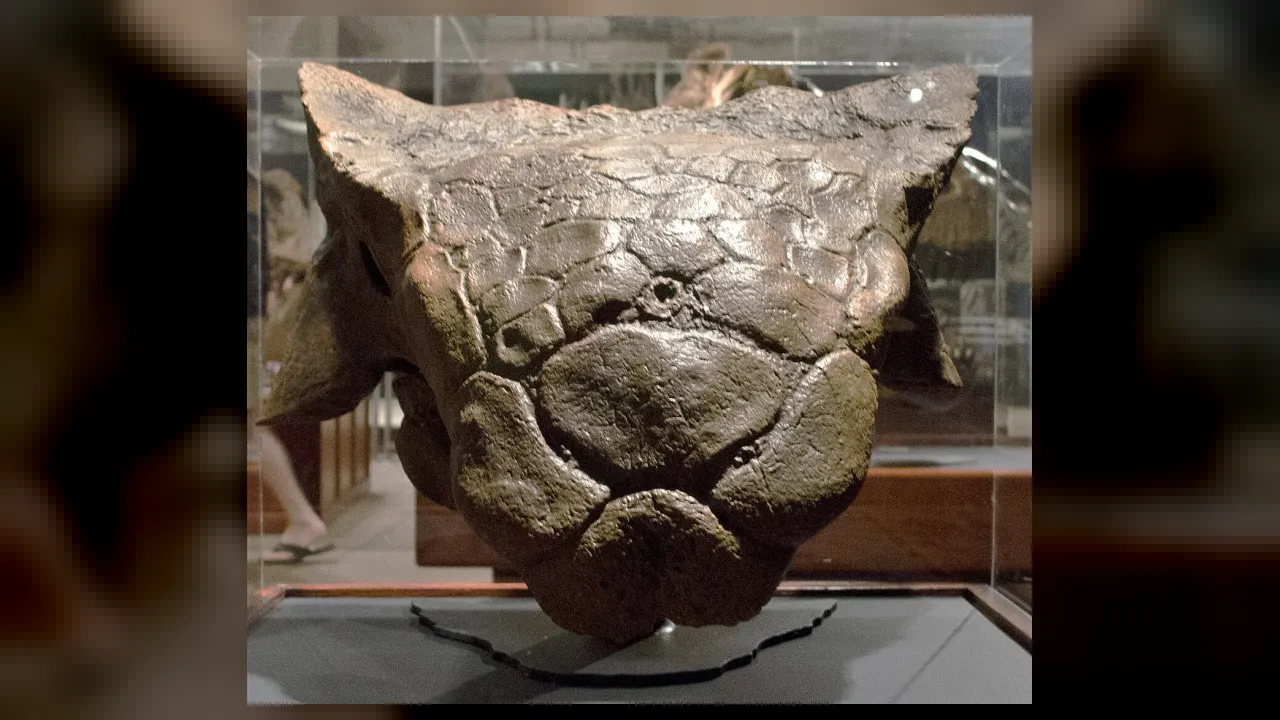
⚡ Survival SuperpowerInterlocking bony back armor, armored eyelids, and a 100-pound bone tail club
🤯 Mind-Blowing Fact • Grade 1
Ankylosaurus family members even had tiny bony plates built into their eyelids that closed like shutters when they blinked!
✨ Word Sparks (Grade 1 Glossary)
Tap 🔊 to hear
Armor
Hard protective covering shielding an animal's body
Club
Heavy rounded knob at the tip of a tail
Shutters
Hard covers that close tightly to protect eyes
🪝
What dinosaur wore bony armor from nose to tail—even over its eyelids?
1
Clank, Thud Through the Woods
Crunch, thud! Low green bushes part beside a muddy stream. Out waddles a wide, spiky dinosaur covered in tough bony plates! Meet the living tank called Ankylosaurus.
2
Armor Everywhere
Rows of hard bony bumps guarded its neck, back, and sides. Even its eyelids had tiny bony ! Only its soft belly underneath had no .
3
Giant Tail Club
At the end of its tail sat a heavy knob of solid bone. One big sideways swing warned any hungry meat-eater to back away!
2. Which part of Ankylosaurus did NOT have hard bony armor?
🤯 Mind-Blowing Fact • Grade 2
The heavy bony club at the tip of an Ankylosaurus tail could weigh up to one hundred pounds!
✨ Word Sparks (Grade 2 Glossary)
Tap 🔊 to hear
Fused
Joined tightly together into one solid piece
Scutes
Thick bony scales set into tough skin
Crouch
To squat low and close to the ground
🪝
How could a peaceful plant-eater stand its ground against Tyrannosaurus Rex?
1
Built Like an Armored Tank
Imagine a dinosaur as wide as a family van and heavier than an elephant, yet standing lower than your dad's shoulders! Sixty-six million years ago, Ankylosaurus munched ferns in the same forests where Tyrannosaurus Rex hunted.
2
Fused Shield of Bone
Its name means lizard because skull plates, ribs, and hip bones joined tightly together. Hundreds of bony sat inside tough leathery skin, making its back almost impossible to bite through!
3
Swinging the Sledgehammer
Stiff rods of bone locked the end of its tail into a straight handle, letting flexible hip muscles whip its hundred-pound bone club low across the ground.
1. Why does the name Ankylosaurus mean 'fused lizard'?
2. What made the end of its tail work like a stiff hammer handle?
🤯 Mind-Blowing Fact • Grade 3
Ankylosaurus armor plates had woven fibers inside the bone that worked just like modern fiberglass helmets to absorb heavy impacts without cracking!
✨ Word Sparks (Grade 3 Glossary)
Tap 🔊 to hear
Collagen
Tough stretchy protein fibers strengthening skin and bone
Magniventris
Latin species name meaning having a great belly
Airways
Breathing tubes carrying air from nose to lungs
🪝
Why did Ankylosaurus have looping roller-coaster air tubes hidden inside its skull?
1
Largest of the Club-Tailed Dinosaurs
Step onto Late Cretaceous floodplains in Montana and Wyoming sixty-seven million years ago. Cropping low shrubs with a wide, shovel-shaped beak walks Ankylosaurus —a seven-ton armored herbivore whose species name means 'great belly.'
2
Lightweight Yet Unbreakable Armor
If every armor plate had been solid rock-heavy bone, Ankylosaurus could barely walk! Microscopic studies show its osteoderms wove crisscross fibers inside spongy bone—making them tough like modern fiberglass bulletproof vests without weighing too much.
3
Crazy Looping Nasal Passages
CT scans inside Ankylosaurus skulls revealed a wild surprise: instead of straight nose tubes, its nasal twisted in long S-shaped loops! Those extra-long passages cooled hot air before it reached the brain and helped boom deep vocal calls.
4
Digesting Ferns in a Giant Gut
Small leaf-shaped teeth chopped plants lightly before its wide, barrel-shaped gut fermented tough fibers.
1. What made Ankylosaurus armor plates strong without being way too heavy?
2. What two jobs did the long looping nasal passages inside the skull perform?
🤯 Mind-Blowing Fact • Grade 4
Fossil rib injuries along the sides of ankylosaurs show they didn't just defend against predators—rivals also sparred with each other using their tail clubs!
✨ Word Sparks (Grade 4 Glossary)
Tap 🔊 to hear
Ossified
Soft tendon or tissue hardened into solid bone
Keeled
Shaped with a raised central ridge like a boat
Generalist
Animal able to eat many varied low plants
🪝
Did Ankylosaurus swing its hundred-pound tail club only at predators, or at rival ankylosaurs too?
1
Barnum Brown's Armored Giant
Four years after finding Tyrannosaurus Rex in Montana's Hell Creek Formation, fossil hunter Barnum Brown uncovered a wide, triangular skull and rows of armor plates in 1906. Naming it Ankylosaurus magniventris in 1908, Brown recognized the largest known member of the ankylosaurid family—measuring up to twenty-five feet long and six feet wide across its armored hips.
2
Physics of the Tail Sledgehammer
Engineering models published by paleontologist Victoria Arbour tested how fast and hard the tail club struck. Seven interlocking terminal vertebrae fused with braided, tendons to form a stiff handle, while two huge side osteoderms formed the striking head. Swinging horizontally at a hundred-degree arc, the club delivered enough impact force to fracture solid tyrannosaur ankle bones!
3
Jousting with Rivals
In 2022, researchers studying remarkably preserved ankylosaur fossils noticed healed rib and flank fractures located high along the sides—where low-swinging tail clubs of rival ankylosaurs would strike during territorial shoving and sparring contests, much like modern giraffes neck-sparring.
4
Wide Muzzle for Generalist Grazing
Whereas narrow-beaked cousins nibbled picky tidbits, Ankylosaurus evolved a broad, square beak built to crop abundant low ferns and fruiting shrubs indiscriminately.
1. What does the broad, square shape of the Ankylosaurus beak tell paleontologists about its diet?
2. What 2022 fossil clue revealed that ankylosaurs used their tail clubs in contests with each other?
🤯 Mind-Blowing Fact • Grade 5
In 2023, scientists discovered the first ever fossilized dinosaur voicebox (larynx) inside an ankylosaur cousin, showing these armored tanks could make bird-like calls!
✨ Word Sparks (Grade 5 Glossary)
Tap 🔊 to hear
Countershading
Dark back and light belly camouflage hiding shadows
Larynx
Muscular voicebox organ in the throat making sounds
Maastrichtian
Final geological stage of the Late Cretaceous Period
🪝
How did Ankylosaurus combine composite biomaterials, cranial air-conditioning, and a biological war-hammer to survive alongside T. rex?
1
Rare Fortress of the Latest Maastrichtian
Surprisingly, despite its fame, Ankylosaurus magniventris is far rarer in the Hell Creek and Lance Formations than Triceratops or Edmontosaurus—probably because it favored upland woodland habitats farther from lowland rivers where rapid burial occurred. Reaching seven to eight meters (23–26 feet) in length and up to eight metric tons, it represented the evolutionary pinnacle of thyreophoran armor right at the close of the Cretaceous Period.
2
Composite Biomaterial Engineering
Histological cross-sections show ankylosaurid osteoderms were far more sophisticated than simple slabs of bone. Sandwiched between dense outer cortices, three-dimensional orthogonal weaves of structural collagen fibers resisted crack propagation under concentrated tooth loads—an evolutionary parallel to modern Kevlar-reinforced composites—while curved cervical half-rings shielded the flexible neck.
3
Convoluted Nasal Turbinates and Voicebox Clues
Micro-CT reconstructions by paleobiologist Jason Bourke demonstrated that extreme looping nasal passages prevented fatal brain overheating inside an insulated, thick-skulled head, reclaiming moisture on every exhale. Furthermore, a fossilized discovered in an Asian ankylosaurid cousin in 2023 revealed bird-like vocal anatomy capable of surprisingly complex, resonant calls!
4
Finite-Element Tail-Club Biomechanics
Finite-element analyses calculate that large ankylosaurid tail clubs accelerated at angular velocities generating 360 to 700 megapascals of stress at the point of impact—more than sufficient to shatter solid cortical bone on contact while internal spongy bone cushioned the tail vertebrae themselves from recoil shockwaves.
5
Countershading Camouflage in Armored Cousins
Preserved melanosome pigments in closely related borealopeltid mummies show reddish-brown upper armor fading to a pale underside—classic camouflage proving even heavily armored multi-ton herbivores benefited from blending quietly into dappled forest shadows whenever sharp-eyed tyrannosaurs patrolled nearby.