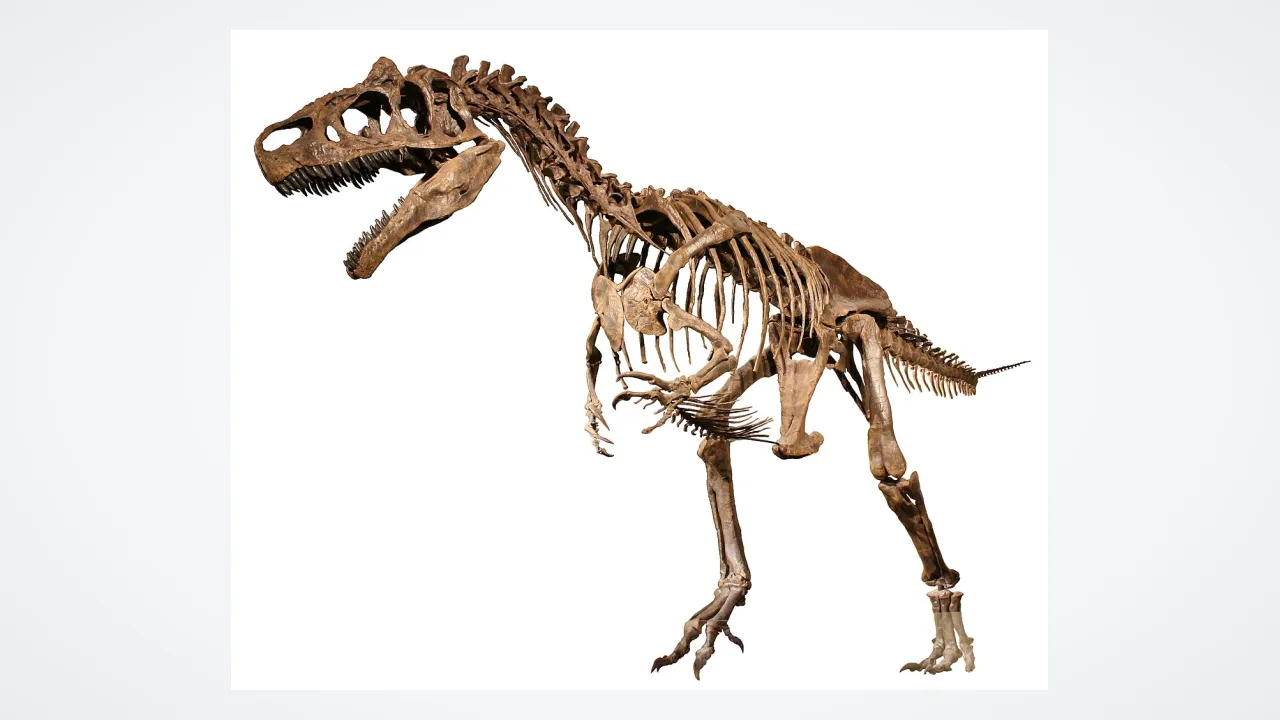
1. How many sharp claws did Allosaurus have on each strong hand?
2. Where did two small bony crests sit on an Allosaurus head?
🤯 Mind-Blowing Fact • Grade 2
In 1988, Utah named Allosaurus its official state fossil because more Allosaurus bones have been found in Utah than anywhere else on Earth!
✨ Word Sparks (Grade 2 Glossary)
Tap 🔊 to hear
Vertebra
One individual bone block in an animal's spine
Hourglass
Shape wide at both ends and narrow mid-center
Nimble
Light on its feet and quick to turn
🪝
Why did scientists name Allosaurus 'different lizard' when they found its backbone?
1
Top Predator of Giant Valley
Imagine walking across sunny plains in Utah one hundred fifty million years ago, long before Tyrannosaurus Rex existed! Ruling those Late Jurassic river valleys was Allosaurus, a thirty-foot meat-eater weighing two tons.
2
Hourglass Backbones
When paleontologist Othniel Marsh studied its backbone in 1877, he noticed -shaped hollows inside each that kept the skeleton strong yet surprisingly light. Because no other dinosaur known back then had bones like that, he named it Allosaurus—meaning different lizard!
3
Curved Teeth and Eyebrow Horns
Like modern eagles, it constantly grew replacement teeth whenever old ones broke, while keratin-covered brow horns helped Allosaurus recognize friends and rivals.
1. Why did Othniel Marsh name Allosaurus 'different lizard' in 1877?
2. Which U.S. state honored Allosaurus as its official state fossil?
🤯 Mind-Blowing Fact • Grade 3
A famous teenage Allosaurus skeleton nicknamed 'Big Al' was preserved so completely in Wyoming that nineteen separate healed injuries tell the story of its rugged life!
✨ Word Sparks (Grade 3 Glossary)
Tap 🔊 to hear
Fracture
A crack or break inside a hard bone
Shock Absorber
Flexible joint that cushions sudden heavy impacts
Quarry
Rocky dig site rich with buried ancient fossils
🪝
What can nineteen healed broken bones on one famous skeleton named 'Big Al' teach us about Late Jurassic life?
1
Lion of the Morrison Ecosystem
Picture vast floodplains shared by towering Brachiosaurus, whip-tailed Diplodocus, and spike-tailed Stegosaurus! Hunting across this land of giants was Allosaurus fragilis, accounting for nearly seventy percent of all large carnivore fossils found in the Morrison Formation.
2
Flexible Skull Built to Slice
Unlike bone-crushing Tyrannosaurus Rex, Allosaurus had a lighter, narrow skull with movable joints that absorbed shock. By unhinging its lower jaw nearly eighty degrees wide and driving its upper teeth downward using powerful neck muscles, it sliced cleanly without snapping its blade-like teeth!
3
The Story of Big Al
In 1991, researchers in Wyoming unearthed a ninety-five-percent-complete teenage Allosaurus nicknamed 'Big Al.' Nineteen separate bones showed healed and infections—from broken ribs to an injured toe—showing just how tough and active life was for a young Jurassic predator!
4
Transatlantic Traveler
Because Europe and North America were still closely connected back then, Allosaurus fossils turn up in coastal cliffs of Portugal too!
1. How did Allosaurus hunting style and jaws differ from Tyrannosaurus Rex?
2. Why have paleontologists found Allosaurus fossils in Portugal as well as Utah and Wyoming?
🤯 Mind-Blowing Fact • Grade 4
Utah's Cleveland-Lloyd Dinosaur Quarry preserves bones from at least forty-six different Allosaurus individuals ranging from tiny youngsters to full-grown giants!
✨ Word Sparks (Grade 4 Glossary)
Tap 🔊 to hear
Disarticulated
Skeleton bones separated apart rather than still connected
Geochemical
Studying rock chemistry to uncover ancient environments
Ornithopod
Two-legged or four-legged beaked plant-eating dinosaur group
🪝
Why were forty-six Allosaurus skeletons buried together in one mysterious Utah mud pit?
1
Mystery of the Cleveland-Lloyd Quarry
Deep in central Utah lies the Cleveland-Lloyd Dinosaur Quarry, containing the densest concentration of Jurassic predator bones on Earth. Out of thousands of bones excavated there, at least forty-six individuals belong to Allosaurus—ranging from three-foot juveniles to thirty-foot adults! Scientists once thought sticky mud trapped predators swarming around stuck herbivores, while newer analyses point toward seasonal drought waterholes that concentrated animals year after year.
2
Biomechanics of an Eighty-Degree Gape
Computerized muscle reconstructions by paleontologist Stephan Lautenschlager proved Allosaurus could stretch its jaw muscles to reach a seventy-nine-to-ninety-two-degree gape without tearing tissue—wider than a ninety-degree corner! Even though its vertical jaw-closing bite was modest, powerful ventroflexor neck muscles drove the whole skull downward like a falcon tearing prey.
3
Meathook Claws on Muscular Forelimbs
Each robust forelimb ended in a massive ten-inch curved thumb claw paired with two outer grasping digits, anchored to deep wishbone and shoulder-blade scars built to hold struggling like Camptosaurus.
4
Rapid Growth Until Age Fifteen
Bone-ring histology shows Allosaurus hit peak growth around age fifteen, gaining over three hundred pounds per year until reaching roughly twenty-eight years of age, allowing agile subadults and massive adults to dominate food webs across both North America and coastal Europe.
1. What newer scientific explanation accounts for the forty-six Allosaurus skeletons at Utah's Cleveland-Lloyd Quarry?
2. How did Allosaurus compensate for having a lighter jaw-closing bite force than T. rex?
🤯 Mind-Blowing Fact • Grade 5
Engineering computer tests showed an Allosaurus skull was built strong enough to withstand fifteen times more upward force than its own jaw muscles produced!
✨ Word Sparks (Grade 5 Glossary)
Tap 🔊 to hear
Paleopathology
Study of ancient injuries and illnesses in fossils
Endocast
3D mold or scan of a hollow braincase
Lacrimal
Skull bone right in front of the eye socket
🪝
How did cranial stress-testing prove Allosaurus skull bones could withstand forces ten times stronger than its own bite?
1
Taxonomic Clarity: Allosaurus fragilis and jimmadseni
Named by Othniel Charles Marsh in 1877 from fragmentary Colorado vertebrae whose spongy, hollowed interiors inspired the species epithet fragilis ('fragile'), Allosaurus dominated Late Jurassic North America for ten million years. In 2020, paleontologists Daniel Chure and Mark Loewen formally described an older Morrison species, Allosaurus jimmadseni, showing how sequential species evolved narrow jugal cheekbones and towering horns.
2
Finite-Element Paradox of an Over-Engineered Skull
In 2001, biomechanical engineer Emily Rayfield subjected a CT-scanned Allosaurus cranium to finite-element stress analysis—the same math engineers use to test suspension bridges. Remarkably, whereas its jaw adductor muscles generated roughly 3,500 newtons of vertical bite force, the fenestrated skull roof could safely absorb nearly 55,000 newtons of upward impact! Loose scarf joints between facial bones dissipated sudden tugging and thrashing stresses.
3
Raptor-Like Neck-Driven Feeding
Subsequent biomechanical studies refined earlier 'hatchet-jaw' hypotheses into a falcon-style strike-and-pull model: Allosaurus anchored its curved upper teeth into quarry, gripped firmly with three-fingered raptorial hands, and retracted its muscular S-curved neck with tremendous precision and control.
4
Neuroanatomy and Semicircular Balance
of the braincase resemble modern crocodilians more closely than coelurosaurian birds, featuring large olfactory bulbs for long-distance scent tracking and elongated horizontal semicircular ear canals tuned to keep the head and eyes rock-steady while sprinting across uneven floodplains at twenty miles per hour.
5
Paleopathology as Behavioral Evidence
Specimens like 'Big Al' (MOR 693) and 'Big Al Two' document rib calluses, tail-spike wounds from Stegosaurus encounters, and healed stress fractures in foot bones, offering paleobiologists one of the richest medical archives of active predator-prey interactions from the entire Mesozoic Era.