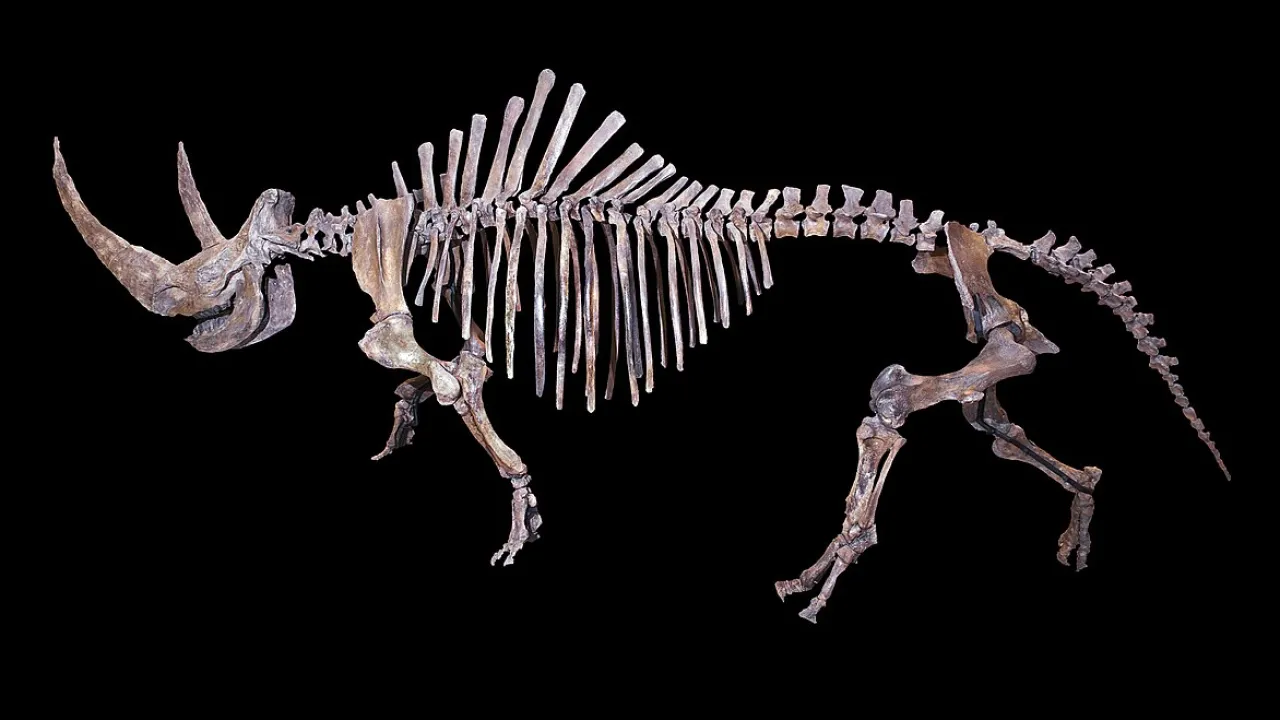
⚡ Survival SuperpowerFlattened three-foot keratin horn used to sweep snow off winter grass
🤯 Mind-Blowing Fact • Grade 1
Frozen Woolly Rhinoceros mummies in icy ground still have their real reddish-brown fur attached after thousands of years!
✨ Word Sparks (Grade 1 Glossary)
Tap 🔊 to hear
shaggy
covered in long, thick, messy hair
snout
an animal's nose and front jaw
herbivore
an animal that eats only plants
🪝
Did rhinos ever wear thick winter coats?
1
Built for Cold Snow
Brrr! Freezing wind blows across icy plains. Out walks a giant beast covered in thick brown fur! Meet the Woolly Rhinoceros, a cousin of today's rhinos.
2
A Snowplow Nose
Two horns grew right on its . The front horn was three feet long and flat! It swept cold snow aside like a big shovel.
3
Munching Hidden Grass
Under the snow grew dry winter grass. This gentle plant-eater munched grass all day long. Small fuzzy ears helped keep its body warm.
1. How did the Woolly Rhinoceros use its flat front horn?
2. Why did the Woolly Rhinoceros have small fuzzy ears?
🤯 Mind-Blowing Fact • Grade 2
People in medieval Europe once mistook giant Woolly Rhinoceros skulls for the heads of legendary dragons!
✨ Word Sparks (Grade 2 Glossary)
Tap 🔊 to hear
keratin
tough material that makes hair and fingernails
underwool
soft inner fur that traps warm air
tundra
cold, treeless plains with frozen ground
🪝
What is a Woolly Rhino's giant horn made out of?
1
Two Coat Layers
Step onto the windy Ice Age plains of Europe and Asia, where woolly mammoths stomp past! Walking beside them is a two-ton tank wrapped in double fur. Soft trapped body heat, while long outer hairs shed snow like a raincoat.
2
Horns Made of Keratin
Unlike deer antlers made of bone, a Woolly Rhinoceros horn was made of tightly packed —the very same material in your fingernails! Its front horn curved forward over three feet, with a smaller second horn behind it.
3
Painted by Cave Artists
Early Ice Age humans saw living Woolly Rhinos with their own eyes. More than thirty thousand years ago, artists painted detailed pictures of their humped shoulders and long horns on cave walls in France!
1. What material made up the Woolly Rhinoceros's horns?
2. How do we know early humans saw living Woolly Rhinos?
🤯 Mind-Blowing Fact • Grade 3
In Poland, an entire pickled Woolly Rhinoceros was discovered preserved inside underground salt and natural mineral oil!
✨ Word Sparks (Grade 3 Glossary)
Tap 🔊 to hear
steppe
wide, dry grassland with very few trees
permafrost
ground that stays frozen all year long
insulating
holding warmth inside and blocking out cold
🪝
Why wasn't a Woolly Rhinoceros horn round like a modern rhino's horn?
1
The Mammoth Steppe Grazer
Swish, scrape, swish! Across the Mammoth —a vast belt of cold, dry grassland stretching from Spain to Siberia—a Woolly Rhinoceros swings its massive head across crusty snow. Beneath that frosty blanket grow nutritious grasses, sedges, and wild herbs that fueled Ice Age giants.
2
A Blade-Shaped Shovel
Modern African rhinos have cone-shaped horns, yet Coelodonta antiquitatis grew a front horn flattened from side to side like a wooden plank! Scientists noticed smooth wear marks along the edges of preserved horns, proving the animal swept snow away left and right to uncover buried plants.
3
Cold-Weather Adaptations
Every inch of this herbivore was engineered for subzero winters. Thick skin, a deep layer of fat, short stocky legs, and a muscular shoulder hump loaded with stored energy helped it survive bitter blizzards when food grew scarce.
4
Preserved in Permafrost
Frozen soil in Siberia, called , and pickled oil seeps in Starunia, Poland, have preserved nearly complete Woolly Rhinoceros bodies. Scientists can even examine the last grass meals still tucked inside their fossilized teeth and stomachs!
1. What clue proved the Woolly Rhinoceros used its horn like a snowplow?
2. What was stored inside the large hump on the Woolly Rhino's shoulders?
🤯 Mind-Blowing Fact • Grade 4
The earliest ancestor of the Woolly Rhinoceros evolved high in the snowy Himalayas more than a million years before the Ice Age covered Europe!
✨ Word Sparks (Grade 4 Glossary)
Tap 🔊 to hear
plateau
a wide area of high, flat land
enamel
the super-hard outer coating on teeth
Beringia
ancient land bridge linking Asia and Alaska
🪝
Where on Earth did cold-loving rhinos first evolve BEFORE the Ice Ages froze Europe?
1
Out of the Tibetan Plateau
Before continental glaciers blanketed northern Europe, Earth already had a natural winter training ground: the towering Tibetan ! In 2011, paleontologists discovered a 3.7-million-year-old ancestor species, Coelodonta thibetana, high in the Himalayas. Living more than 14,000 feet above sea level taught early woolly rhinos how to scrape snow and endure freezing winds long before global Ice Ages allowed them to spread across Eurasia.
2
Built-In Lawn Mower Teeth
Clearing snow was only half the job—chewing gritty, frost-hardened steppe grass wears down ordinary teeth quickly. Coelodonta antiquitatis evolved wide, square lips like today's white rhinoceros and tall-crowned molars reinforced with thick ridges of . A bony wall dividing its nasal cavity—unusual among mammals—added structural support right beneath the base of its giant keratinous horn.
3
Why None Crossed Into North America
Woolly mammoths, steppe bison, and lions all crossed the land bridge from Siberia into Alaska, yet Woolly Rhinoceroses stopped right at Siberia's northeastern edge! Paleontologists suspect boggy summer tundra, deep wet snowdrifts, and scarce grazing plants in Beringia blocked this heavy, short-legged specialist.
4
Warming Skies and Deepening Snow
Ancient DNA extracted from Siberian fossils shows Woolly Rhinoceros populations stayed healthy until about 18,500 years ago, then declined rapidly around 14,000 years ago as warmer, wetter climates turned dry grassy steppes into deep snowfields and mossy shrubs.
1. Where did the earliest ancestor of the Woolly Rhinoceros first adapt to snowy weather?
2. How did a bony wall inside the Woolly Rhino's nose help it survive?
🤯 Mind-Blowing Fact • Grade 5
Ancient DNA proves the Woolly Rhinoceros's closest living relative is the rare, fuzzy-eared Sumatran rhinoceros of tropical Southeast Asia!
✨ Word Sparks (Grade 5 Glossary)
Tap 🔊 to hear
hypsodont
having tall-crowned teeth built for gritty grass
septum
a dividing wall inside the nose
paleogeneticists
scientists who study ancient DNA from fossils
🪝
Who is the closest living cousin of the Ice Age Woolly Rhinoceros—and where does it hide today?
1
A Tropical Cousin in Disguise
Picture a two-and-a-half-ton grazer coated in rust-brown fur trudging beside woolly mammoths across Ice Age Eurasia, breath steaming in minus-forty-degree air. Surprisingly, ancient mitochondrial DNA reveals that the closest living relative of Coelodonta antiquitatis is not an African savanna rhino, but the critically endangered Sumatran rhinoceros hiding in steamy Southeast Asian rainforests! Both belong to an ancient Eurasian lineage of two-horned, hairy rhinoceroses that diverged millions of years ago, with one branch adapting to tropical jungle shade and the other conquering glacial steppes.
2
Cranial Architecture and Hypsodont Dentition
The scientific name Coelodonta means 'hollow tooth,' coined by German paleontologist Heinrich Georg Bronn in 1831 in reference to the deep cavities visible inside its worn molars. Those high-crowned () cheek teeth withstood relentless abrasion from silica-rich steppe grasses mixed with windblown silt. Above its premaxilla rose an ossified nasal —a solid wall of bone fusing the snout to support an anterior keratin horn reaching up to 1.3 meters (4.3 feet) long, laterally compressed like a scimitar.
3
Chauvet Cave's Eyewitness Field Notes
Because keratin decays in ordinary soil, bone skeletons alone could never reveal the exact silhouette of the living animal. Fortunately, Paleolithic artists painting inside France's Chauvet Cave roughly 32,000 years ago illustrated Coelodonta with astonishing anatomical precision: high nuchal humps, dark waist bands across thick coats, and sweeping dual horns—details later confirmed by intact permafrost carcasses from Yakutia, Siberia.
4
Genomic Clues to Extinction
In 2020, sequenced nuclear genomes from fourteen Siberian specimens dating near the species' disappearance around 14,000 years ago. Unlike dwindling island populations, these late rhinos showed low inbreeding and stable genetic diversity until abrupt Bølling-Allerød warming.
5
When Wet Snow Replaced Dry Steppe
Why was warmth fatal? Cold Ice Age air was dry, leaving thin powdery snow that flat horns easily swept aside. Rapid climate warming brought heavy wet snowfalls and boggy shrub tundra; sinking on short legs with high foot-loading pressure, the snowplow giant lost its grassland home.