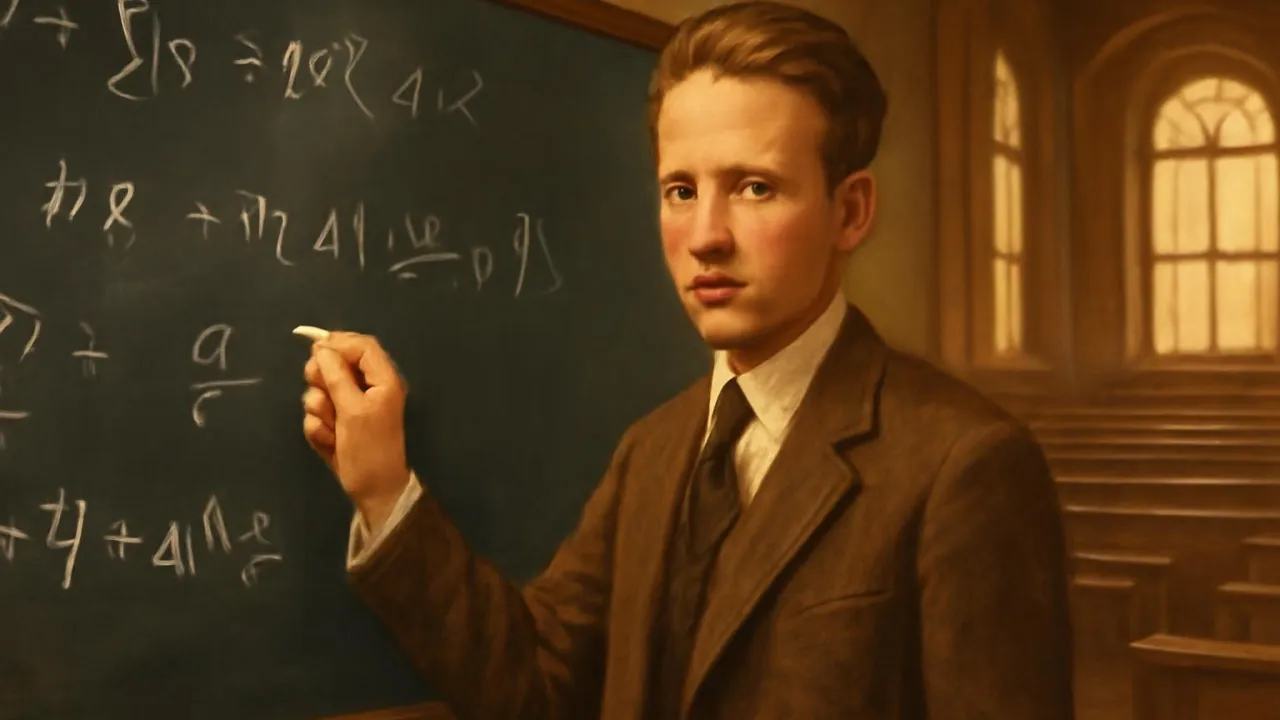
Werner Heisenberg helped create quantum mechanics, a new way to understand the universe!
✨ Word Sparks (Grade 2 Glossary)
Tap 🔊 to hear
curiosity
Wanting to learn and ask questions.
quantum
About the tiniest parts of nature.
principle
An important rule or idea in science.
🪝
Have you ever tried to catch a bouncy ball that moves too fast to see clearly?
1
Young Wonderer
Werner always wondered how things worked, even as a child. He liked to watch water swirl and stars twinkle. He asked his teachers many questions about the world. His made him love science even more.
2
Solving Hard Problems
Werner worked hard to solve tricky math puzzles. He spent hours writing numbers and symbols on chalkboards. Sometimes he stayed up late thinking about tiny atoms. His hard work helped him become a great scientist.
3
A New Science Rule
Werner discovered the Uncertainty in physics. It showed we cannot know both where and how fast something tiny moves. This rule changed how scientists study atoms and light. Werner's idea won him the Nobel Prize.
Werner played the piano to help him think about tough science problems!
✨ Word Sparks (Grade 3 Glossary)
Tap 🔊 to hear
perseverance
Never giving up, even when it's hard.
equation
A math sentence that shows a rule.
particle
A very tiny piece of matter.
🪝
Imagine trying to measure a super tiny particle, but every time you look, it changes!
1
A Boy with Big Questions
Werner Heisenberg grew up in Germany, always curious about how the world worked. He loved exploring nature, reading books, and solving math puzzles. Even as a boy, he wondered about things no one could see. His questions led him to study science in school.
2
The Puzzle of Atoms
Werner became fascinated by atoms, which are the building blocks of everything. He spent long hours thinking about how atoms move and behave. He used chalkboards to write and test his ideas. His hard work showed he had and creativity.
3
The Uncertainty Principle
Werner made a huge discovery called the Uncertainty Principle. It means you cannot know exactly where a tiny is and how fast it is moving at the same time. This idea is important in quantum mechanics, a field that studies the smallest parts of nature. Werner's discovery changed how scientists understand the universe.
4
Changing Science Forever
Werner's work helped create quantum mechanics, which explains how atoms and light behave. He won the Nobel Prize in Physics in 1932 for his discoveries. Scientists all over the world use his ideas to make new inventions. Werner showed that asking bold questions can lead to amazing answers.
Werner once solved a math problem so tough, even his teachers were amazed!
✨ Word Sparks (Grade 4 Glossary)
Tap 🔊 to hear
quantum mechanics
The science of how tiny things work.
legacy
What someone leaves for the future.
discovery
Finding something new or important.
🪝
What if the tiniest things in the universe refused to be fully measured, no matter how clever you were?
1
A Curious Mind in Changing Times
Growing up in early 1900s Germany, Werner Heisenberg was surrounded by exciting discoveries and world-changing events. He loved exploring the countryside and reading about math, often solving puzzles that challenged even adults. His curiosity led him to study physics, where he was fascinated by the invisible world of atoms. He dreamed of uncovering the secrets hidden in nature’s smallest building blocks.
2
The Quantum Challenge
As a young scientist, Werner worked with famous physicists to solve mysteries about atoms and light. He spent countless hours at the chalkboard, using equations to describe things too tiny to see. Werner’s perseverance helped him face difficult problems that many others gave up on. He believed that the universe’s tiniest pieces followed strange, surprising rules.
3
The Uncertainty Principle Emerges
In 1927, Werner made his most famous : the Uncertainty Principle. This principle states that you cannot know both the exact position and speed of a tiny particle at the same time. His idea became a key part of , a new science that changed how we understand the universe. The Uncertainty Principle showed that nature has limits, even for the best scientists.
4
A Lasting Legacy in Science
Werner Heisenberg’s discoveries earned him the Nobel Prize in Physics in 1932, making him one of the most important scientists of his time. His work inspired new technologies, from computers to medical imaging machines. Scientists around the world still use his ideas to explore the mysteries of atoms and energy. Werner’s bold thinking taught everyone that sometimes, asking the hardest questions leads to the greatest discoveries.
1. What did Werner believe about the universe’s tiniest pieces?
2. What did the Uncertainty Principle help create?
🤯 Mind-Blowing Fact • Grade 5
Werner Heisenberg’s equations helped invent the MRI scanner, which doctors use to see inside our bodies without surgery.
✨ Word Sparks (Grade 5 Glossary)
Tap 🔊 to hear
momentum
How fast and in what direction something moves.
subatomic
Smaller than an atom, like electrons or protons.
framework
A set of ideas that helps explain something complex.
🪝
Have you ever wondered if there are limits to what humans can know, even with the best tools and minds?
1
A Young Mind Amidst Revolution
Werner Heisenberg grew up in Germany during a time of scientific revolution and social change, where curiosity and innovation filled the air. As a boy, he loved hiking through the countryside, playing chess, and challenging himself with advanced math puzzles that most adults found impossible. His early fascination with numbers and patterns led him to study physics, where he became captivated by the mysteries of atoms and invisible forces. Even in his teenage years, Werner’s teachers noticed his remarkable ability to solve problems creatively and persistently.
2
Breaking the Barriers of Classical Physics
In the 1920s, scientists struggled to explain strange experiments involving atoms and light that didn’t fit the old rules of physics. Werner joined a group of brilliant thinkers, including Niels Bohr and Max Born, to tackle these puzzles. He spent countless nights at his chalkboard, inventing new mathematical equations to describe the unpredictable behavior of electrons. Werner’s work required not only deep knowledge but also courage to challenge long-held scientific beliefs, pushing the boundaries of what was thought possible.
3
The Birth of the Uncertainty Principle
Werner’s most famous breakthrough came in 1927, when he formulated the Uncertainty Principle, a cornerstone of quantum mechanics. This principle states that it is impossible to know both the exact position and exact (speed and direction) of a particle at the same time. The more precisely you measure one, the less precisely you can know the other. This wasn’t just a problem with measuring tools—it revealed a fundamental limit built into nature itself, changing how scientists think about reality at the smallest scales.
4
Impact on Science and the Modern World
Heisenberg’s Uncertainty Principle revolutionized physics and inspired generations of scientists to explore quantum mechanics, leading to inventions like transistors, lasers, and MRI machines. In 1932, he received the Nobel Prize in Physics for creating quantum mechanics, a mathematical that explains the strange behavior of atoms and energy. His ideas not only advanced science but also sparked philosophical debates about knowledge, observation, and the limits of human understanding. Werner continued to teach, research, and mentor young scientists throughout his life.
5
Legacy of Curiosity and Courage
Werner Heisenberg’s legacy endures in every modern technology that relies on quantum science, from computers to medical imaging. He showed that even the most mysterious puzzles can be explored with creativity, perseverance, and an open mind. By daring to ask questions no one else would, Werner changed the course of science forever and inspired others to look beyond the obvious. His story reminds us that uncertainty is not a weakness, but a doorway to discovery. Today, scientists still build on his work, seeking answers to the universe’s most challenging mysteries.