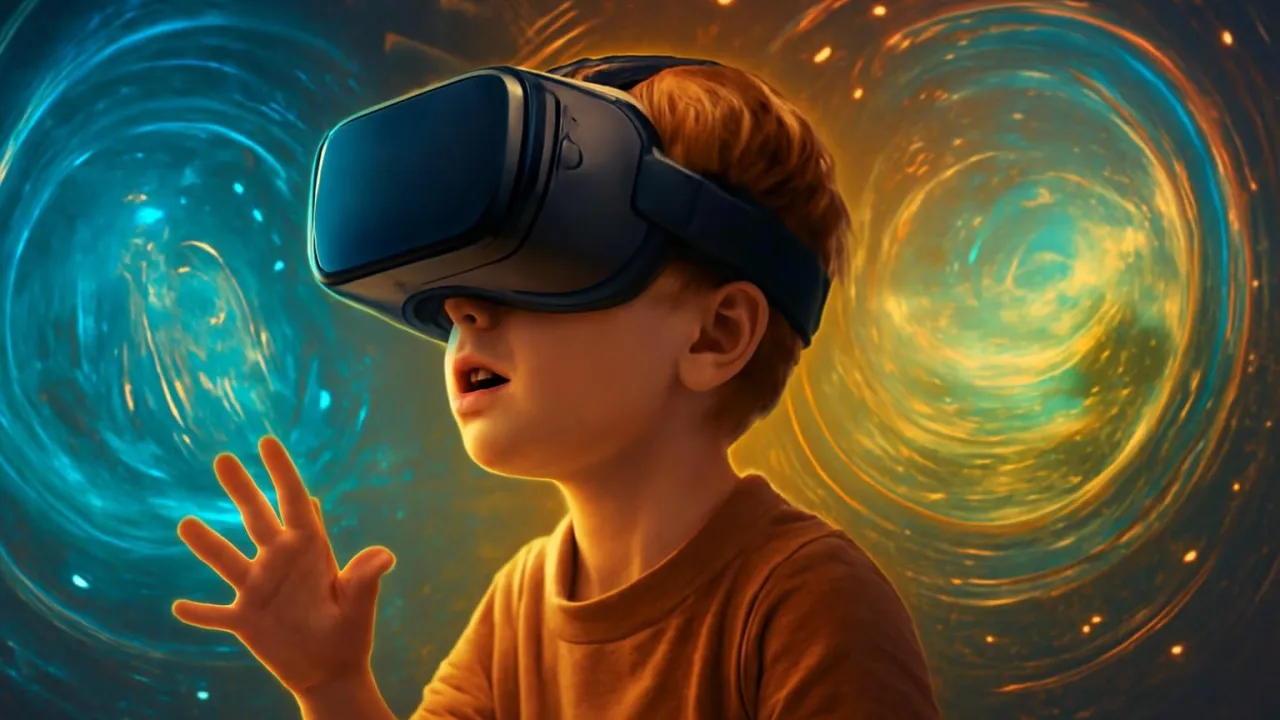
1. What do you wear on your face to see a new world?
2. What happens when you turn your head?
🤯 Mind-Blowing Fact • Grade 2
Doctors use virtual reality to help train for real surgeries!
✨ Word Sparks (Grade 2 Glossary)
Tap 🔊 to hear
controller
A tool to move or grab things
3D
Something with height, width, and depth
adventure
A fun or exciting journey
🪝
How does it feel to walk inside a dream world?
1
A Window to New Worlds
When you put on a virtual reality headset, you see places that are not really there. The headset has two small screens, one for each eye, so your brain thinks you are inside the scene. The pictures look close and far, just like real life.
2
Move and Play in 3D
Special sensors inside the headset know when you turn your head or look up and down. The pictures move with you, so you can look all around. Some games let you use hand to grab or touch things in the virtual world.
3
Fun for Everyone
People use virtual reality to play games, learn about space, or visit faraway places. Some kids draw in the air or ride roller coasters. The headset makes all these feel real and exciting.
The first VR headsets were invented in the 1960s and called the 'Sword of Damocles'!
✨ Word Sparks (Grade 3 Glossary)
Tap 🔊 to hear
immersion
Feeling like you are really there
gyroscope
A tool that senses turning movement
stereoscopic
A way to see 3D with both eyes
🪝
What secrets hide behind the glowing screens of a VR headset?
1
Step Into the Impossible
Imagine putting on a headset and suddenly standing atop a mountain or swimming with dolphins. Virtual reality headsets create these experiences by using two tiny screens, one for each eye, to make a 3D image. This trick is called vision, and it fools your brain into seeing depth. The world you see feels as if it wraps all around you.
2
Sensors Make It Real
Inside the headset, sensors track your head’s movement in every direction. When you turn or tilt your head, the images shift instantly, matching your motion. This creates a feeling called , where your senses believe you are truly inside the digital world. Some headsets even track your eyes or hands for more realistic play.
3
From Games to Learning
Virtual reality is not just for fun games. Scientists use VR to study the ocean or explore Mars. Doctors practice surgeries with virtual patients, and artists paint in 3D space. The headset is a tool for adventure, learning, and creativity.
4
How Does It Work?
A VR headset uses high-resolution screens and special lenses to create sharp, lifelike images. The sensors use and accelerometers to detect movement quickly. When you move, the computer updates the scene right away, preventing dizziness. All these parts work together to make the virtual world feel real.
Some VR headsets can track your hands and even your facial expressions in real time!
✨ Word Sparks (Grade 4 Glossary)
Tap 🔊 to hear
algorithm
A set of steps for computers to follow
accelerometer
A sensor that measures speed and direction
illusion
Something that tricks your senses
🪝
Could a headset really transport your mind to another universe?
1
A Portal to Digital Worlds
When you slip on a virtual reality headset, your eyes and ears are surrounded by screens and speakers that block out the real world. These headsets use stereoscopic displays and precise lenses to create a sense of depth, making flat images appear three-dimensional. As you move your head, motion sensors like gyroscopes and instantly update the view, so the digital world moves just as your real world would. This seamless movement tricks your brain, producing a powerful called immersion.
2
Engineering the Experience
To keep the convincing, VR headsets need high-resolution screens and fast computers that can update images in milliseconds. If the images lag behind your movements, your brain notices and you might feel dizzy or sick. Modern headsets use advanced and lightweight materials to make the experience smooth and comfortable. Some even include eye-tracking sensors, allowing the virtual world to respond to where you’re looking.
3
Beyond Play: Real-World Uses
While VR is famous for video games, its uses go far beyond entertainment. Scientists use VR to simulate natural disasters or study animal habitats. Architects design buildings and walk through them before construction even begins. Surgeons practice delicate operations on virtual patients, and teachers take students on field trips to ancient cities or outer space—all without leaving the classroom.
4
A Growing Global Impact
Since Palmer Luckey’s Oculus Rift sparked the modern VR era in 2012, headsets have become more affordable and widespread. Companies worldwide are developing new ways to use VR in medicine, education, and art. As technology improves, virtual reality may change how people learn, work, and connect across the globe.
Modern VR headsets can display over 16 million colors and refresh images up to 120 times per second!
✨ Word Sparks (Grade 5 Glossary)
Tap 🔊 to hear
latency
The tiny delay between action and response
foveated rendering
Only showing sharp detail where you look
haptic feedback
Vibrations or touches you can feel in VR
🪝
What if you could trick your senses into believing you’re on Mars or inside a painting?
1
The Science of Virtual Worlds
Virtual reality headsets create immersive experiences by combining advanced display technology, precise optics, and motion tracking. Each headset contains two high-resolution screens—one for each eye—paired with convex lenses that bend light to simulate depth, producing a stereoscopic 3D effect. Motion sensors, including gyroscopes and accelerometers, detect even the slightest head movement, while some systems use external cameras or infrared sensors to track your position in space. This integration of hardware and software enables the headset to update the digital scene in real time, maintaining the illusion of presence.
2
Engineering for the Human Brain
To prevent discomfort, VR headsets must minimize —the delay between your movement and the screen’s response. Most modern systems achieve latencies below 20 milliseconds, which is fast enough to keep your brain convinced that the virtual world is real. Field of view, refresh rate, and pixel density are all carefully engineered to match human vision. Some headsets also include eye-tracking, allowing for , where only the part you’re looking at is rendered in full detail to save computing power.
3
From Gaming to Global Solutions
While VR is popular for immersive gaming, its impact extends far beyond entertainment. Medical professionals use VR simulations for surgical training, exposure therapy, and even pain management. Scientists and engineers explore virtual prototypes of spacecraft, buildings, and vehicles before constructing real ones. In education, students can explore ancient civilizations or conduct virtual chemistry experiments, making abstract concepts tangible and memorable.
4
A Brief History and Future Vision
The concept of virtual reality dates back to the 1960s, when Ivan Sutherland created the first head-mounted display, nicknamed the 'Sword of Damocles.' However, it wasn’t until Palmer Luckey’s Oculus Rift in 2012 that consumer VR became practical and popular. Today, companies like Sony, Meta, and HTC continue to advance VR technology, making headsets lighter, more affordable, and more interactive. As wireless systems and become standard, the line between virtual and real continues to blur.
5
Transforming How We Experience the World
Virtual reality has the potential to revolutionize communication, creativity, and problem-solving on a global scale. Remote teams collaborate in shared virtual offices, doctors treat patients across continents, and artists sculpt in digital space. As VR technology evolves, it raises important questions about accessibility, ethics, and the boundaries of human experience. The headset is not just a gadget—it’s a gateway to new ways of seeing, learning, and connecting.