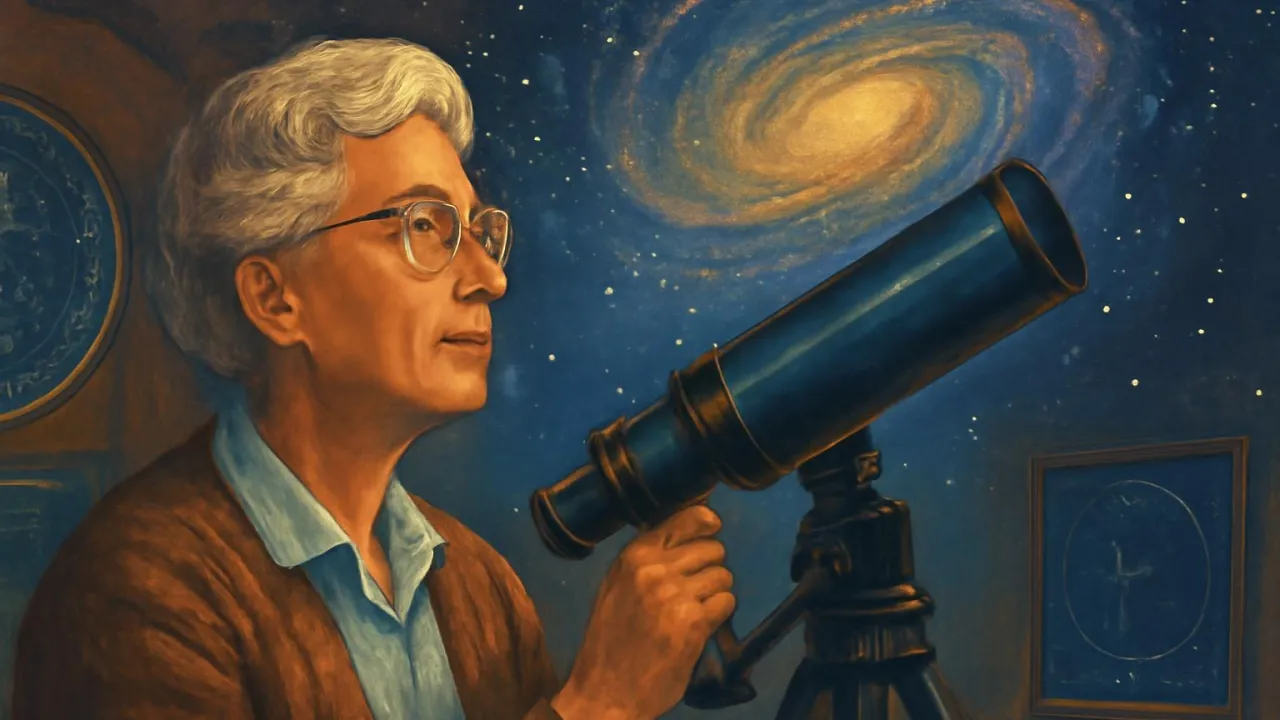
Vera Rubin’s discovery changed how scientists think about the whole universe!
✨ Word Sparks (Grade 2 Glossary)
Tap 🔊 to hear
astronomer
A scientist who studies stars
spin
To turn around in circles
universe
Everything in space and beyond
🪝
Have you ever wondered why stars twinkle and move in the sky?
1
Curious About the Night
Vera was a curious girl who loved looking at stars. She asked questions about how they moved and why. She wanted to learn all she could about space.
2
A Scientist’s Tools
Vera studied hard and learned to use big telescopes. She watched how galaxies spun and wrote down her ideas. She worked late into the night, never giving up.
3
A Big Discovery
Vera noticed galaxies spun faster than they should. She knew something invisible must be helping them. Her work showed dark matter fills most of the .
Vera Rubin’s dark matter research led to one of the biggest mysteries in science today!
✨ Word Sparks (Grade 3 Glossary)
Tap 🔊 to hear
gravity
The force that pulls things together
hypothesis
A smart guess that can be tested
perseverance
Never giving up, even when it’s hard
🪝
What if most of the universe is made of something you cannot see?
1
A Girl With Big Questions
As a child, Vera Rubin would gaze at the night sky, filled with questions. She wondered why stars moved the way they did and what secrets space might hold. Her curiosity led her to read books about astronomy and draw maps of stars. Vera’s dream was to discover something new in the universe.
2
Learning to Explore
Vera studied science in school, even when few girls did. She learned how to use powerful telescopes to observe galaxies far away. She took careful notes and made detailed charts of stars’ movements. Vera’s helped her become a respected astronomer.
3
The Mystery of Spinning Galaxies
When Vera watched galaxies, she noticed they spun much faster than scientists predicted. According to the laws of , they should have flown apart. Vera realized something invisible, called dark matter, must be holding them together. Her changed how people understood space.
4
Changing the Universe
Vera Rubin’s work proved that most matter in the universe is invisible. Her discovery of dark matter helped scientists ask new questions about space. She inspired many young people, especially girls, to study science. Vera showed that curiosity and hard work can reveal the universe’s secrets.
1. Why did Vera think something invisible was in space?
2. How did Vera inspire others?
🤯 Mind-Blowing Fact • Grade 4
Vera Rubin’s research showed that about 85% of the universe is made of dark matter!
✨ Word Sparks (Grade 4 Glossary)
Tap 🔊 to hear
astronomy
The study of stars and space
evidence
Proof that something is true
legacy
What someone leaves behind for others
🪝
Imagine discovering that most of the universe is made of something no one can see—would you believe it?
1
A Passion for the Night Sky
Vera Rubin’s fascination with stars began when she was a child, spending hours watching the night sky from her bedroom window. Despite the fact that few girls studied science at the time, Vera’s parents encouraged her curiosity and supported her love for . She built her own telescope out of cardboard and mirrors, determined to see as much as she could. This early passion set her on a path to become a trailblazing astronomer.
2
Breaking Barriers in Science
Vera faced many obstacles as she pursued her scientific dreams, since women were often discouraged from working in . She studied at Vassar College and Cornell University, where she learned to use powerful telescopes and analyze star data. Vera’s perseverance and determination helped her earn respect in a field dominated by men. Her careful observations and detailed research made her a leader in galaxy studies.
3
Unveiling the Dark Matter Mystery
While studying how galaxies spin, Vera found that the stars on the edges moved just as fast as those near the center. According to the laws of physics, this should not have been possible without more mass than could be seen. Vera proposed that an invisible substance, which she called dark matter, must be present to hold galaxies together. Her groundbreaking work provided the first strong that dark matter makes up most of the universe’s mass.
4
A Legacy That Shines On
Vera Rubin’s discoveries changed how scientists understand the universe and inspired a new generation of astronomers. Her work on dark matter opened up a whole new field of research, with scientists still searching for answers today. Vera also encouraged young people, especially girls, to follow their curiosity and explore science. Her proves that asking big questions can lead to amazing discoveries.
1. What did Vera’s discovery about galaxies prove?
2. How did Vera Rubin help future scientists?
🤯 Mind-Blowing Fact • Grade 5
Vera Rubin’s galaxy rotation studies proved that visible matter makes up less than 15% of the universe!
✨ Word Sparks (Grade 5 Glossary)
Tap 🔊 to hear
rotation curve
A graph showing how fast stars orbit in a galaxy
spectrograph
A tool that splits light to study stars
astrophysics
The science of how stars and space work
🪝
What would you do if your observations revealed a cosmic mystery no one else believed in?
1
A Childhood Spark Under the Stars
Long before she became a renowned astronomer, Vera Rubin spent countless nights gazing out her window, captivated by the swirling constellations above. Her fascination with the night sky began in childhood, when she built homemade telescopes and mapped the motion of stars from her bedroom. Despite living in an era when women faced significant barriers in science, Vera’s parents encouraged her curiosity and supported her scientific ambitions. She devoured books about astronomy, always searching for answers to the universe’s biggest mysteries. These early experiences fueled her determination to pursue a career in .
2
Breaking Through Barriers in Astronomy
Vera Rubin attended Vassar College, where she was often the only woman in her science classes, and later earned her master’s at Cornell University. Facing skepticism and exclusion from male colleagues, she persevered by focusing on her research and building strong collaborations. Rubin became an expert in using and telescopes, meticulously recording the movement of stars and galaxies. Her commitment to scientific rigor and her willingness to challenge accepted ideas set her apart in the field. By the time she joined the Carnegie Institution, she was recognized for her groundbreaking work in galaxy rotation.
3
The Dark Matter Discovery
While studying the of spiral galaxies in the 1970s, Vera Rubin made a revolutionary observation: stars at the outer edges of galaxies were moving just as quickly as those near the center. According to Newtonian physics, this should have been impossible unless there was far more mass than could be seen. Rubin’s careful measurements provided the first convincing evidence for the existence of dark matter—a mysterious, invisible substance making up about 85% of the universe’s mass. Her findings fundamentally changed how scientists understand the structure and fate of the cosmos.
4
Impact and Legacy in Modern Science
Vera Rubin’s research not only transformed astronomy but also inspired a new generation of scientists, especially women and girls. She published over 200 scientific papers and advocated for greater inclusion and recognition of women in science throughout her career. Rubin’s work on dark matter remains central to ongoing research, as physicists and astronomers continue to search for its true nature. She received numerous prestigious awards, though she was never awarded a Nobel Prize, a fact many consider a significant oversight. Today, the Vera C. Rubin Observatory is named in her honor, continuing her legacy of discovery.
5
Inspiration for Future Explorers
Vera Rubin’s story demonstrates the power of curiosity, perseverance, and the courage to challenge accepted ideas. Her willingness to ask difficult questions and pursue evidence, even when it contradicted established beliefs, opened new frontiers in science. Rubin’s legacy reminds us that groundbreaking discoveries often begin with a simple question and the determination to seek answers. She showed that anyone, regardless of gender or background, can change the way we see the universe. Vera’s life continues to inspire young scientists to look up, wonder, and explore the mysteries of the cosmos.