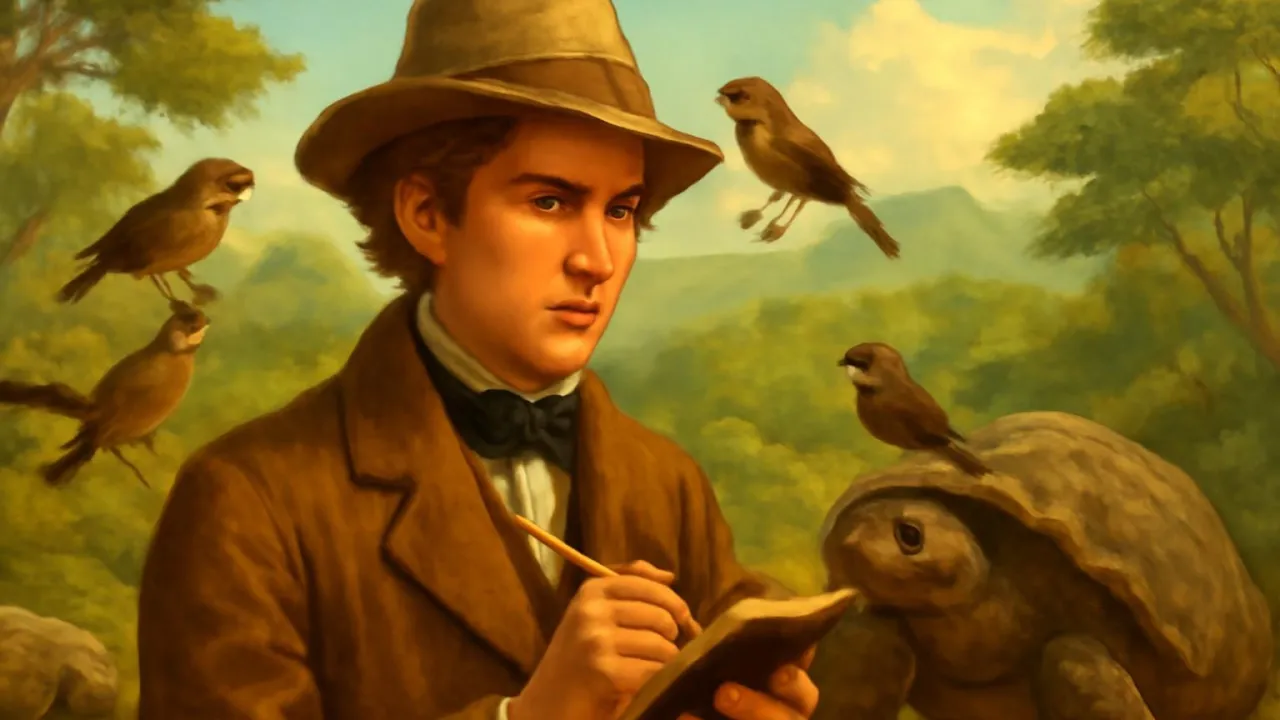
Charles Darwin’s book, ‘On the Origin of Species,’ became famous all over the world.
✨ Word Sparks (Grade 2 Glossary)
Tap 🔊 to hear
evolution
How living things change over time
journal
A special notebook for ideas
Galápagos
Islands with many unique animals
🪝
What would you discover if you explored a new island?
1
A Curious Boy
Charles loved to collect bugs and plants, and he always asked questions. He wondered why some birds had short beaks while others had long ones. He enjoyed reading about nature and drawing pictures in his notebook.
2
Sailing Adventure
When Charles grew up, he sailed on a ship called the Beagle. He visited the Islands, where he saw many strange animals. He wrote about his discoveries every day in his .
3
A Big Idea
Charles noticed that animals changed to fit their homes. He called this idea , and he wrote a famous book about it. His work changed how people think about living things.
Darwin’s finch sketches from the Galápagos are still used by scientists today.
✨ Word Sparks (Grade 3 Glossary)
Tap 🔊 to hear
natural selection
Nature’s way of choosing helpful traits
trait
A feature or quality you have
evidence
Clues that help prove something
🪝
Why do some animals look different from others, even if they live close by?
1
Young Charles’s Curiosity
As a child, Charles Darwin spent hours exploring fields and rivers near his home. He collected beetles, plants, and rocks, always asking questions about what he found. His curiosity led him to read books about science and nature. Charles dreamed of discovering something new about the world.
2
Voyage of the Beagle
Charles joined a long sea journey on a ship called the HMS Beagle. He traveled to the Galápagos Islands, where he saw giant tortoises and many kinds of finches. Charles carefully observed how animals on each island were different. He filled his journals with notes and drawings of everything he saw.
3
The Theory of Evolution
Charles noticed that animals had special that helped them survive. He realized that these traits could be passed from parents to their young. This idea became known as the theory of evolution by . Charles explained his discoveries in a famous book that changed science forever.
4
Changing the World
At first, not everyone agreed with Charles’s ideas, but he kept sharing his . Over time, scientists saw that his theory explained many mysteries about living things. Today, people all over the world study evolution to understand how life changes. Charles Darwin’s curiosity helped unlock the secrets of nature.
Darwin’s notebooks from his Beagle voyage are still preserved in museums today.
✨ Word Sparks (Grade 4 Glossary)
Tap 🔊 to hear
adapt
To change to fit your environment
diversity
Many different kinds together
offspring
Animals’ babies or young
🪝
Have you ever wondered how animals get their special features and adapt to their homes?
1
A Childhood of Wonder
Growing up in England during the early 1800s, Charles Darwin was fascinated by the natural world around him. He spent countless hours collecting insects, observing plants, and reading scientific books in his father’s library. His curiosity about why creatures looked and behaved differently sparked many questions. These early adventures planted the seeds for his future discoveries.
2
The Historic Voyage
In his twenties, Charles joined the HMS Beagle as a naturalist, setting sail on a five-year journey around the world. The Galápagos Islands amazed him with their giant tortoises and unique finches, each adapted to their own environment. Charles filled notebooks with careful observations and detailed drawings, comparing animals from different islands. This voyage became the turning point in his scientific career.
3
Unlocking Evolution’s Mystery
After returning home, Charles studied his notes and noticed patterns among the animals he observed. He realized that certain traits helped animals survive and have , while others did not. This led to his groundbreaking theory of evolution by natural selection, which explained how species change over many generations. In 1859, he published ‘On the Origin of Species,’ forever changing biology.
4
Legacy and Impact
Although some people disagreed with his ideas at first, Charles’s careful evidence convinced many scientists over time. His theory helped explain the incredible of life on Earth and inspired future research in genetics and ecology. Today, Darwin’s work is celebrated worldwide, and his questions continue to inspire young scientists. Charles Darwin’s legacy is a testament to the power of curiosity and careful observation.
1. Why were the Galápagos Islands important to Darwin?
2. What did Darwin’s theory help explain?
🤯 Mind-Blowing Fact • Grade 5
Darwin’s research influenced not only biology, but also genetics, medicine, and even computer science.
✨ Word Sparks (Grade 5 Glossary)
Tap 🔊 to hear
specimen
A sample collected for study
fossil
Remains of ancient plants or animals
inherit
To get traits from parents
🪝
Imagine discovering clues that reveal how every living thing on Earth is connected—what would you find?
1
A Young Naturalist’s Curiosity
Long before Charles Darwin became a world-famous scientist, he was a curious boy wandering the English countryside. He collected beetles, observed birds, and filled notebooks with sketches and questions about the living world. His father hoped Charles would become a doctor, but Charles’s passion for nature was unstoppable. By reading scientific books and exploring outdoors, he developed a keen eye for detail and a deep love for discovery.
2
The Voyage That Changed Science
In 1831, Charles joined the HMS Beagle as a naturalist, embarking on a five-year journey around the globe. The ship’s most famous stop was the Galápagos Islands, where Charles observed giant tortoises, marine iguanas, and especially finches with different beak shapes on each island. He meticulously recorded his observations, collected , and sketched animals and plants, realizing that even small differences could be important clues about how species adapt to their environments.
3
Forming the Theory of Evolution
After returning to England, Darwin spent over twenty years analyzing his data, comparing , and reading about animal breeding. He noticed that animals with helpful traits were more likely to survive and have offspring, passing those traits to the next generation. This process, which he called natural selection, explained how species change over time. In 1859, Darwin published ‘On the Origin of Species,’ presenting evidence for evolution and challenging old beliefs about life’s history.
4
Controversy, Evidence, and Legacy
Darwin’s theory was controversial, as it questioned traditional views and sparked debates among scientists and religious leaders. However, his careful research and the detailed evidence he provided convinced many experts. Over time, discoveries in genetics and DNA confirmed his ideas, showing how traits are inherited and how all living things are related. Today, evolution is a cornerstone of biology, and Darwin’s work continues to inspire research in ecology, medicine, and conservation.
5
Inspiration for Future Scientists
Charles Darwin’s journey from a curious child to a groundbreaking scientist reminds us that big discoveries often begin with simple questions. His patience, careful observation, and willingness to challenge old ideas changed how we understand life on Earth. By following his example—exploring, questioning, and learning from nature—anyone can help unlock new mysteries. Darwin’s legacy proves that curiosity and determination can change the world.