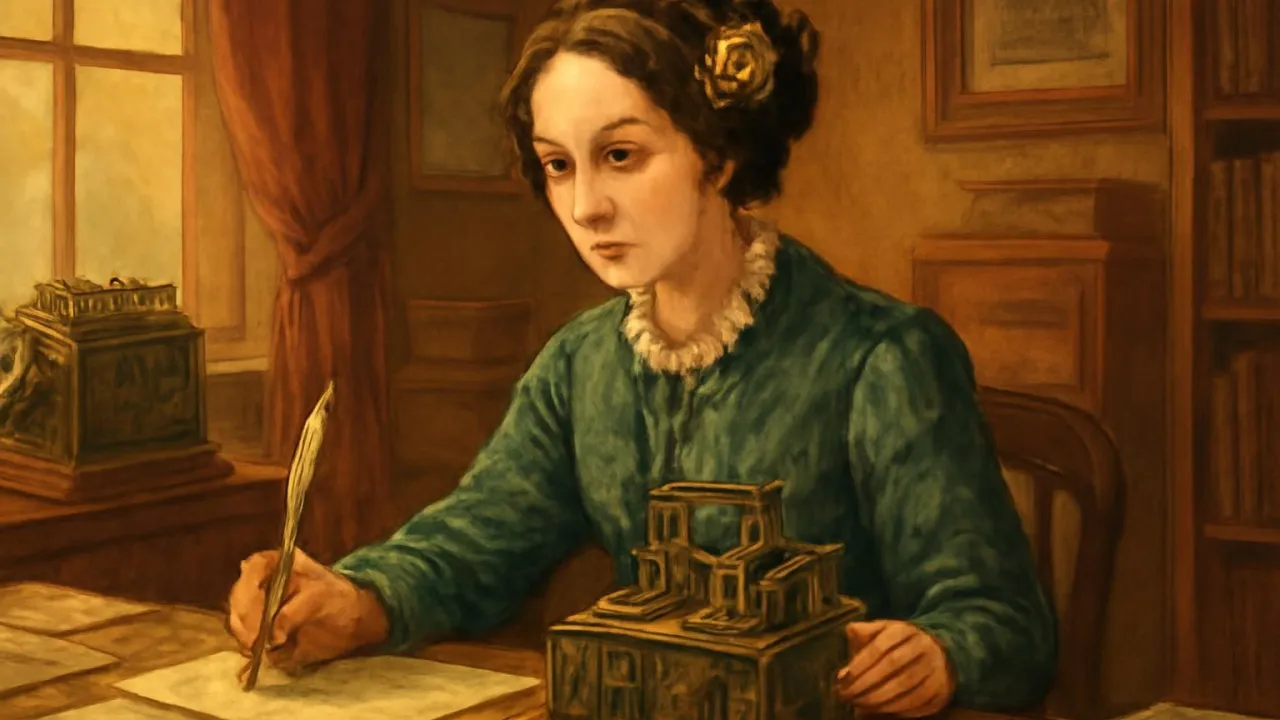
Ada Lovelace’s notes became the first computer program in history.
✨ Word Sparks (Grade 2 Glossary)
Tap 🔊 to hear
curious
Wanting to learn new things
machine
A tool that helps do work
program
Instructions for a machine
🪝
How can a person tell a machine to solve a puzzle?
1
Ada’s Early Curiosity
Ada loved numbers and puzzles when she was a child. She practiced math every day after school. She was about how might solve problems.
2
Hard Work and Learning
Ada studied with teachers who showed her new math ideas. She worked hard to understand that could calculate numbers. She used a machine called the Analytical Engine to learn.
3
A Big Achievement
Ada wrote special notes that explained how to use the . Her notes showed the first computer ever. This helped people think about future computers.
Ada Lovelace’s notes are considered the first computer program ever written.
✨ Word Sparks (Grade 3 Glossary)
Tap 🔊 to hear
algorithm
Step-by-step instructions for a machine
perseverance
Never giving up on hard work
computation
Doing math with machines
🪝
How did Ada Lovelace use her perseverance to change computing forever?
1
A Mind Full of Curiosity
Ada Lovelace showed great curiosity about mathematics and machines from a young age. She believed machines could do more than just calculate numbers. Her helped her study complex ideas about .
2
Learning About the Analytical Engine
Ada worked closely with Charles Babbage, who designed the Analytical Engine. She wrote detailed notes explaining how the machine could follow instructions, or , to solve problems. This was a new idea in the world of mathematics.
3
Writing the First Computer Program
Ada’s notes included what is now called the first computer program. She described how the machine could repeat steps and make decisions. This showed her deep understanding of programming and through challenges.
4
Changing the Future of Computing
Ada’s work inspired future scientists and engineers to build real computers. Her vision of machines doing more than calculation changed how people thought about technology and problem-solving.
1. What did Ada write that helped machines solve problems?
2. How did Ada’s work change the future?
🤯 Mind-Blowing Fact • Grade 4
Ada Lovelace predicted that machines could create art and music, not just math!
✨ Word Sparks (Grade 4 Glossary)
Tap 🔊 to hear
algorithm
A list of steps for a machine to follow
conditional
Making choices based on information
looping
Repeating steps again and again
🪝
What made Ada Lovelace’s ideas about machines so revolutionary in her time?
1
A Time of New Ideas
During the Victorian Era, machines were mostly for simple tasks, but Ada imagined they could do much more. She studied mathematics deeply and worked with Charles Babbage on his Analytical Engine, a machine designed to perform complex calculations. This was a time when few people thought machines could do anything beyond basic math.
2
A Turning Point in Computing
Ada’s detailed notes on the Analytical Engine explained how it could use to perform any calculation. She foresaw that machines could follow instructions to create music or art, not just numbers, which was a groundbreaking idea at the time. Her vision helped people imagine new possibilities for technology.
3
Innovations and Techniques
Ada introduced the concept of , where a machine repeats steps automatically, and logic, where the machine makes choices based on data. These techniques are still used in modern programming languages today. Her work was a major innovation that shaped how computers operate now.
4
Global Impact and Legacy
Though Ada lived a short life, her visionary work laid the foundation for computer science. Today, she is celebrated worldwide as the first computer programmer and an inspiration to women in STEM fields. Her legacy continues to encourage new generations of inventors and thinkers.
The computer programming language Ada is named in honor of Ada Lovelace’s pioneering work.
✨ Word Sparks (Grade 5 Glossary)
Tap 🔊 to hear
algorithm
A detailed set of instructions for computers
conditional branching
When a computer chooses what to do next
looping
Repeating actions automatically in a program
🪝
How did Ada Lovelace’s pioneering work shape the future of computer science and technology?
1
Early Life and Intellectual Roots
Ada Lovelace, daughter of poet Lord Byron, was raised with a strong emphasis on logic and mathematics, encouraged by her mother to focus on science rather than poetry. Her early education included advanced studies in mathematics and science, which were rare for women in the 19th century. She showed remarkable talent and curiosity from a very young age.
2
The Analytical Engine and Programming Concepts
Working with Charles Babbage, Ada studied the Analytical Engine, a mechanical general-purpose computer. She wrote extensive notes describing how the machine could be programmed using , including the first published algorithm intended for machine processing, which is recognized as the first computer program. Her detailed explanations revealed deep insights into the machine’s potential.
3
Quantitative Achievements and Innovations
Ada introduced key programming concepts such as and , allowing machines to perform repeated operations and make decisions based on data. Her notes detailed how the Analytical Engine could calculate Bernoulli numbers, showcasing a complex mathematical application well ahead of its time. These innovations laid the groundwork for modern computing.
4
Historical Legacy and Recognition
Though Ada died young at 36, her visionary ideas influenced the development of computer science decades later. She is honored today with the programming language Ada named after her and celebrated as a pioneer who bridged mathematics and computing. Her contributions were largely unrecognized during her lifetime but have since gained worldwide acclaim.
5
Inspiration for Future Generations
Ada Lovelace’s story inspires countless women and men in STEM fields to pursue innovation and perseverance. Her legacy teaches that imagination combined with scientific rigor can change the world and that early ideas can spark revolutions in technology. She remains a symbol of creativity and determination in science and technology.