🧬 HUMAN BODY
🧬 Nervus Vagus (Cranial Nerve X) • Parasympathetic Nervous System
VA Science & Health SOL 1.1, 3.1, 4.2, 5.1 (Cells, Organs & Body Systems)
Vagus Nerve
Your Body's Wandering Superhighway of Calm
Grade 2 • Developing • 103 words
🩺 Body System & LocationPeripheral & Autonomic Nervous Systems • Brainstem down through neck, heart, lungs, and gut
🔬 Size / Cell CountLongest of all 12 cranial nerves • Left and right pair containing ~100,000 fibers each
⚙️ Core JobSlows racing heartbeats, deepens calm breathing, guides digestion, and carries gut signals up
⚡ Body Superpower80% of its fibers carry news UP from your organs so your 'gut feelings' reach your brain
🤯 Mind-Blowing Fact • Grade 1
Humming your favorite song gently vibrates your throat and switches on your calming vagus nerve!
✨ Word Sparks (Grade 1 Glossary)
Tap 🔊 to hear
wander
To travel far along a winding path
calm
Peaceful, relaxed, and steady inside
digest
To break food down into body energy
🪝
Why does taking one big, slow breath help you feel calm right away?
1
Breathe In, Breathe Out!
Take a slow, deep belly breath and blow it out gently! Did your chest start to feel ? You just woke up your friendly vagus nerve!
2
The Great Wanderer
Its name means wandering! Starting at your brain, it travels past your throat, hugs your heart and lungs, and visits your tummy.
3
Rest and Cozy Digest
After a big game of tag, it tells your fast heart to slow back down. Then it helps your tummy lunch!
1. What does your vagus nerve tell a racing heart to do after a game of tag?
2. Easy everyday actions like slow belly breathing or humming do what?
🤯 Mind-Blowing Fact • Grade 2
Four out of every five fibers inside your vagus nerve actually carry messages UP from your belly and heart to your brain—not the other way around!
✨ Word Sparks (Grade 2 Glossary)
Tap 🔊 to hear
adventurous
Ready to travel far to new places
brainstem
Lower brain stalk connecting to spinal cord
vibrate
To buzz back and forth very quickly
🪝
Have you ever felt 'butterflies in your tummy' before a big school show?
1
Why It Is Called the Wanderer
Most head nerves stay right around your eyes, nose, or jaw, yet one pair goes on a grand road trip! Named from the Latin word for 'wandering,' the vagus nerve travels from your down your neck to your chest and belly.
2
Butterflies on a Two-Way Phone
Ever wonder why exciting news gives your stomach fluttery butterflies? Your brain and tummy chat nonstop over the vagus nerve like best friends sharing a telephone line!
3
Your Built-In Calm Button
Whenever you finish running or feel nervous before a test, slow breathing activates this nerve. Right away, it slows your heart rate and switches your body into cozy 'rest and digest' mode.
2. Which direction do most of the fibers inside the vagus nerve send messages?
🤯 Mind-Blowing Fact • Grade 3
In hospital labs, doctors use Roman numeral X to label the vagus nerve because it is the tenth of your twelve cranial nerve pairs!
✨ Word Sparks (Grade 3 Glossary)
Tap 🔊 to hear
cranial
Emerging directly from the brain inside skull
parasympathetic
Calming nerve team guiding rest and digestion
larynx
The throat's voice box holding vocal cords
🪝
Why does one head nerve skip the spinal cord completely to visit your voice box, heart, lungs, and stomach?
1
Cranial Nerve Number Ten
Count the twelve pairs of nerves emerging straight from the underside of your brain, and number ten steals the spotlight! Known as the vagus nerve, it slips through a tiny opening at the base of your skull without ever entering your backbone, wandering all the way down to your digestive organs.
2
Captain of 'Rest and Digest'
Your automatic body controls have two balanced modes: a revved-up 'fight or flight' pedal for action, and a soothing 'rest and digest' brake called the system. The vagus nerve is captain of that calming team—releasing chemical signals that gently slow your heartbeat, relax airways, and stir stomach juices after dinner.
3
Helping You Speak and Swallow
On its way down your neck, small vagus branches power muscles inside your throat and (voice box), letting you sing high notes, swallow smoothies safely, and cough out dust.
4
The Gut-Brain Hotline
Down in your intestines, vagus sensors taste nutrients and listen to friendly gut microbes, sending 'I'm full and happy!' updates straight upstairs to your brain!
1. Which half of your automatic nervous system is led by the vagus nerve?
2. Besides your heart and stomach, which helpful job in your neck depends on vagus nerve branches?
🤯 Mind-Blowing Fact • Grade 4
Left and right vagus nerves split up duties in your chest: the right vagus mostly sets the tempo of your heart's main pacemaker node, while the left vagus helps pace the relay gate between heart chambers!
✨ Word Sparks (Grade 4 Glossary)
Tap 🔊 to hear
interoception
Your brain's inner sense of organ conditions
peristalsis
Wave-like muscle squeezes moving food along
pacemaker
Cell cluster setting your heart's steady beat
🪝
Why does your heart naturally speed up slightly when you inhale and slow down when you exhale?
1
Feel Your Breath Tune Your Heartbeat
Place two fingers gently on your wrist pulse, inhale slowly for four seconds, and then exhale slowly for six seconds. If you pay close attention, you can detect a cool physiological rhythm: your pulse ticks slightly faster as lungs expand and glides slightly slower as air flows out! That healthy beat-to-beat flexibility—heart rate variability—is sculpted directly by your tenth cranial nerve, the vagus nerve, releasing tiny puffs of calming acetylcholine onto your heart's natural during every long exhale.
2
Interoception: Your Hidden Sixth Sense
Everyone knows the five outward senses, yet neuroscientists study a vital inward sense called —knowing whether your lungs are stretched, your blood pressure is steady, or your stomach is full. Roughly eighty percent of the vagus nerve's two hundred thousand left-and-right fibers are sensory afferents streaming real-time organ telemetry upward to the brainstem's solitary nucleus.
3
Directing the Digestive Symphony
Motor fibers making up the remaining twenty percent stimulate rhythmic muscle waves called along your esophagus, stomach, and small intestine, while cueing digestive enzymes from your pancreas and bile release from your gallbladder.
4
Why Long Exhales Work Like Magic
Because stretch sensors in your lungs and chest report directly through vagal pathways, slow diaphragmatic breathing acts like a physical remote control—dialing down stress hormones whenever you need steady focus.
1. What happens at your heart's pacemaker when you let out a long, slow exhale?
2. What do scientists call your brain's ability to sense internal signals like fullness, heartbeat, and lung stretch?
🤯 Mind-Blowing Fact • Grade 5
In a long-necked giraffe, that looping vagus branch—the recurrent laryngeal nerve—travels nearly fifteen feet down into the chest and back up just to connect two spots only inches apart!
✨ Word Sparks (Grade 5 Glossary)
Tap 🔊 to hear
viscera
Internal organs inside chest and abdominal cavities
microbiome
Community of helpful microbes living inside gut
inflammation
Protective immune swelling that needs careful balance
🪝
How can one cranial nerve quiet runaway inflammation, talk with trillions of gut microbes, and steady your heartbeat all at once?
1
Anatomy of Cranial Nerve X
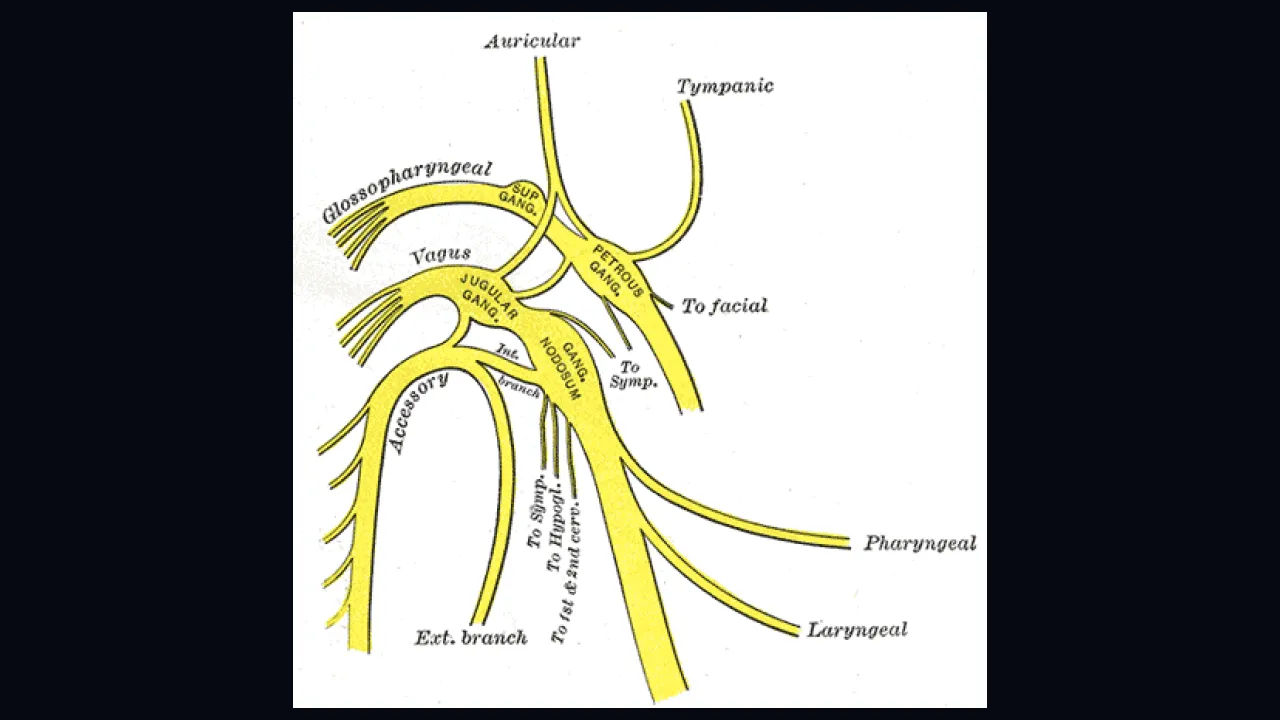
Emerging as delicate rootlets from the medulla oblongata and exiting the skull alongside the internal jugular vein through the jugular foramen, the paired vagus nerves embark on the most expansive journey of any cranial pathway. Carrying roughly seventy-five percent of all parasympathetic nerve fibers in the human body, they thread through the carotid sheath of the neck, weave plexuses around the heart and bronchial tree, pierce the diaphragm alongside the esophagus, and innervate abdominal all the way to the transverse colon.
2
An Evolutionary Detour in the Neck
One curious vagal branch—the recurrent laryngeal nerve—takes a famous anatomical detour! Instead of traveling straight from brainstem to voice box, the left branch loops all the way down into the chest beneath the aortic arch before climbing back up the neck to move the vocal cords—a developmental souvenir from ancient fish-like vertebrate ancestors whose embryonic heart vessels sat just behind gill arches.
3
The Microbiome-Gut-Brain Axis
Approximately eighty percent of vagal axons are unmyelinated and lightly myelinated sensory fibers whose cell bodies sit in the nodose and jugular ganglia. Lining the intestinal wall, specialized neuropod cells form direct synapse-like links with vagal endings, transmitting nutrient chemistry and signals from beneficial gut bacteria to the brainstem's nucleus tractus solitarius in milliseconds!
4
Discovery of the Inflammatory Reflex
Around the year 2000, neurosurgeon and immunologist Kevin Tracey uncovered a startling partnership between nerves and immunity: the cholinergic anti-inflammatory pathway. When vagal sensory fibers detect localized infection or tissue stress, outgoing vagal signals travel to the spleen area, prompting immune macrophages to dial down excessive cytokine so healthy tissues stay unharmed.
5
Bioelectronic Medicine Today
Harnessing this discovery, biomedical engineers have designed tiny pacemaker-like vagus nerve stimulators—and even gentle ear-clip devices targeting a tiny vagal skin branch on the outer ear—to help treat epilepsy and inflammatory conditions.