🧬 HUMAN BODY
🧬 Stratum Myelinicum • Glial Axon Insulation
VA Science & Health SOL 1.1, 3.1, 4.2, 5.1 (Cells, Organs & Body Systems)
Myelin Sheath
Speedy Turbo Coats Around Your Nerves
Grade 2 • Developing • 94 words
🩺 Body System & LocationCentral & Peripheral Nervous Systems • Wrapped like jelly rolls around long nerve axons
🔬 Size / Cell CountMicroscopic layers 10–100+ wraps thick • Boosts signal speed up to 268 mph (430 km/h)
⚙️ Core JobInsulates nerve fibers so electrical messages leap forward without leaking away
⚡ Body SuperpowerMakes nerve sparks hop from gap to gap up to 100 times faster than bare fibers
🤯 Mind-Blowing Fact • Grade 1
Wearing a myelin sheath helps a nerve spark zoom up to one hundred times faster than a bare nerve!
✨ Word Sparks (Grade 1 Glossary)
Tap 🔊 to hear
sheath
A snug wrap covering something long
spark
A tiny quick flash of energy
wobble
To tip side to side unsteadily
🪝
Why do lamp cords and your body's nerves both wear cozy coats?
1
Cozy Nerve Coats
Look at a safe plastic coat on a lamp cord! Inside your body, long nerve tails wear a smooth white coat too. Scientists call it a myelin " onclick="pulseWordSpark(1, 0)" title="Tap to highlight Word Spark">sheath.
2
Hop, Skip, Zoom!
Without that coat, tiny move much slower. With that coat on, your nerve sparks hop and zoom super fast!
3
Growing Smarter Moves
Babies when they first stand up. As their nerve coats grow thicker, kids can run, skip, and catch balls!
1. What does a myelin sheath look and act like around a nerve fiber?
2. Why can older kids run and catch balls more smoothly than tiny babies?
🤯 Mind-Blowing Fact • Grade 2
All that pearly white myelin wrapping millions of brain fibers is the exact reason scientists call deep brain highways 'white matter'!
✨ Word Sparks (Grade 2 Glossary)
Tap 🔊 to hear
layer
One thin sheet wrapped over another
insulate
To wrap something so energy stays inside
coordinate
To move body parts smoothly together
🪝
How can wrapping a nerve like a tiny jelly roll turn a slow walk into a race-car zoom?
1
Wrapped Like a Jelly Roll
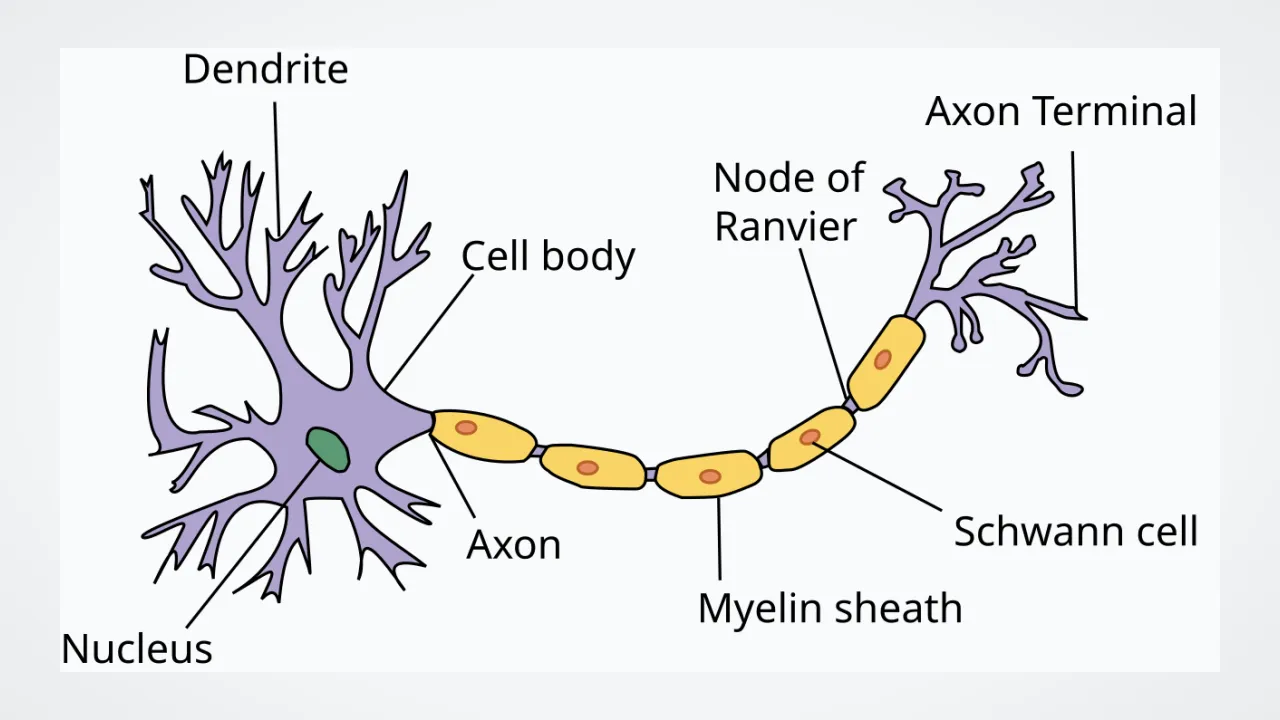
Picture rolling a soft blanket round and round a broomstick! Inside your brain and body, special helper cells wrap smooth, fatty around long nerve fibers to build a shiny white myelin sheath.
2
Kangaroo Hops Along the Wire
Tiny bare spaces sit between each little bead of myelin, looking like links of sausage on a string. Instead of trudging down every inch of the nerve, electrical sparks leap from gap to gap like speedy kangaroos!
3
Practice Builds More Myelin
Every time you practice tying shoelaces, dribbling a basketball, or playing violin, helper cells add fresh of myelin to make that skill smoother!
1. How does a nerve spark travel along an axon wrapped in myelin?
2. What gives your brain's 'white matter' its bright pearly white color?
🤯 Mind-Blowing Fact • Grade 3
One single octopus-shaped oligodendrocyte cell in your brain can stretch out arms to wrap myelin coats around up to fifty different nerve fibers at once!
✨ Word Sparks (Grade 3 Glossary)
Tap 🔊 to hear
oligodendrocyte
A brain helper cell building myelin coats
node
A tiny bare recharge spot between wraps
lipid
A natural healthy fat used by cells
🪝
Why would you need spinal nerves as thick as garden hoses if your body didn't have myelin?
1
Saving Space and Boosting Speed
Catch a fast baseball before it hits the grass! That split-second grab only worked because nerve messages raced down your arm at over two hundred miles per hour. Without a fatty insulating coat called the myelin sheath, bare human nerves would conduct signals at a sluggish stroll—unless each nerve grew as thick as a garden hose!
2
Two Teams of Glial Builders
Neurons do not actually weave their own myelin coats. Instead, partner glial cells handle the tailoring! Inside your brain and spinal cord, octopus-shaped wrap dozens of axons at once, while out in your arms and legs, dedicated Schwann cells wrap individual segments.
3
Nodes of Ranvier
Between each wrapped bead sits a microscopic bare gap called a of Ranvier. Packed with ion gates, these tiny nodes recharge the electrical signal as it leaps down the axon without losing strength.
4
Still Growing Into Adulthood
Your body keeps adding fresh myelin all through childhood and even into your twenties, steadily sharpening your athletic timing and decision-making!
1. Which cells wrap myelin around nerves out in your arms and legs?
2. What happens at each tiny bare gap called a node of Ranvier?
🤯 Mind-Blowing Fact • Grade 4
If your optic nerve lacked myelin sheaths and had to rely on giant squid-style bare axons to keep the same speed, each optic nerve behind your eye would have to be nearly three feet thick!
✨ Word Sparks (Grade 4 Glossary)
Tap 🔊 to hear
saltatory
Moving forward by rapid leaps between gaps
unmyelinated
Lacking an outer insulating myelin coat
internode
One wrapped myelin segment between bare nodes
🪝
How does 'jumping conduction' cut your brain's energy bill while multiplying nerve speed fifty-fold?
1
Saltatory Conduction: The Art of Leaping
In Spanish and Latin, the verb 'saltare' means 'to leap or dance'—and that is the exact root of conduction, the physics trick behind your fastest thoughts and movements! Along an fiber, ion gates must open and close across every nanometer of membrane, creeping along at barely one meter per second. Wrap that axon in a lipid-rich myelin sheath, however, and current shoots effortlessly underneath each insulated segment to pop out at the next node of Ranvier at over one hundred meters per second!
2
Slashing the Brain's Energy Budget
Speed is only half the victory; energy savings are just as vital. Resetting sodium and potassium ions after an action potential costs cellular fuel called ATP. Because myelinated axons only open ion channels at the tiny nodes of Ranvier—less than one percent of the axon's surface—neurons use dramatically less energy for every message sent.
3
Oligodendrocytes Versus Schwann Cells
Composed of roughly eighty percent lipids and twenty percent specialized proteins, myelin differs subtly by region. Central nervous system oligodendrocytes insulate multiple axons simultaneously, whereas peripheral Schwann cells dedicate their entire spiral body to one single segment—and can even guide damaged limb nerves to regrow!
4
Adaptive Myelination When You Practice
Modern brain scans show that mastering piano scales or juggling literally thickens myelin along active circuits, fine-tuning arrival times so distant brain regions stay in harmony.
1. Why does saltatory conduction save huge amounts of cellular ATP energy?
2. What does modern brain imaging reveal when people spend weeks practicing a new skill like juggling?
🤯 Mind-Blowing Fact • Grade 5
Each node of Ranvier packs more than one thousand voltage-gated sodium channels into every single square micrometer of membrane—roughly fifty times denser than bare nerve regions!
✨ Word Sparks (Grade 5 Glossary)
Tap 🔊 to hear
capacitance
How much electrical charge a membrane stores
prefrontal
Front brain region handling planning and choices
precursor
A starter cell ready to mature later
🪝
How did jawed vertebrates evolve a microscopic spiral wrap that unlocked compact, giant-brained intelligence?
1
An Evolutionary Leap in Vertebrate Speed
More than four hundred million years ago in ancient Devonian seas, early jawed fishes debuted a cellular breakthrough that forever changed animal life: compact myelin. Invertebrates like giant squids could only accelerate nerve impulses by inflating axon diameter to nearly a millimeter. By wrapping thin axons in up to a hundred concentric layers of lipid bilayer membrane, vertebrates achieved velocities exceeding 110 meters per second inside axons mere micrometers wide—allowing billions of fast circuits to pack inside a single human skull.
2
Molecular Zippers and Capacitance Physics
In 1854, German pathologist Rudolf Virchow coined 'myelin' from the Greek word 'myelos' (marrow), and twenty-four years later French histologist Louis-Antoine Ranvier spotted the periodic bare constrictions now bearing his name. Biophysical measurements reveal why this partnership works: thick lipid wraps slash membrane and raise electrical resistance across each internode, preventing charge leakage while dense clusters of voltage-gated Nav1.6 sodium channels—over a thousand per square micrometer at each node of Ranvier—regenerate crisp action potentials.
3
Structural Proteins and Metabolic Support
Compacting dozens of slippery membrane turns without trapping fluid requires molecular 'zippers' such as myelin basic protein (MBP) and proteolipid protein. Remarkably, oligodendrocytes also act as fuel tankers, shuttling lactate through microscopic cytoplasmic channels directly into long axons to power their mitochondria.
4
Back-to-Front Brain Maturation
Human myelination unfolds on a decades-long timetable mapped from back to front: sensory and motor pathways myelinate first in infancy, language hubs follow in childhood, and the cortex—seat of long-term planning and self-control—continues myelinating into a person's mid-twenties.
5
Protecting and Repairing Insulation
When immune errors or injuries fray myelin, signals slow or scatter like frayed speaker wire; today, neurobiologists are studying oligodendrocyte cells that stand ready throughout life to spin fresh replacement sheaths.