1. Do most brain cells touch directly when they share a message?
2. How does a message cross the tiny space of a synapse?
🤯 Mind-Blowing Fact • Grade 2
A synapse gap is more than two thousand times thinner than a single strand of your hair, so chemical messengers cross it in less than a millisecond!
✨ Word Sparks (Grade 2 Glossary)
Tap 🔊 to hear
messenger
Something that carries news to another place
millisecond
One tiny thousandth of a single second
junction
A meeting spot where paths connect together
🪝
How does an electric brain spark cross a river when there is no bridge?
1
A Ferry Across the River
Imagine a speedy train reaching a narrow river where the tracks stop! To get passengers to the other side, ferryboats carry them across the water. Inside your brain, a tiny gap called a synapse sits between one neuron and the next.
2
Chemical Keys and Locks
When an electric signal reaches the end of a neuron, it releases tiny chemical into the gap. These messengers float across in a flash and click into matching locks on the neighbor cell!
3
Practice Builds Bridges
Once those locks click, a brand-new spark starts up! Practicing bicycle riding or spelling words makes your busiest synapses faster every day.
1. In the ferryboat story, what acts like the little ferryboats crossing the synapse gap?
2. How wide is a synapse compared to a strand of human hair?
🤯 Mind-Blowing Fact • Grade 3
A single brain neuron does not just have one synapse—it typically shares between one thousand and ten thousand synaptic connections with its neighbors!
✨ Word Sparks (Grade 3 Glossary)
Tap 🔊 to hear
neurotransmitter
A chemical messenger crossing a synapse gap
vesicle
A tiny bubble storing messengers inside neurons
receptor
A docking spot catching matching chemical keys
🪝
Why does your brain switch from electricity to chemistry trillions of times every second?
1
Switching Signals Mid-Trip
Snap your fingers once! During that quick snap, millions of messages raced through your brain by changing disguises along the way. Inside each neuron, signals travel as electricity, yet at every meeting point—called a synapse—most signals transform into tiny bursts of chemistry.
2
Neurotransmitters Take Flight
When an electrical pulse reaches the tip of an axon, tiny storage bubbles called pop open into the narrow synaptic cleft. Out spill special molecules called , which swim across the twenty-nanometer gap and fit into matching on the next neuron's dendrite.
3
Green Lights and Red Lights
Why bother with chemicals instead of solid wires? Because different give your brain control! Some act like green traffic lights telling the next cell 'Fire now!' while others act like red lights whispering 'Stay calm and wait.'
4
Cleaning Up Fast
Right after a message lands, tiny vacuum pumps recycle the leftover so the synapse is clean and ready for the very next thought!
1. What is one big advantage of chemical synapses over plain solid wires?
2. What happens to leftover neurotransmitters right after they deliver their message?
🤯 Mind-Blowing Fact • Grade 4
A two-year-old child's brain buzzes with nearly twice as many synapses as an adult's before helpful 'synaptic pruning' streamlines the busiest superhighways!
✨ Word Sparks (Grade 4 Glossary)
Tap 🔊 to hear
presynaptic
On the sending side before the synapse
postsynaptic
On the receiving side after the synapse
acetylcholine
The neurotransmitter telling skeletal muscles to contract
🪝
How do chemical keys like dopamine, serotonin, and acetylcholine shape everything from piano solos to happy moods?
1
Presynaptic Sender, Postsynaptic Receiver
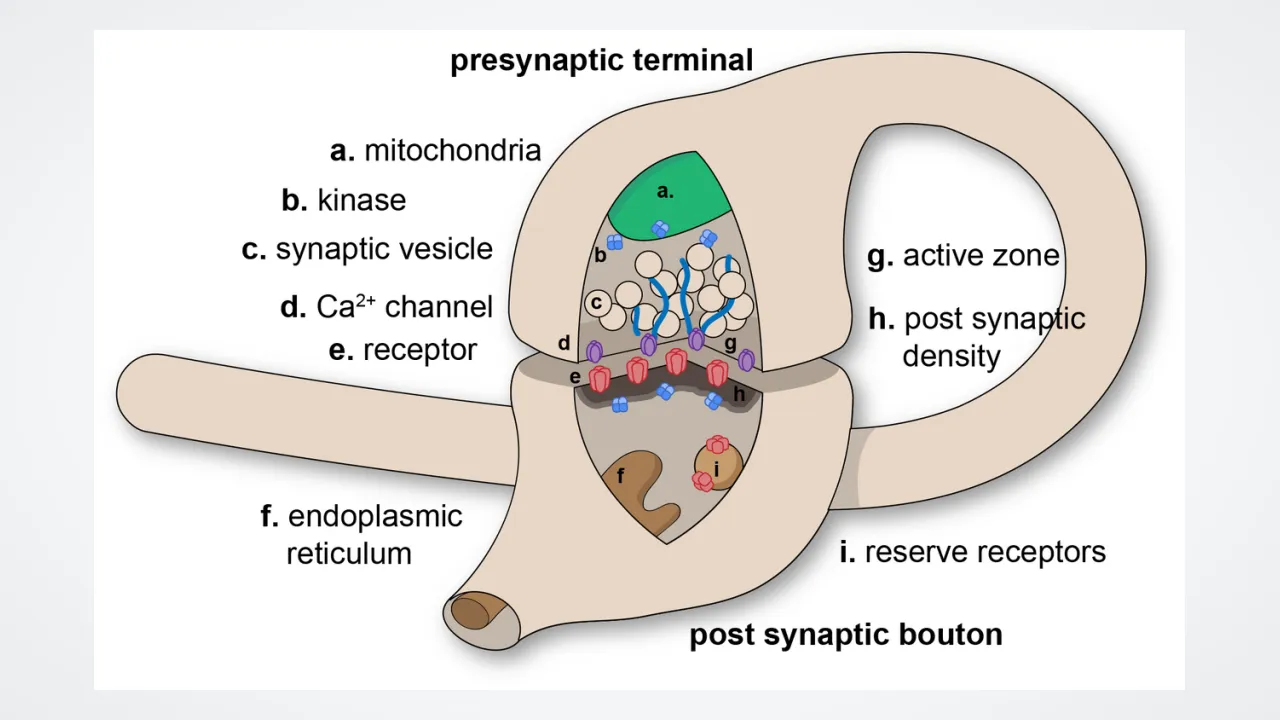
Zoom in ten million times on a thinking brain and watch a microscopic choreography unfold at the synapse! An arriving action potential reaches the swollen tip of the sending—or —axon terminal and opens calcium gates. Rushing calcium ions nudge round synaptic vesicles to fuse with the outer membrane, releasing thousands of neurotransmitter molecules across the twenty-nanometer synaptic cleft toward the receiving—or —cell.
2
A Cast of Chemical Messengers
Scientists have identified more than a hundred distinct neurotransmitters, each carrying specialized instructions. leaps across neuromuscular junctions to contract your skeletal muscles every time you sprint or smile. Glutamate acts as the brain's main 'accelerate' pedal for learning, GABA serves as the calming 'brake' that prevents runaway chatter, dopamine rewards curiosity and practice, and serotonin steadies mood and sleep.
3
Fast Electrical Cousins
While chemical synapses dominate the human brain because they can amplify or quiet signals, a few circuits use direct 'electrical synapses'—tiny protein tunnels called gap junctions that synchronize heartbeats and ultra-fast eye reflexes.
4
Sculpting Your Growing Brain
Toddlers actually have even more synapses than adults! As you grow through elementary school and beyond, your brain strengthens busy pathways and prunes unused ones—making your thinking sharper and faster.
1. Which ion rushes into the presynaptic terminal to trigger vesicles to release neurotransmitters?
2. Why does a growing child's brain prune away unused synapses over time?
🤯 Mind-Blowing Fact • Grade 5
Acetylcholinesterase is one of nature's fastest enzymes—a single enzyme molecule inside a muscle synapse can snip apart twenty-five thousand acetylcholine molecules in just one second!
✨ Word Sparks (Grade 5 Glossary)
Tap 🔊 to hear
exocytosis
Releasing bubble packets outward across cell membranes
potentiation
Long-lasting strengthening of busy synaptic connections
enzyme
A protein helper speeding up chemical reactions
🪝
How did a midnight dream on Easter night help a scientist prove that thoughts leap across synapses using pure chemistry?
1
Otto Loewi's Midnight Breakthrough
In 1897, British physiologist Charles Sherrington coined the word 'synapse' from Greek roots meaning 'to clasp together,' yet for decades a fierce debate raged: were synaptic signals electrical sparks or chemical potions? On Easter night in 1921, Austrian pharmacologist Otto Loewi woke from a vivid dream with the decisive experiment! By stimulating the vagus nerve of one isolated frog heart in saline solution and pipetting just the surrounding fluid onto a second heart, he watched the second heart slow down too—proving chemical neurotransmission via a molecule he named 'Vagusstoff,' today known as acetylcholine.
2
Sub-Millisecond Exocytosis
Modern electron microscopy reveals the astonishing precision inside that twenty-to-forty-nanometer synaptic cleft. When an action potential depolarizes the presynaptic terminal, voltage-gated calcium channels open within two hundred microseconds. Calcium binds to synaptotagmin sensors, zipping together coiled SNARE proteins that fuse neurotransmitter-filled vesicles with the membrane in rapid .
3
Summation: Excitation Versus Inhibition
Across the cleft, neurotransmitters dock onto ionotropic or metabotropic receptors. Excitatory messengers like glutamate open sodium or calcium channels, nudging the postsynaptic neuron closer to firing, whereas inhibitory GABA opens chloride channels, stabilizing the cell. Every neuron acts as a microscopic microprocessor, summing thousands of simultaneous votes before deciding whether to fire.
4
Long-Term Potentiation and Memory
How does a fleeting afternoon study session become a lifelong memory? When two connected neurons fire repeatedly in sync, special NMDA glutamate receptors admit calcium into the postsynaptic dendritic spine, inserting extra AMPA receptors and physically enlarging the spine—a lasting boost called long-term (LTP).
5
Clearing the Cleft
Precision endings require rapid cleanup: such as acetylcholinesterase slice transmitters apart in microseconds, while presynaptic transporter proteins vacuum up dopamine and serotonin for reuse alongside neighboring astrocyte glia.