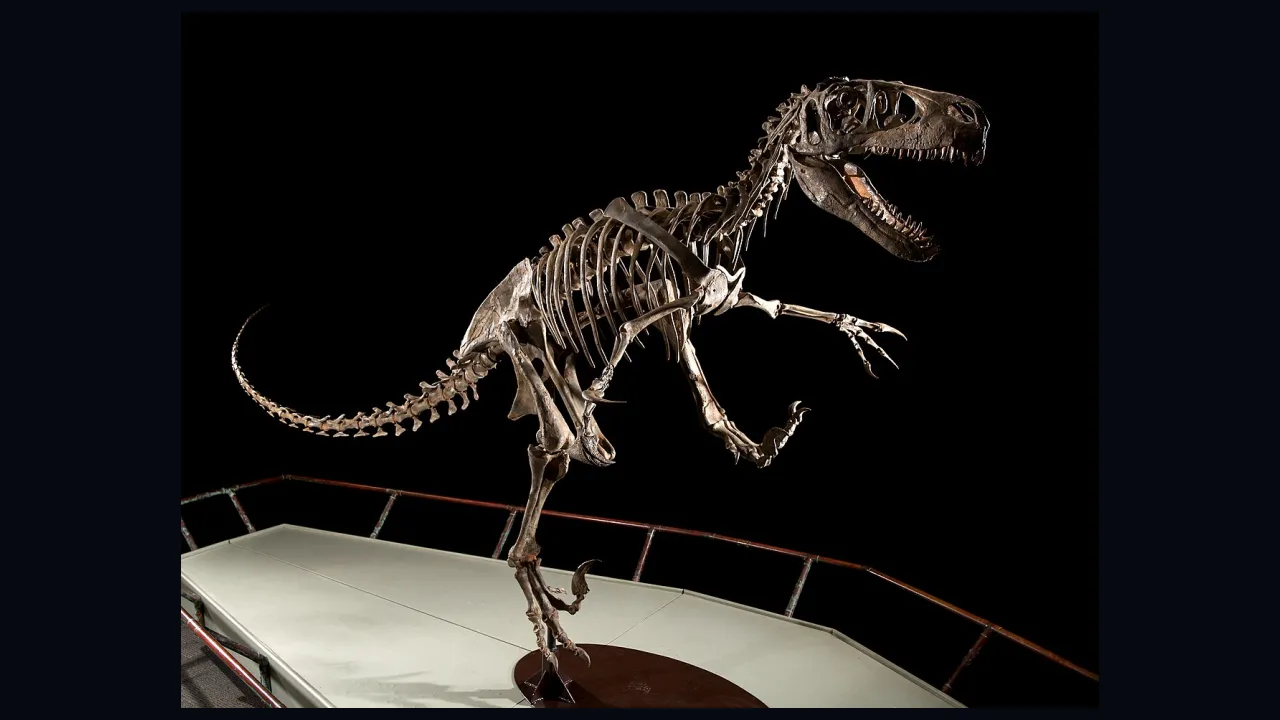
⚡ Survival SuperpowerHalf-ton grizzly-sized feathered build armed with 9.5-inch curved sickle toe claws
🤯 Mind-Blowing Fact • Grade 1
A single curved toe claw on Utahraptor grew nearly ten inches long—longer than an adult's whole hand!
✨ Word Sparks (Grade 1 Glossary)
Tap 🔊 to hear
Powerhouse
Extraordinarily strong and muscular living creature
Canyon
Deep rocky valley with tall cliff walls
Claw
Sharp curved nail on a toe or finger
🪝
What feathered raptor grew as heavy as a giant polar bear?
1
Biggest Raptor Ever!
Thud, crunch! Out from behind red boulders steps a giant feathered hunter! Forget turkey-sized raptors—this weighed as much as a polar bear! Meet mighty Utahraptor.
2
Nine-Inch Toe Claws
Look down at its muscular feet! Each curved second-toe stretched past nine inches long—bigger than a dinner plate!
3
Built for Strength
Thick legs, deep jaws, and warm shaggy feathers made this twenty-foot dinosaur the boss of ancient Utah.
1. How big was Utahraptor compared to all other known raptors?
2. About how heavy was a full-grown Utahraptor?
🤯 Mind-Blowing Fact • Grade 2
Paleontologists officially announced Utahraptor in June 1993—the exact same month giant fictional raptors debuted in movie theaters!
✨ Word Sparks (Grade 2 Glossary)
Tap 🔊 to hear
Stocky
Thick, sturdy, and heavily muscled in build
Ambush
Surprise rush from cover instead of long chase
State Dinosaur
Official fossil symbol chosen to represent a state
🪝
How did paleontologists dig up a real giant raptor in Utah in the exact same year a famous dinosaur movie came out?
1
Amazing Timing in 1993!
Imagine movie artists inventing giant six-foot raptors on screen—thinking no real raptor grew that big—while paleontologist James Kirkland and his team unearthed an even BIGGER real raptor in eastern Utah! Named Utahraptor in June 1993, this twenty-one-foot giant surprised the entire world.
2
Built Like a Grizzly, Not a Greyhound
While smaller cousins like Velociraptor had slender sprinting shins, Utahraptor evolved , muscular leg bones built for tackling heavy armored dinosaurs and iguanodonts rather than marathon races.
3
Utah's Official State Dinosaur
In 2018, students helped inspire lawmakers to crown Utahraptor the official of Utah!
1. How was Utahraptor built differently from smaller cousins like Velociraptor?
2. Which U.S. state named Utahraptor its official State Dinosaur in 2018?
🤯 Mind-Blowing Fact • Grade 3
A single nine-ton block of sandstone excavated near Moab, Utah, preserved an adult, teenagers, and baby Utahraptors all trapped together in ancient quicksand!
✨ Word Sparks (Grade 3 Glossary)
Tap 🔊 to hear
Quicksand
Water-soaked loose sand that sinks under heavy weight
Megablock
Multi-ton slab of fossil-rich rock lifted whole
Iguanodont
Thumb-spiked plant-eating dinosaur hunted by Early Cretaceous predators
🪝
What happened when a whole group of Utahraptors got trapped inside an ancient quicksand pit?
1
Older Than T. rex by 65 Million Years!
Step back 132 million years to Early Cretaceous floodplains in Utah's Cedar Mountain Formation—older than Tyrannosaurus Rex by sixty-five million years! Patrolling conifer groves walked Utahraptor ostrommaysi, honoring raptor pioneer John Ostrom in its species name.
2
The Nine-Ton Quicksand Megablock
In 2001, geology student Matt Stikes spotted bone peeking from sandstone above Moab, Utah. Excavating an enormous nine-ton rock block revealed a prehistoric trap! Preserved inside together lay a sixteen-foot adult Utahraptor, at least four teenagers, and tiny three-foot babies alongside a trapped plant-eating .
3
Curved Lower Jaw Tip
Preparing fragile skulls inside that block revealed a bizarre surprise: the front tip of Utahraptor's lower jaw curved downward, holding forward-angled teeth that gripped prey like pliers!
4
Feathered Insulation
Because smaller ancestors already wore full pennaceous feathers, Utahraptor retained bird-like plumage for display and brooding.
1. What trapped multiple Utahraptors of all ages together in the famous Moab nine-ton fossil block?
2. What surprising shape did fossil preparators find at the front tip of a Utahraptor lower jaw?
🤯 Mind-Blowing Fact • Grade 4
In 2023, scientists dated microscopic zircon crystals from the Utahraptor quarry and discovered Utahraptor lived 135 million years ago—ten million years older than textbooks had listed!
✨ Word Sparks (Grade 4 Glossary)
Tap 🔊 to hear
Preparator
Specialist who carefully cleans rock off delicate fossils
Zircon
Tiny durable mineral crystal used to date rocks
Apex Slot
Top hunter position in a food web
🪝
Why did it take fossil preparator Scott Madsen thousands of hours with microscopic needles to free Utahraptor from rock?
1
Unlocking the Utahraptor Project Block
Lifting an eighteen-thousand-pound sandstone block off a steep Utah ridge in 2014 required bulldozers, logging sleds, and steel frames! Inside the lab, master fossil Scott Madsen spent thousands of painstaking hours under a microscope chipping rock grains away from paper-thin baby Utahraptor skulls. His careful work revealed over a dozen individuals spanning hatchlings to massive adults.
2
Family Group or Predator Trap?
Finding adults, juveniles, and yearlings buried inches apart raises an exciting behavioral question! Either Utahraptors lived and foraged in multi-age family groups—unusual among reptiles—or solitary individuals were drawn one after another by the calls of mired iguanodonts, much like California's La Brea Tar Pits.
3
Why Giant Raptors Evolved Twice
During the earliest Cretaceous in North America, giant Jurassic allosaurs had dwindled while huge tyrannosaurs had not yet evolved. Utahraptor stepped into that open apex predator slot by supersizing the dromaeosaur body plan to five hundred kilograms!
4
2023 Rock-Dating Surprise
Uranium-lead crystal dating published in 2023 pushed Utahraptor's age back ten million years earlier than previously thought—to at least 135 million years ago, proving giant feathered dromaeosaurs ruled North America right near the dawn of the Cretaceous Period!
1. What ecological opportunity allowed Utahraptor to evolve to polar-bear size in Early Cretaceous North America?
2. How did geologists determine in 2023 that Utahraptor lived at least 135 million years ago?
🤯 Mind-Blowing Fact • Grade 5
Utahraptor shared its ancient Utah floodplains with Gastonia, a spiky armored ankylosaur cousin covered in shoulder blades sharp enough to challenge even a half-ton raptor!
✨ Word Sparks (Grade 5 Glossary)
Tap 🔊 to hear
Procumbent
Teeth angled forward at the front of jaws
Valanginian
Early stage of the Cretaceous Period 135 MYA
Diapir
Upwelling column of water-soaked quicksand trapping fossils
🪝
How did scaling a swift dromaeosaur up to 500 kilograms reshape every bone from snout to sickle claw?
1
Discovery in the Yellow Cat Member
First recognized in 1991 when paleontologist James Kirkland examined a 24-centimeter (9.5-inch) pedal sickle ungual stored from eastern Utah's Dalton Wells Quarry, `Utahraptor ostrommaysi` (described in 1993 by Kirkland, Robert Gaston, and Donald Burge) astonished theropod specialists. Subsequent uranium-lead geochronology published by Greg Ludvigson and colleagues in 2023 dated the lower Yellow Cat Member of the Cedar Mountain Formation to 135 million years ago (), establishing `Utahraptor` as one of the earliest—yet largest—dromaeosaurids on Earth.
2
Graviportal Scaling vs. Cursorial Ancestors
Scaling a bipedal dromaeosaurid to 6.5 meters (21 feet) and nearly 500 kilograms forced profound biomechanical compromises. Unlike fleet-footed `Velociraptor` whose tibia markedly exceeded femur length, `Utahraptor` evolved thick, robust femora, broad pelvic blades, and shortened, stocky metatarsals engineered to withstand extreme torsional forces while grappling multi-ton ankylosaurians (`Gastonia`) and iguanodontians (`Hippodraco`).
3
Procumbent Dentary and Ziphodont Dentition
Cranial elements freed from the Stikes Quarry megablock revealed an autapomorphic downturned anterior dentary symphysis bearing (forward-angled) teeth, paired with laterally compressed, serrated maxillary crowns that functioned as precision gripping-and-slicing shears during powerful close-range ambushes.
4
Fluidized Sand Diapir Taphonomy
Sedimentological cross-sections of the nine-ton megablock demonstrate a fluidized sand volcano () where pressurized artesian groundwater turned buried river sand into inescapable quicksand—preserving articulated ontogenetic stages from one-meter hatchlings to robust half-ton adults without scavenger scattering.
5
Convergent Gigantism in Dromaeosauridae
Only Late Cretaceous `Achillobator` in Mongolia and fish-hunting `Austroraptor` in Argentina approached `Utahraptor`'s formidable mass, proving feathered dromaeosaurids independently evolved bear-sized apex predator builds across at least three separate continental ecosystems over seventy million years of Cretaceous history.