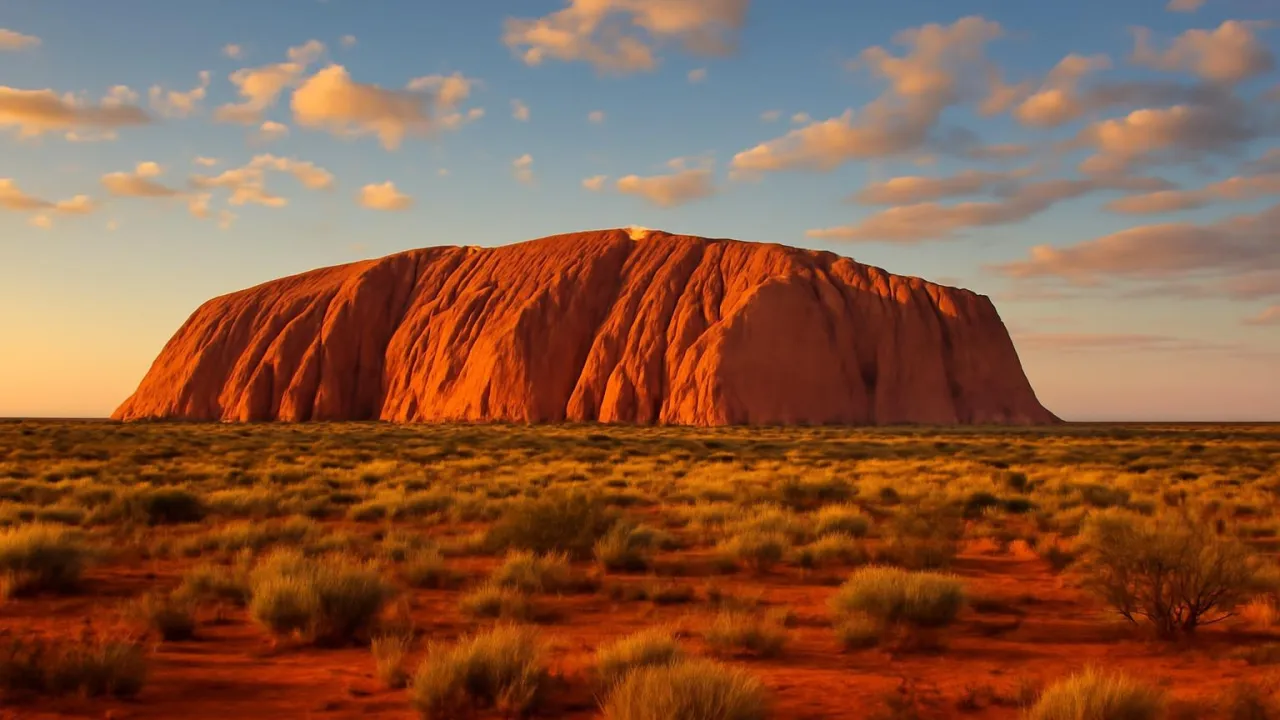
Uluru is about as long as 38 school buses lined up!
✨ Word Sparks (Grade 2 Glossary)
Tap 🔊 to hear
desert
A dry, sandy place with little water
Aboriginal
Australia’s first people
respect
To care about someone or something
🪝
What would you see if you visited a giant glowing rock in the desert?
1
A Surprise in the Sand
Imagine walking across red sand and spotting Uluru rising high above the flat land. The rock looks bright and bold, and you can see it from far away. Its surface feels rough and sandy, and it almost seems to glow in the sun.
2
Colors That Change All Day
Uluru changes its color as the sun moves across the sky. In the morning, it can look orange or gold, but at sunset, it glows a deep red. After rain, the rock sometimes looks purple or gray, making each visit special.
3
A Place Full of Stories
Uluru is very important to people called the Anangu, who share stories about it. They believe ancient spirits made the land and left marks on the rock. Visitors are asked to Uluru and learn about its meaning.
If you walked all the way around Uluru, you’d travel nearly 6 miles!
✨ Word Sparks (Grade 3 Glossary)
Tap 🔊 to hear
erosion
Wearing away by wind or water
resonance
How light or sound bounces and changes
sacred
Very special or holy
🪝
Can you imagine a rock so big it glows red at sunset?
1
Australia’s Glowing Landmark
Uluru rises from the flat desert, its red sandstone shining under the sun. This giant monolith is taller than a skyscraper and stretches for miles. People visit from all over the world to see its colors change. Uluru’s surface feels rough because wind and rain shape its sandstone.
2
A Rock That Changes Color
Uluru’s color shifts from orange at sunrise to deep red at sunset. Sometimes, after rain, it appears purple or silver. The changing colors happen because sunlight hits the rock at different angles. This effect is called optical , and it makes Uluru look magical.
3
Ancient Stories and Sacred Ground
Uluru is to the Anangu, Australia’s Aboriginal people. They believe ancestral spirits created the land and left marks on the rock. Their stories, called Tjukurpa, explain Uluru’s cracks and caves. Visitors learn about these traditions and are asked to show respect.
4
How Uluru Was Formed
Uluru is over 550 million years old, formed by and pressure. Layers of sand and mud turned into hard sandstone deep underground. Over time, wind and water wore away the softer rock, leaving Uluru standing alone. Today, it towers 1,142 feet above the desert floor.
Uluru’s base is even bigger underground than what you see above!
✨ Word Sparks (Grade 4 Glossary)
Tap 🔊 to hear
monolith
A single, giant rock formation
optical resonance
How light makes colors look different
Outback
Australia’s wild, dry center
🪝
What would it feel like to stand beside a glowing red giant in the desert?
1
A Natural Wonder in the Outback
Uluru stands alone in Australia’s dry , rising 1,142 feet above the desert floor. Its massive size and bright red color make it one of the world’s most famous . The rock’s surface is rough and marked with caves, ridges, and grooves shaped by millions of years of erosion. Every year, thousands of visitors travel to Uluru-Kata Tjuta National Park to see this natural wonder.
2
The Science Behind the Colors
Uluru’s stunning color changes are caused by the way sunlight interacts with its iron-rich sandstone. As the sun moves, the angle of the light creates a phenomenon called , making the rock appear orange, red, or even purple. After rain, a thin layer of water can make Uluru shimmer with silver or black streaks. These color shifts have fascinated scientists and visitors alike for generations.
3
Ancient Land, Sacred Stories
For the Anangu people, Uluru is a sacred place filled with meaning. Their Tjukurpa, or Dreamtime stories, describe how ancestral beings shaped the land and left marks on the rock. These stories are passed down through generations and are connected to the caves, springs, and paintings found around Uluru. Visitors are encouraged to learn about and respect these deep cultural traditions.
4
How Uluru Was Formed
Uluru began forming over 550 million years ago when sand and mud settled in an ancient sea. Over time, pressure turned these layers into hard sandstone, buried deep underground. Powerful forces pushed the rock upward, and erosion gradually wore away the softer stone around it. Today, Uluru stands as a testament to the slow, powerful forces of nature and time.
1. What makes Uluru’s surface shimmer after it rains?
2. Why is Uluru important to the Anangu people?
🤯 Mind-Blowing Fact • Grade 5
Uluru’s underground root may extend over 3 miles deep, making it much larger than it appears above ground!
✨ Word Sparks (Grade 5 Glossary)
Tap 🔊 to hear
arkose
A hard sandstone with feldspar and iron
tectonic
Relating to Earth’s moving crust plates
custodian
A person who cares for something special
🪝
Imagine standing in the Australian Outback as the world’s largest red monolith glows like fire—how did such a giant form, and why does it matter?
1
Uluru: The Heart of Australia’s Red Centre
Uluru rises 1,142 feet (348 meters) above the flat, arid plains of central Australia, making it one of the world’s most iconic natural landmarks. This immense sandstone monolith stretches 2.2 miles (3.6 kilometers) long and 1.5 miles (2.4 kilometers) wide, dominating the landscape of Uluru-Kata Tjuta National Park. Its brilliant red color comes from iron minerals in the rock, which oxidize, or rust, in the dry desert air. The surrounding Outback is sparsely vegetated, allowing Uluru’s massive form to be visible from miles away.
2
The Science of Uluru’s Changing Colors
Uluru’s surface color dramatically shifts throughout the day due to a phenomenon called optical resonance. As the angle of sunlight changes, the wavelengths of light reflected by the iron-rich sandstone also change, causing Uluru to glow orange at sunrise, deep red at sunset, and sometimes purple or silver after rain. The rough texture of the rock, shaped by millions of years of wind and water erosion, enhances these effects by scattering light in all directions. These color changes are so striking that they have become a symbol of Australia’s natural beauty.
3
Geological Origins: A Story Millions of Years Old
Uluru began forming over 550 million years ago, when sand and mud settled in an ancient inland sea. Over time, pressure transformed these sediments into , a type of hard sandstone rich in feldspar and iron. forces pushed this rock upward, tilting it nearly vertical. Erosion by wind and water gradually removed the softer surrounding rock, leaving Uluru standing alone as a massive, exposed monolith. Scientists estimate that much of Uluru’s bulk remains hidden underground, making its visible size only part of its true scale.
4
Cultural Significance and Indigenous Knowledge
For the Anangu, the Aboriginal people of the region, Uluru is a sacred site deeply connected to their Tjukurpa, or Dreamtime, stories. These stories explain the creation of the land, the origins of animals and people, and the meaning of the caves, springs, and rock art found around Uluru. The Anangu act as traditional , sharing their knowledge with visitors and guiding respectful behavior within the park. In 1985, the Australian government returned ownership of Uluru to the Anangu, recognizing its cultural and spiritual importance.
5
A World Heritage Landmark and Conservation Efforts
Uluru is recognized as a UNESCO World Heritage Site for both its natural and cultural values. The park is jointly managed by the Anangu and Parks Australia, who work together to protect its unique ecosystems and ancient traditions. Visitors are encouraged to walk around the base, learn from Anangu guides, and observe the rich biodiversity of the desert. Climbing Uluru is now discouraged out of respect for its sacred status, and conservation efforts focus on preserving the rock and its surrounding habitats for future generations.