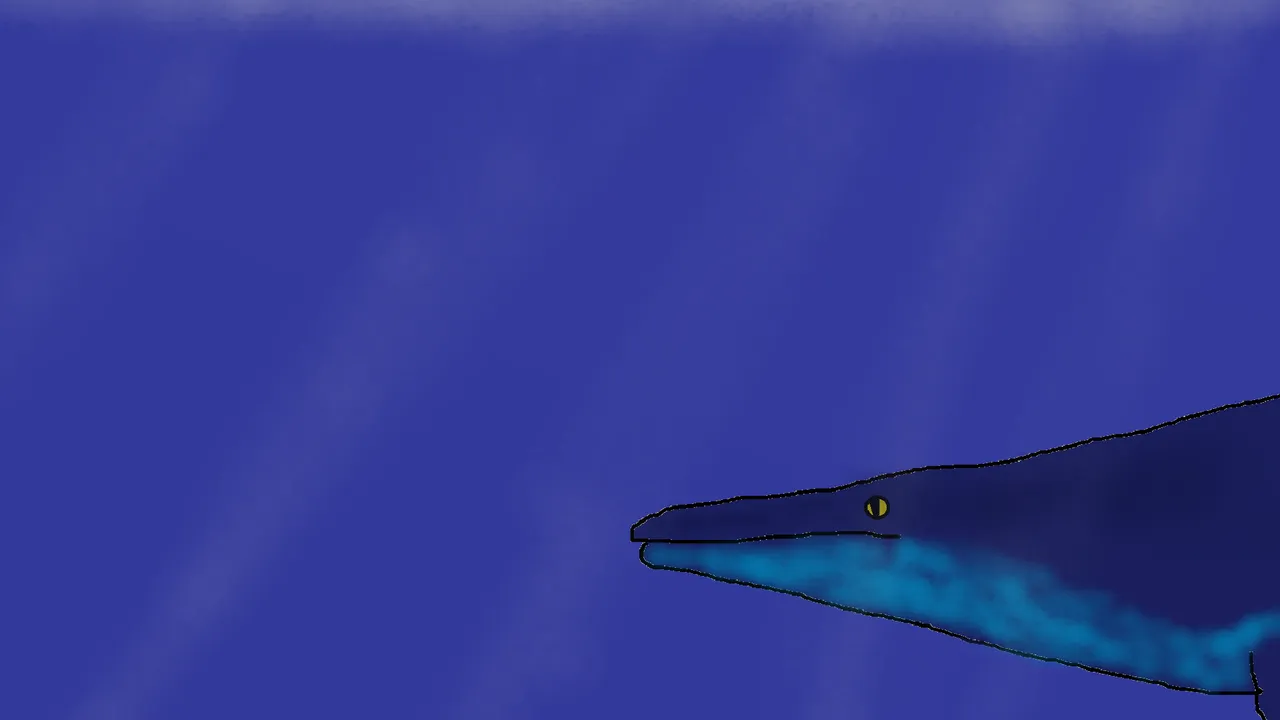
1. Where did Tylosaurus hide two secret extra rows of teeth?
2. Which living animals are closely related to Tylosaurus?
🤯 Mind-Blowing Fact • Grade 2
One fossilized Tylosaurus skeleton from South Dakota still held the bones of a diving seabird, a shark, a bony fish, and a smaller mosasaur inside its stomach!
✨ Word Sparks (Grade 2 Glossary)
Tap 🔊 to hear
cylinder
A solid tube-like shape with rounded sides
rivals
Competitors trying to win the same space
impressions
Prints or outlines pressed into soft mud
🪝
Why are skeletons of this forty-foot ocean predator found under Kansas wheat fields?
1
Ruler of the Chalk Sea
Imagine snorkeling over western Kansas eighty-two million years ago! Instead of tall prairie grass, warm turquoise waves stretched for hundreds of miles. Ruling that inland ocean was Tylosaurus, a fierce mosasaur up to forty-six feet long.
2
A Built-In Battering Ram
The name Tylosaurus means 'knob lizard' because the front of its upper snout formed a solid of bone with zero teeth at the very tip. Scientists think it used this reinforced nose to bump or stun fast swimmers!
3
Shark-Like Tail Fin
Fossil skin show Tylosaurus wore tiny diamond-shaped scales that cut glare underwater, while a two-lobed tail fin pushed it forward in fast bursts.
1. Why did scientists give Tylosaurus the name 'knob lizard'?
2. What amazing clue did paleontologists find inside a South Dakota Tylosaurus belly?
🤯 Mind-Blowing Fact • Grade 3
Tiny ridged scales preserved on Kansas Tylosaurus fossils measure less than an eighth of an inch wide—smaller than the scales on a modern rattlesnake!
✨ Word Sparks (Grade 3 Glossary)
Tap 🔊 to hear
palate
The roof inside an animal's mouth
rostrum
The projecting snout or beak of an animal
keeled
Having a raised central ridge along a scale
🪝
How did a lizard evolve snake-like hinged jaws and a shark-shaped tail to rule Cretaceous seas?
1
Apex Predator of the Niobrara Chalk
Beneath the sunlit surface of North America's Western Interior Seaway, few creatures dared cross paths with Tylosaurus proriger. Stretching more than forty feet long and weighing over ten tons, this giant mosasaur left dozens of spectacular skeletons buried in the pale Niobrara Chalk beds of Kansas.
2
Snake-Style Swallowing Jaws
Because mosasaurs shared ancestors with snakes and monitor lizards, Tylosaurus possessed flexible joints mid-way along its lower jawbones. Combined with two extra rows of backward-curving pterygoid teeth on its , its jaws ratcheted huge prey straight down its gullet whole!
3
Rewriting How Mosasaurs Swam
For over a century, artists painted Tylosaurus wriggling slowly like a sea snake with a ribbon-shaped tail. Then well-preserved fossils revealed a downward kink at the end of its spine supporting a stiff, crescent-shaped upper tail fin—giving it shark-like cruising speed!
4
Armored Scales and Nose Bumps
Tiny scales covered its sleek body to channel smooth water flow and prevent shiny reflections that might warn prey. Up front, healed bone scars on its dense (snout) suggest Tylosaurus rammed targets at high speed.
1. How did flexible lower jaw joints and palate teeth help Tylosaurus eat?
2. What did fossil tail impressions reveal about how Tylosaurus swam?
🤯 Mind-Blowing Fact • Grade 4
Kansas paleontologist Charles Sternberg once uncovered a thirty-foot Tylosaurus skeleton with the bones of an entire plesiosaur still resting inside its ribcage!
✨ Word Sparks (Grade 4 Glossary)
Tap 🔊 to hear
mandible
The lower jawbone used for biting
hypocercal
Tail fin supported below by a downward spine
stamina
Strength to keep moving for a long time
🪝
How did two fierce rival fossil hunters in 1860s Kansas race to name North America's greatest sea lizard?
1
Fossil Feuds on the Kansas Frontier
Wind-carved chalk bluffs in western Kansas became a scientific battleground in 1868 when rival paleontologists Edward Drinker Cope and Othniel Charles Marsh raced to describe giant marine reptiles from Fort Wallace. After early name changes, Marsh's genus Tylosaurus ('knob lizard') stuck! Stretching twelve to fourteen meters across the Campanian Western Interior Seaway, Tylosaurus proriger quickly emerged as the quintessential American mosasaur.
2
Cranial Kinesis and Ramming Snouts
Examine a Tylosaurus skull and two features leap out immediately: an elongated, toothless premaxillary rostrum packed with dense structural bone, and mobile joints within the lower . Stress-distribution studies indicate that this reinforced snout absorbed heavy impact forces during high-speed ramming strikes, stunning plesiosaurs or giant fish before double-hinged jaws and recurved pterygoid teeth engulfed them.
3
Carangiform Propulsion and Countershading
Soft-tissue fossils revolutionized mosasaur biomechanics by revealing a tail—where the backbone angled downward to brace the lower lobe while dense connective tissue formed a tall upper fluke. Paired with hydrodynamic keeled micro-scales and dark dorsal melanosomes for countershaded stealth, Tylosaurus combined cruising with explosive ambush lunges.
4
Viviparity in Open Seas
Like ichthyosaurs before them, mosasaurs gave birth to live, active young right at sea rather than hauling their ten-ton bodies ashore to lay eggs. Young Tylosaurus hunted agile fish in sheltered waters before graduating to offshore apex status.
1. Why were tiny keeled scales helpful to a giant predator like Tylosaurus?
2. Where were young Tylosaurus babies born?
🤯 Mind-Blowing Fact • Grade 5
Oxygen isotopes locked inside Tylosaurus tooth enamel show it maintained a warm body temperature around 97 degrees Fahrenheit—nearly identical to yours!
✨ Word Sparks (Grade 5 Glossary)
Tap 🔊 to hear
Squamata
The reptile order containing all lizards and snakes
cranial kinesis
Flexible movement between skull and jaw bones
pterygoid teeth
Extra gripping teeth anchored to the upper palate
🪝
How did terrestrial squamate lizards transform within twenty million years into fourteen-meter oceanic apex predators like Tylosaurus?
1
Squamate Invasion of Late Cretaceous Oceans
Following the mid-Cretaceous extinction of giant pliosaurids and ichthyosaurs around ninety million years ago, semi-aquatic varanoid-like lizards () radiated explosively into vacant marine apex niches. By eighty-five million years ago, the russellosaurine lineage produced Tylosaurus proriger—a twelve-to-fourteen-meter, twelve-ton leviathan dominating North America's epicontinental Western Interior Seaway from subtropical Texas northward to subarctic Canada.
2
Battering-Ram Rostrum and Streptostylic Jaws
Named for its robust, cylindrical premaxillary projection extending well ahead of the anterior teeth, Tylosaurus combined blunt-force trauma with snake-like . Neurovascular foramina dotting the rostrum housed sensitive mechanoreceptors, while thickened trabecular bone resisted fracture when ramming prey. Once seized, victims met intramandibular joints and twin rows of recurved palatal that ratcheted large carcasses—including Hesperornis seabirds, Cretoxyrhina sharks, and polycotylid plesiosaurs—down the esophagus.
3
Hydrodynamic Evolution and Soft-Tissue Insights
Exceptionally preserved russellosaurine fossils (including juvenile Tylosaurus and sister taxon Platecarpus) dismantled outdated depictions of serpentine anguilliform swimming. Downward-deflected caudal vertebrae anchored a stiffened, bilobed hypocercal fluke suited to carangiform thrust, while paddle-shaped limbs steered rapid maneuvers. Scanning electron microscopy of fossilized integument further revealed sub-millimeter keeled scales reducing boundary-layer drag alongside dark melanin countershading.
4
Endothermy and Rapid Growth
Oxygen-isotope ratios in Tylosaurus tooth enamel demonstrate body temperatures noticeably warmer than ambient seawater—around 35 to 39 degrees Celsius—confirming elevated metabolic rates. Bone histology corroborates rapid juvenile growth, propelling meter-long neonates toward multi-ton maturity within several years.
5
Bone Wars Legacy in the Smoky Hill Chalk
First unearthed near Monument Rocks, Kansas, in 1868 during the famed 'Bone Wars' rivalry between Edward Drinker Cope and Othniel Charles Marsh, Tylosaurus remains the crown jewel of the Smoky Hill Chalk Member. Its articulated skeletons—complete with healed intraspecific facial bite scars and fossilized gut contents—offer one of paleontology's richest windows into Mesozoic marine food webs.