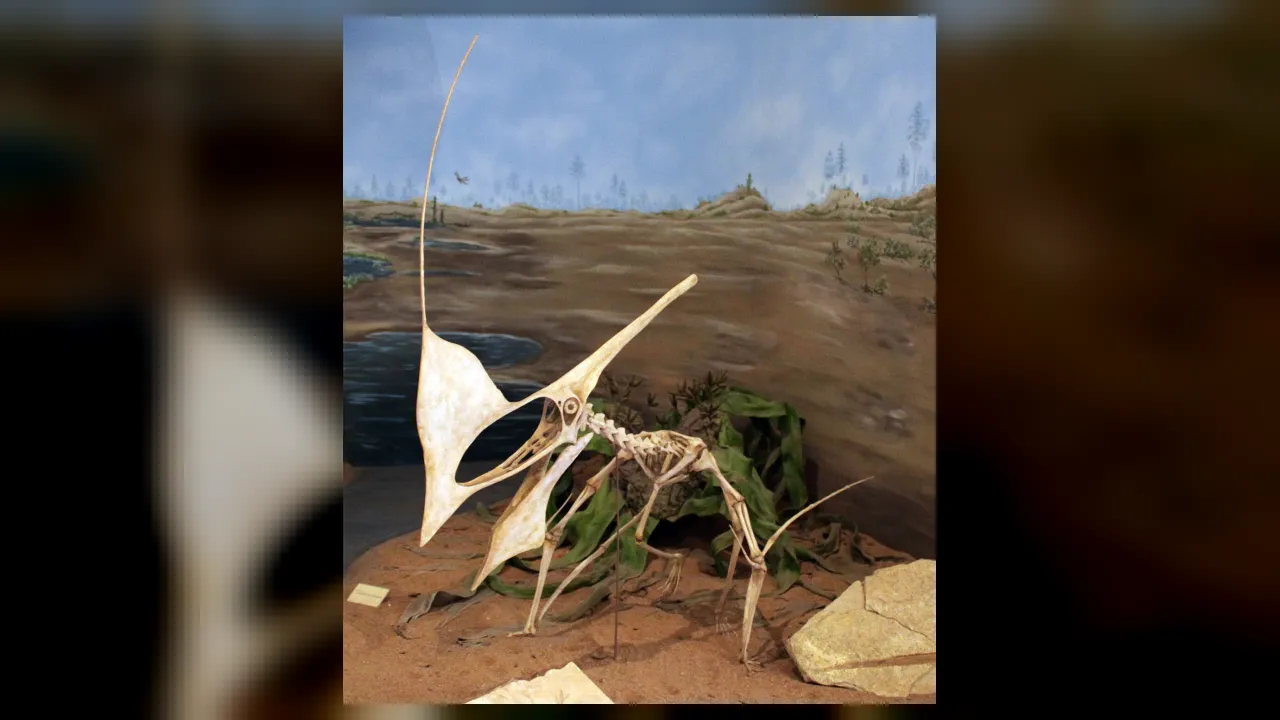
1. What held up Tupandactylus's huge skin head crest?
2. What does the name Tupandactylus mean?
🤯 Mind-Blowing Fact • Grade 2
Microscopes revealed tiny color packets inside Tupandactylus's crest and fuzz, proving pterosaurs could grow patterned colors just like modern tropical birds!
✨ Word Sparks (Grade 2 Glossary)
Tap 🔊 to hear
Billboard
Large bold sign meant to be noticed
Gust
Sudden strong rush of blowing wind
Branched
Splitting outward like tiny feather strands
🪝
How did a 115-million-year-old fossil from Brazil prove that flying reptiles could grow colorful branched feathers?
1
A Living Billboard
Look across a calm lagoon in Early Cretaceous Brazil 114 million years ago! Striding along the shore with a fourteen-foot wingspan is Tupandactylus. Rising above its pointed, toothless beak is an enormous fan-shaped crest built from tough skin fibers stretched between two long bony prongs.
2
Why Such a Huge Sail?
Wind tests show that giant crest would twist its neck if used purely like a boat sail in strong . Instead, Tupandactylus used its towering crest like a peacock's tail—flashing bright colors to communicate with friends from far away!
3
Feathers on a Pterosaur!
In 2022, scientists studying fuzzy strands at the back of Tupandactylus's skull found tiny feathers holding real color capsules—proving pterosaurs wore colorful fuzz!
1. What was the main job of Tupandactylus's huge colorful head crest?
2. What surprising discovery did scientists announce in 2022 from the back of a Tupandactylus skull?
🤯 Mind-Blowing Fact • Grade 3
Over 80 percent of Tupandactylus's giant head crest was made of lightweight stiffened skin rather than bone, keeping its head light enough to fly!
✨ Word Sparks (Grade 3 Glossary)
Tap 🔊 to hear
Keratinous
Made of tough fingernail-and-beak protein
Spar
Slender strong pole supporting a wing or sail
Forage
To search around an area for food
🪝
How could Tupandactylus fly smoothly when its spectacular head crest grew five times taller than its skull?
1
Two Spectacular Species
Overlooking the ancient lakes of Brazil's Crato Formation 114 million years ago lived two dazzling cousins: Tupandactylus imperator and Tupandactylus navigans! While imperator swept its two-pronged crest far behind its head like an emperor's crown, navigans raised a tall vertical dome straight skyward like a sailboat's mainsail.
2
Built Paper-Light
How did Tupandactylus lift such an outrageous head ornament into the sky? Fine limestone slabs preserved dark impressions of the crest's soft tissue. Instead of heavy solid bone, over eighty percent of the crest was a thin skin sheet stiffened by vertical fibers, framed only at the edges by hollow bony !
3
Walking Tall on Land
In 2021, paleontologists studied the most complete skeleton of Tupandactylus navigans ever found. Long limbs and a relatively long neck showed it spent plenty of time foraging on the ground for fruits, seeds, and small animals.
4
Deep Evolutionary Roots of Feathers
Discovery of branched feather tufts and differently shaped color melanosomes on Tupandactylus in 2022 proved color-patterned plumage helped both dinosaurs and pterosaurs communicate!
1. How did Tupandactylus keep its giant head crest light enough for flight?
2. How did Tupandactylus navigans's crest shape differ from Tupandactylus imperator's?
🤯 Mind-Blowing Fact • Grade 4
In 2013, Brazilian police rescued the most complete Tupandactylus skeleton ever found from fossil smugglers, keeping it safe in São Paulo for scientists and students!
✨ Word Sparks (Grade 4 Glossary)
Tap 🔊 to hear
Laminated
Built from paper-thin stacked rock layers
Supraoccipital
Bone located at the upper back of skull
Triassic
First geologic period of the Mesozoic Era
🪝
How did a police rescue of smuggled Brazilian fossils and an electron microscope rewrite the origin of feathers?
1
Emperor of the Crato Lagoons
Travel 114 million years back to the Early Cretaceous Araripe Basin of northeastern Brazil, where limestone beds of the Crato Formation preserved insects, flowering plants, and flying reptiles in exquisite soft-tissue detail. Soaring across these lakeside forests on 4-to-5-meter (13-to-16-foot) wings was Tupandactylus imperator, named in 2007 by Alexander Kellner and Diogenes Campos.
2
Architecture of an Extravagant Sail
Tupandactylus imperator boasted arguably the most dramatic cranial display in vertebrate history. From its toothless premaxilla shot an upward bony spine, while an elongated rod extended far behind the braincase. Stretched taut between those two hollow prongs was a towering soft-tissue sail reinforced by parallel vertical fibers—turning its profile into a three-foot living banner!
3
A Rescued Skeleton Reveals Ground Life
In 2013, Brazilian federal police intercepted 3,000 smuggled fossils, rescuing a nearly complete skeleton of sister species Tupandactylus navigans for the University of São Paulo! Published by Victor Beccari and colleagues in 2021, CT scans revealed long limbs and stiff neck vertebrae showing that—because its giant upright sail created wind drag during long flights—it excelled at short bursts of flight and active terrestrial foraging.
4
2022 Feather Breakthrough
A year later, Aude Cincotta's team examined a repatriated Tupandactylus imperator skull in Nature, discovering branched feathers along the skull base containing distinct rod-shaped and oval melanosomes—confirming true color-patterned feathers originated in the ancestor shared by pterosaurs and dinosaurs!
1. What did the rescued 2021 complete skeleton of Tupandactylus navigans show about its everyday lifestyle?
2. Why did finding differently shaped melanosomes inside Tupandactylus's branched fuzz matter so much in 2022?
🤯 Mind-Blowing Fact • Grade 5
The 2022 discovery of Stage IIIa branched feathers with central shafts and side barbs on Tupandactylus pushed the evolutionary origin of true feathers back roughly 70 million years earlier than Archaeopteryx!
✨ Word Sparks (Grade 5 Glossary)
Tap 🔊 to hear
Sexual Selection
Evolution driven by traits that attract mates
Homologous
Inherited from one shared evolutionary ancestor
Avemetatarsalian
Reptile branch uniting pterosaurs, dinosaurs, and birds
🪝
How did Tupandactylus unite biomechanics, fossil law enforcement, and evolutionary developmental biology in back-to-back scientific breakthroughs?
1
Lagerstätte Jewel of Gondwana
During the late Aptian stage of the Early Cretaceous (~115 to 113 million years ago), anoxic hypersaline lakes in Brazil's Araripe Basin deposited the finely laminated micritic limestones of the Crato Formation. Dominating this ecosystem's skies with a 4-to-5-meter wingspan was Tupandactylus imperator—originally described as a species of Tapejara in 1997 before Alexander Kellner and Diogenes Campos established Tupandactylus ('Tupan finger') in 2007.
2
Biomechanics of Sexual Selection vs. Aerodynamics
Spanning nearly one meter in total cranial length, T. imperator framed a vast fibrous soft-tissue crest between an anterior premaxillary spine and a sweeping posterior supraoccipital process, whereas congener T. navigans raised a towering vertical dome lacking a long caudal spur. Wind-tunnel and neck-torque analyses of the 2021 articulated T. navigans skeleton (GP/2E 9266, recovered during a landmark 2013 Brazilian anti-smuggling operation) revealed high lateral yaw moments that constrained sustained open-air cruising—classic evidence of runaway prioritizing visual display alongside terrestrial foraging.
3
Homology of Avemetatarsalian Feathers
In 2022, Aude Cincotta, Pascal Godefroit, Maria McNamara, and Brazilian colleagues published a transformative Nature study on a repatriated T. imperator cranium preserved with post-occipital integument. Alongside monofilamentous pycnofibers, microscopy revealed Stage IIIa branched feathers featuring a central rachis with lateral barbs—anatomically to theropod plumulaceous feathers!
4
Melanosome Diversity and Visual Signaling
Scanning electron microscopy and chemical spectroscopy uncovered abundant preserved melanosomes whose geometry differed sharply between tissue types: ovoid melanosomes packed the skin and crest base, whereas elongated rodlets filled the branched feathers. In living birds, varying melanosome shapes produce distinct hues and iridescence, proving genetic machinery for color-patterned plumage existed in Early Triassic ~250 million years ago.
5
Legacy of Repatriated Heritage
Both the 2021 São Paulo skeleton and the 2022 repatriated skull underscore how safeguarding fossil heritage fuels global paleontological discovery.