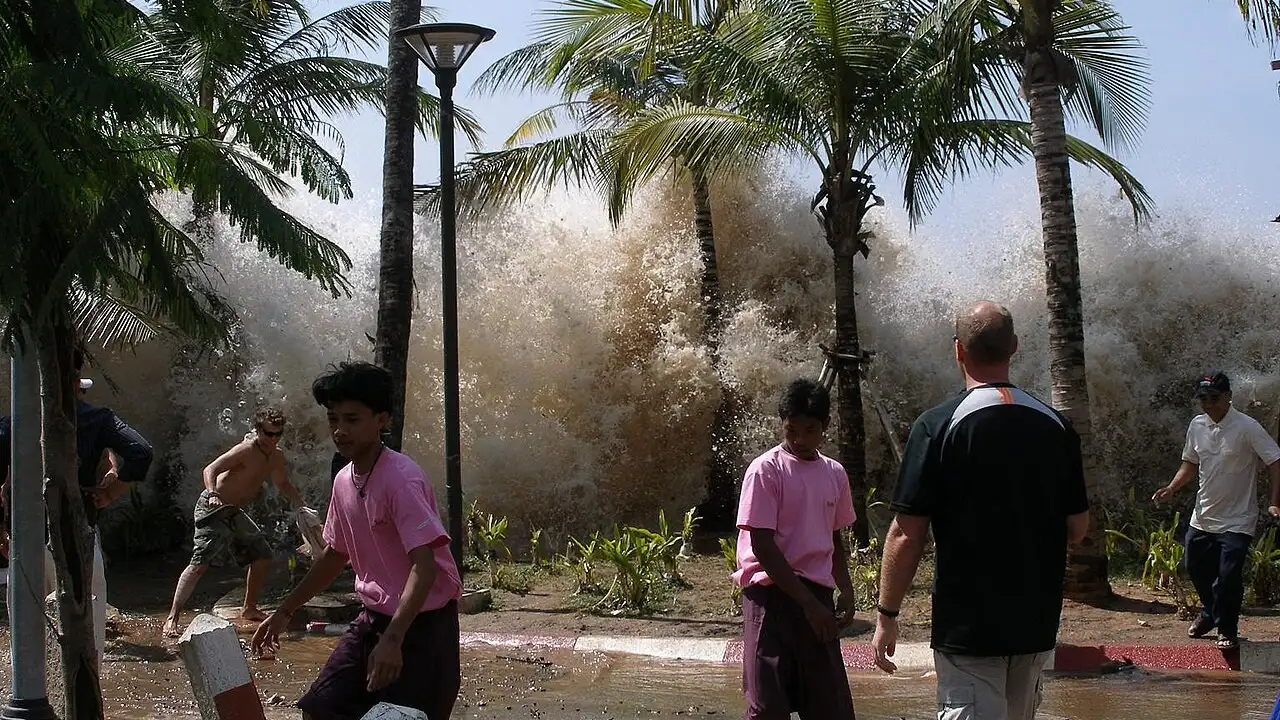
🌋 Where It FormsEntire Ocean Water Column From Deep Trenches to Coastlines
💎 Key Properties700–800 km/h Deep-Ocean Speed & 100+ km Wavelength
⚡ Planet Earth SparkRaces across deep oceans as fast as a jetliner while barely raising a bump under ships
🤯 Mind-Blowing Fact • Grade 1
Out in the deep ocean, a tsunami races faster than 500 miles per hour—as fast as a passenger jet plane!
✨ Word Sparks (Grade 1 Glossary)
Tap 🔊 to hear
tsunami
Giant ocean waves caused by underwater jolts.
buoy
A floating ocean tool with sensors on board.
shallow
Water that is not very deep near shore.
🪝
What happens to ocean water when the rocky floor underneath suddenly jumps up?
1
A Push From Below
Bump the bottom of a tub full of water. Watch big ripples slosh from side to side! When an earthquake jolts the seafloor, it pushes the whole ocean above it.
2
Zooming Across the Sea
Out in deep water, these waves zoom as fast as a jet plane! Yet they stay wide and low, so boats barely feel them pass.
3
Smart Warning Buoys
Near beaches, waves slow down and pile up tall. Floating ocean warn towns early to walk up high hills!
1. What usually starts a tsunami deep in the ocean?
2. How fast can a tsunami travel across the deep open ocean?
🤯 Mind-Blowing Fact • Grade 2
The word 'tsunami' comes from Japanese words meaning 'harbor wave,' because fishermen out in deep water never felt the wave that surged into their harbor!
✨ Word Sparks (Grade 2 Glossary)
Tap 🔊 to hear
wave train
A series of tsunami waves following one another.
crest
The highest top part of a moving wave.
displace
To push water aside and out of place.
🪝
How is a tsunami completely different from ordinary surfing waves blown by the wind?
1
Top Water vs. All the Water
Blow across a bowl of soup and tiny ripples skim just the top. Wind waves at the beach work the same way! A tsunami is totally different: an underwater earthquake, landslide, or volcano shoves the entire ocean from the very bottom to the top.
2
A Wave Train, Not One Wave
Out in deep water, each wave can stretch 100 miles from to crest and stand only two feet tall—so sailors never notice it! Instead of one single wave, a tsunami travels as a '' of several waves arriving many minutes apart.
3
Nature's Shoreline Clue
As the wave enters shallow coastal water, its front slows down while the back catches up, piling water high. Often the sea pulls unusually far back first—a natural signal to head straight to high ground!
1. Why don't ships out in the deep ocean get tossed around by a passing tsunami?
2. What does the Japanese word 'tsunami' translate to in English?
🤯 Mind-Blowing Fact • Grade 3
Remember: the very first wave in a tsunami wave train is often NOT the biggest—later waves arriving 30 or 60 minutes afterward can surge even higher!
✨ Word Sparks (Grade 3 Glossary)
Tap 🔊 to hear
wavelength
Distance measured from one wave crest to next.
shoaling
Waves slowing down and growing taller near shore.
oceanographer
A scientist who studies oceans and sea waves.
🪝
Why does people calling a tsunami a 'tidal wave' make ocean scientists shake their heads?
1
Nothing to Do With Tides!
For years, folks nicknamed tsunamis 'tidal waves.' avoid that name because daily tides are pulled gently by the gravity of the Moon and Sun, whereas tsunamis are triggered by sudden geologic jolts—underwater earthquakes, submarine landslides, volcanic eruptions, or rare ocean meteorite impacts!
2
Wavelength Makes It Special
Ordinary beach waves have around 100 meters apart and break into white surf before rolling back out. A tsunami's wavelength spans 100 to 200 kilometers! When it reaches land, it doesn't curl like a surfer's wave—it surges inland like a fast-rising flood for 15 to 30 minutes.
3
Shoaling Near the Coast
Why does a low deep-ocean wave grow tall near land? Friction with the rising seafloor slows the wave from 800 km/h down to 50 km/h, squeezing its huge energy upward in a process called .
4
DART Buoys on Patrol
Across the Pacific and Atlantic, seafloor pressure sensors teamed with satellite buoys—called DART stations—spot passing tsunamis centimeters high and alert coastal communities in minutes!
1. Why is 'tidal wave' an inaccurate nickname for a tsunami?
2. What happens during 'shoaling' as a tsunami enters shallow coastal water?
🤯 Mind-Blowing Fact • Grade 4
By matching tree rings in sunken Washington cedar 'ghost forests' with centuries-old samurai harbor logs in Japan, detectives pinpointed a prehistoric Pacific tsunami to the exact evening of January 26, 1700!
✨ Word Sparks (Grade 4 Glossary)
Tap 🔊 to hear
trough
Lowest dip or valley between two wave crests.
DART system
Deep-ocean pressure sensors and buoys detecting tsunamis.
vertical displacement
Upward or downward movement of seafloor fault blocks.
🪝
Why does a vertical megathrust fault spark an ocean-wide tsunami while an equally strong sideways fault barely ripples the sea?
1
Vertical Displacement Is Key
Not every strong underwater earthquake launches a tsunami! When two plates grind horizontally past each other along a strike-slip fault, they barely lift the water column above. By contrast, at a convergent subduction zone—like those ringing the Pacific and Indian oceans—an overriding plate bends downward for centuries before snapping violently upward by several meters! That sudden vertical piston-push lifts billions of tons of seawater, gravity pulls the water mound back down, and tsunami waves radiate outward in all directions.
2
Deep-Water Speed Depends Only on Depth!
Because a tsunami's 200-kilometer wavelength is far wider than even the deepest 4-kilometer ocean basin, physics treats a tsunami as a 'shallow-water wave' even in the middle of the abyss! Its speed equals the square root of gravity times ocean depth (`v = √(g × d)`). In 4,000-meter-deep Pacific water, every tsunami travels right around 200 meters per second—720 kilometers per hour!
3
Why Troughs Sometimes Arrive First
Depending on which side of a tilted seafloor fault sits nearest shore, either a wave crest OR a wave can arrive first. When a trough arrives first, coastal water drains rapidly seaward, exposing reefs and harbor floors minutes before the main surge arrives.
4
Ghost Forests and Tsunami Engineering
In Washington and Oregon, drowned cedar 'ghost forests' and sand sheets matched with Japanese harbor records proved Cascadia's last great tsunami struck on January 26, 1700—inspiring modern vertical-evacuation towers and global DART networks!
1. Why do subduction megathrust earthquakes trigger far bigger tsunamis than underwater strike-slip earthquakes?
2. What single ocean measurement controls how fast a tsunami travels across an ocean basin?
🤯 Mind-Blowing Fact • Grade 5
In 1958, a massive rockslide crashing into Alaska's narrow Lituya Bay pushed a local megatsunami splash 524 meters (1,720 feet) up the opposite mountainside—taller than New York's Empire State Building!
✨ Word Sparks (Grade 5 Glossary)
Tap 🔊 to hear
run-up
Highest vertical elevation surging tsunami water reaches onshore.
refraction
Bending of waves caused by changing seafloor depths.
meteotsunami
Tsunami-like wave driven by rapid air-pressure shifts.
🪝
Why does an ocean-deep abyss still count as 'shallow water' to a tsunami—and how did an Alaskan fjord splash a wave 524 meters up a mountainside?
1
Hydrodynamics of Long-Period Gravity Waves
In fluid dynamics, any surface wave whose wavelength (`λ`) exceeds twenty times the water depth (`d`) behaves as a 'shallow-water gravity wave' because orbital water motion reaches all the way to the seabed. Wind swell (`λ ≈ 150 m`) touches bottom only near beaches, whereas a tectonic tsunami (`λ ≈ 150–300 km`) exceeds twenty times the 4-kilometer abyssal Pacific depth (`20 × 4 km = 80 km`) across the entire ocean! Consequently, phase velocity obeys `c = √(gd)`: in a 4,500-meter basin (`g = 9.8 m/s²`), `c ≈ 210 m/s` (756 km/h) with minimal geometric energy loss across 10,000 kilometers.
2
Green's Law, Bathymetric Focusing, and Run-Up
As water depth `d` shoals toward a continental shelf, wave period (`T`, typically 10 to 60 minutes) remains constant while speed `c` and wavelength `λ` drop sharply. Conservation of energy flux—approximated by Green's Law (`H ∝ d^(-1/4)`)—forces wave amplitude `H` to steepen dramatically, while submarine ridges and V-shaped bays refract and focus wave energy onto headlands. Coastal scientists distinguish shoreline wave height from '': the maximum vertical elevation above sea level reached by surging water inland.
3
Landslide Megatsunamis: Lituya Bay 1958
While tectonic megathrusts generate trans-oceanic tsunamis (such as 1960 Chile, 1964 Alaska, 2004 Indian Ocean, and 2011 Tōhoku), localized rockslides plunging into confined fjords or volcanic island collapses produce extreme local . On July 9, 1958, an earthquake shook 30 million cubic meters of rock into Alaska's narrow Lituya Bay—splashing water an astonishing 524 meters (1,720 feet) up the opposite granite ridge, higher than the Empire State Building!
4
Meteotsunamis and Volcanic Krakatoa Waves
Even fast-moving atmospheric pressure jumps across shallow seas or the Great Lakes can resonate with water depth (`c = √(gd)`) to generate smaller ',' while caldera collapses and pyroclastic flows triggered deadly waves at Krakatoa (1883) and Hunga Tonga (2022).
5
Bottom-Pressure Recorders and GNSS Forecasting
Modern DART bottom-pressure recorders detect millimeter-scale water-column weight changes 5,000 meters down, pairing with real-time coastal GNSS slip inversions and mangrove/seawall buffers to protect shorelines worldwide.