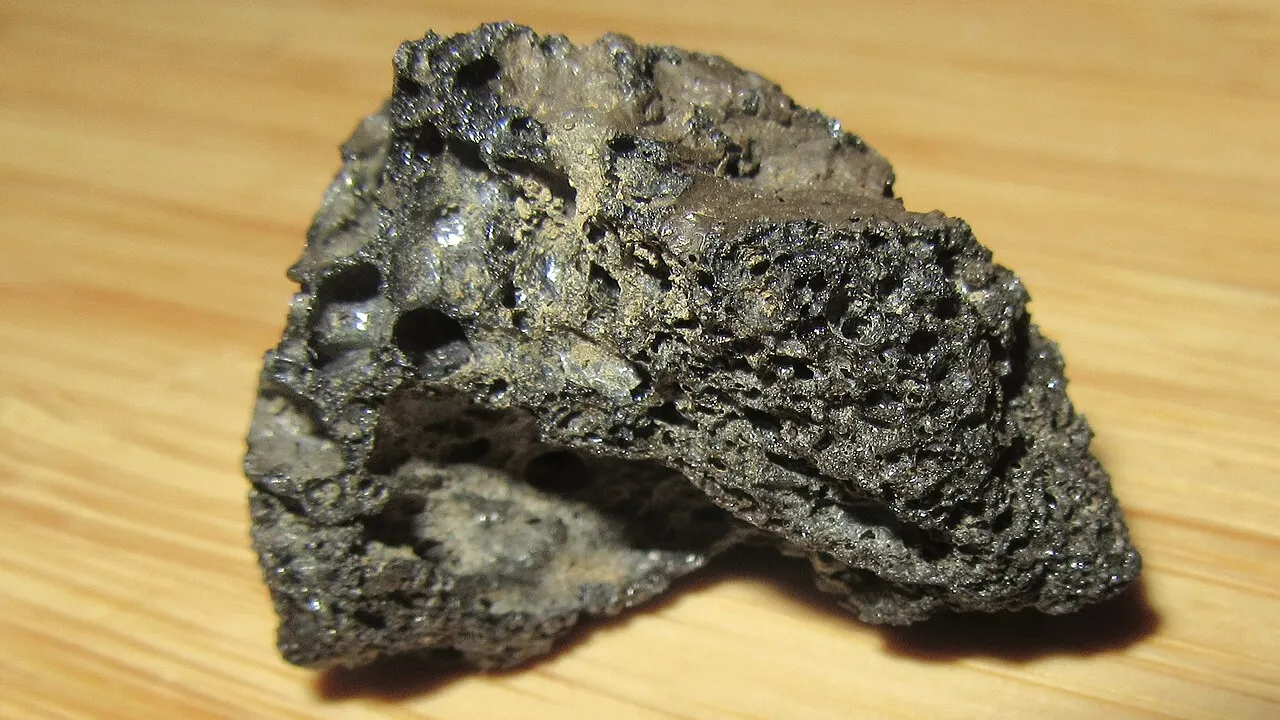
1. What happens when you drop a piece of scoria into water?
2. What colors are most pieces of scoria?
🤯 Mind-Blowing Fact • Grade 2
Arizona's Sunset Crater gets its glowing red and orange rim from iron-stained scoria cinders that still look like a sunset!
✨ Word Sparks (Grade 2 Glossary)
Tap 🔊 to hear
cinder cone
A steep volcano hill built of loose scoria
vent
An opening where lava and gas escape Earth
rusty
Reddish-brown from iron mixing with oxygen
🪝
Have you ever seen red 'lava rocks' in a flower bed and wondered how a volcano made them?
1
Sprayed From a Lava Fountain
Picture glowing orange lava shooting hundreds of feet into the night sky! As blobs of runny lava fly through cool air, gas bubbles puff them up like Swiss cheese before they clatter to the ground as crunchy scoria.
2
Building Cinder Cone Mountains
Millions of falling scoria chunks pile up around the in a steep ring. Geologists call these neat, bowl-topped hills . Because iron in the hot rock reacts with air, scoria often turns brick-red.
3
Scoria Around Your Neighborhood
Scoria holds heat well and drains rainwater fast. Gardeners spread red scoria around bushes to keep weeds away, and towns scatter crushed cinders on icy winter roads for extra grip.
1. What kind of volcano landform piles up from falling pieces of scoria?
2. Why does black scoria sometimes turn bright brick-red?
🤯 Mind-Blowing Fact • Grade 3
Mexico's Parícutin cinder cone piled up so much scoria during its first year of erupting that the new mountain grew taller than the Empire State Building!
✨ Word Sparks (Grade 3 Glossary)
Tap 🔊 to hear
mafic
Dark igneous rock rich in magnesium and iron
basaltic
Made of dark, runny volcanic basalt lava
vesicular
Riddled with preserved gas-bubble holes
🪝
How can geologists tell scoria and pumice apart in just three seconds?
1
Born From Dark Mafic Magma
Imagine standing safely downwind from a Hawaiian or Icelandic fire fountain. Unlike thick, pale silica magma that makes pumice, scoria forms from magma—dark or andesitic melt rich in heavy iron and magnesium. Because mafic lava is much runnier, expanding gas bubbles grow larger and often burst into one another.
2
Scoria Versus Pumice
Hold pumice in one hand and scoria in the other, and three clues jump right out. First, scoria is dark black, chocolate brown, or brick red, whereas pumice is usually white, cream, or pale gray. Second, scoria has larger, coarser bubble holes with thicker rock walls. Third, drop both in water: pumice floats, while dense scoria sinks immediately!
3
Tops of Moving Lava Rivers
Scoria does not only fall from sky-high fire fountains. It also forms the jagged, bubbly upper crust on moving rivers of lava as dissolved gases bubble toward the cooling surface.
4
Lightweight Building Blocks
Even though scoria sinks in water, its open vesicles still make it much lighter than solid granite. Builders mix crushed scoria into cinder blocks and insulating roof tiles.
Steepest slope loose rock fragments pile without sliding
hematite
Reddish iron-oxide mineral formed when iron oxidizes
🪝
Why does runny basaltic lava build neat, steep-sided cinder cones instead of shattering an entire mountain?
1
Strombolian Fountains and Low-Viscosity Melt
Listen to the rhythmic booming of Italy's Stromboli volcano—a sound geologists honor by calling mild, gas-driven lava blasts eruptions. Scoria begins as mafic magma containing roughly 45 to 55 percent silica alongside abundant iron, magnesium, and calcium. Because low silica keeps the melt fluid, expanding steam and carbon dioxide coalesce into large gas slugs that burst cleanly at the vent, flinging incandescent clots of frothy basalt skyward.
2
Glassy Rims, Connected Pores, and Specific Gravity
During their brief arc through cool air, scoria fragments chill into a mixture of dark volcanic glass and microscopic crystals of plagioclase feldspar and pyroxene. Unlike pumice's sealed micro-chambers, scoria's vesicles are millimeter-to-centimeter cavities that frequently interconnect, and the solid basaltic framework has a high mineral density near 3.0 grams per cubic centimeter. Even with fifty percent pore space, water rushes straight into open passages and the rock sinks.
3
Angle of Repose on Cinder Cones
Jagged, interlocking scoria clasts lock together as they land around a volcanic vent, piling up at a natural near 30 to 35 degrees. Oxidizing volcanic steam near the central crater often alters dark magnetite into crimson , painting the cone's summit fiery red.
4
Green Roofs and Water Filtration
Engineers value scoria's tough, porous structure for urban green roofs, bio-filter beds that host water-cleaning bacteria, and high-temperature gas grill briquettes that radiate infrared heat evenly.
1. Why do Strombolian eruptions toss out scoria cinders rather than blowing a whole mountain apart?
2. Why does scoria sink immediately in water even though half its volume can be bubble space?
🤯 Mind-Blowing Fact • Grade 5
Tiny microscopic droplets of magma trapped inside olivine crystals within scoria allow scientists to measure the exact gases brewing miles underground before the volcano erupted!
✨ Word Sparks (Grade 5 Glossary)
Tap 🔊 to hear
tephra
All rock fragments and ash ejected by eruptions
tachylyte
Dark iron-rich basaltic volcanic glass in scoria
melt inclusion
Tiny magma droplet trapped inside a growing crystal
🪝
What can the size and shape of frozen bubbles inside scoria reveal about an eruption no human ever witnessed?
1
Reading Bubble Geometry as a Volcanic Flight Recorder
Slice open a fist-sized piece of basaltic scoria and you are looking at a frozen snapshot of fluid dynamics inside a volcanic conduit. Scoria crystallizes and quenches from mafic to intermediate melts—containing 45 to 63 percent silica—that erupt at blazing temperatures of 1,050 to 1,200 degrees Celsius. Volcanologists scan scoria under X-ray micro-tomography to measure vesicle size distributions: spherical bubbles record late-stage gas expansion after ejection, whereas twisted, coalesced channels reveal intense shear along conduit walls seconds before fragmentation.
2
Tephra Ballistics: Lapilli, Volcanic Bombs, and Spatter
Ejected scoria belongs to a family of airborne volcanic fragments called . Pea- to walnut-sized cinders are classified as scoriaceous lapilli, while larger molten clots twist aerodynamically in midair into spindle-shaped volcanic bombs over 64 millimeters across. If clots hit the ground still partially molten, they weld together into rugged spatter ramparts instead of rolling loosely down a 33-degree cinder cone slope.
3
Mineralogy, Oxidation State, and Melt Inclusions
Within scoria's dark —basaltic volcanic glass—microscopic phenocrysts of green olivine, black clinopyroxene, and lath-shaped calcium plagioclase often sit preserved like tiny time capsules. Tiny droplets of magma trapped inside olivine crystals, known as , lock in the original pre-eruption water, sulfur, and carbon dioxide budget from miles deep in the mantle.
4
Engineering Aggregate and Hydroponic Media
With high compressive strength, chemical inertness, thermal stability above 1,000 degrees Celsius, and abundant macropores, quarried scoria serves worldwide in lightweight structural concrete, railroad ballast, geothermal heat storage, and sterile hydroponic farming beds.
5
Basaltic Scoria Across the Inner Solar System
Because basaltic volcanism dominates rocky worlds, scoria-like vesicular basalts appear across the Moon's dark maria and giant Martian shield volcanoes like Pavonis Mons, linking backyard lava rock to planetary evolution.