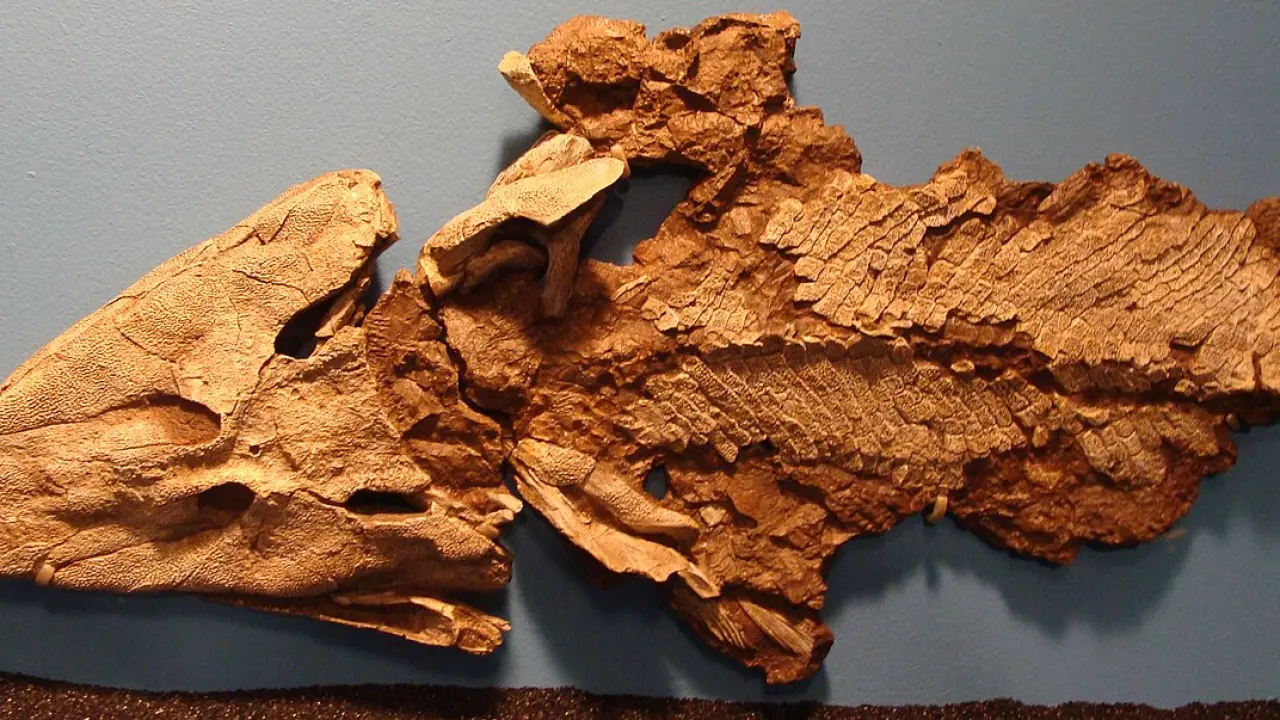
⚡ Survival SuperpowerFins packed with shoulder, elbow, and wrist bones able to do push-ups
🤯 Mind-Blowing Fact • Grade 1
Tiktaalik was the first fish cousin known to have a real neck, letting it turn its head without turning its whole body!
✨ Word Sparks (Grade 1 Glossary)
Tap 🔊 to hear
Wrist
Bendy joint between the arm and hand
Gills
Organs that help fish breathe underwater
Shallow
Water that is not very deep
🪝
Have you ever seen a fish do a push-up in the mud?
1
Peek Out of the Stream
Plop, splash! Two eyes peek above warm muddy water. Say hello to Tiktaalik! It had shiny scales and fins like a fish. Yet its flat head looked like a little crocodile.
2
Strong Arm Fins
Hidden inside its front fins were strong arm bones and ! Tiktaalik pressed down on mud to prop up its chest. It could also turn its neck side to side.
3
Gills Plus Lungs
Tiktaalik breathed underwater with AND gulped fresh air with lungs! It showed how water animals began exploring land.
1. What special bones hid inside Tiktaalik's front fins?
2. How did Tiktaalik breathe in its warm shallow streams?
🤯 Mind-Blowing Fact • Grade 2
Inuit elders in Nunavut, Canada, chose the name Tiktaalik, which means 'large freshwater fish' in the Inuktitut language!
✨ Word Sparks (Grade 2 Glossary)
Tap 🔊 to hear
Fishapod
Nickname for an animal halfway between fish and tetrapods
Ribs
Curved bones forming a cage around the chest
Mudflat
Low muddy land uncovered by shallow water
🪝
Why did fossil hunters travel to the icy Arctic to find a warm-water fish with wrists?
1
Half Fish, Half Land Explorer
Picture a winding tropical stream 375 million years ago, choked with fallen branches and muddy sandbars. Pushing its flat head above the surface is Tiktaalik! Scientists nickname it a '' because it blended fish scales and fins with features of four-legged land animals.
2
Built for Shallow Shortcuts
Deep-water fish cannot hold up their bodies when water gets shallow. Tiktaalik had thick overlapping to protect its lungs and bendable wrist joints inside muscular fins. It pushed across and tangled plants where big predatory fish got stuck.
3
Found in Frozen Rocks
In 2004, scientists found Tiktaalik on icy Ellesmere Island in northern Canada, which drifted northward millions of years after those ancient streams turned to stone!
1. Why were icy rocks in northern Canada holding a warm-water animal like Tiktaalik?
2. What does the Inuktitut name 'Tiktaalik' mean?
🤯 Mind-Blowing Fact • Grade 3
Every four-limbed animal alive today—frogs, dinosaurs, birds, whales, and you—shares the same one-bone, two-bone, wrist-bone arm pattern seen inside Tiktaalik's fins!
✨ Word Sparks (Grade 3 Glossary)
Tap 🔊 to hear
Tetrapod
Vertebrate animal with four limbs, or its descendants
Transitional
Showing steps between an older form and newer form
Pelvis
Hip bone structure that supports rear limbs
🪝
How did paleontologists predict the exact rock layer hiding the missing link between fish and land vertebrates?
1
A Scientific Treasure Map
Before 2004, paleontologists knew fish swam in rivers 385 million years ago and four-legged walked through swamps 365 million years ago. Team leaders Neil Shubin, Ted Daeschler, and Farish Jenkins predicted that freshwater sandstone from 375 million years ago should hold a animal right between the two!
2
Six Summers in the Arctic
After searching geological maps, the team flew to Ellesmere Island in Nunavut, Canada. On their fourth Arctic expedition, a V-shaped snout jutting from a cliff revealed three preserved skeletons of Tiktaalik roseae.
3
Inside the Lobed Fin
When preparators chipped away rock from Tiktaalik's pectoral fin, they found one upper arm bone, two forearm bones, and a cluster of wrist bones—matching the exact bone blueprint inside human arms! Sturdy shoulder muscles let the fin flex like a palm doing a push-up.
4
Rear-Wheel Power Too
Later study of Tiktaalik's showed surprisingly large hip sockets as well, proving strong hind fins helped propel it across muddy shallows.
1. How did Neil Shubin's team decide where to dig for Tiktaalik?
2. Which bone pattern inside Tiktaalik's front fins matches your own arms today?
🤯 Mind-Blowing Fact • Grade 4
Large breathing holes called spiracles on the back of Tiktaalik's skull eventually evolved into the tiny middle-ear tube that pops in your ears on an airplane!
✨ Word Sparks (Grade 4 Glossary)
Tap 🔊 to hear
Sarcopterygian
Lobe-finned fish group ancestral to all land vertebrates
Spiracle
Top-of-head opening used for gulping air or water
Carpal
Relating to the small bones of the wrist
🪝
Why would a Devonian river predator evolve a bendable neck, flat skull, and weight-bearing wrists before ever leaving the water permanently?
1
Navigating Warm Devonian Floodplains
Travel back 375 million years to the Frasnian Stage of the Late Devonian, when equatorial river systems wound across the continent of Laurussia. Towering shrubby trees had just begun dropping leaves into warm, slow-moving backwaters. As bacteria decomposed that plant litter, dissolved oxygen plummeted—turning shallow marshes into tough places for ordinary gill-breathing fish, yet safe nurseries rich in invertebrates and small fish.
2
Anatomy of a Mosaic Vertebrate
Gliding into those oxygen-poor shallows was Tiktaalik roseae, a lobe-finned up to 2.7 meters long. It retained diamond-shaped bony scales, gill arches, and fin rays, yet its skull was dorsoventrally flattened with eyes perched on top. Crucially, Tiktaalik had lost the bony opercular plates linking skull to shoulder in other fish, freeing a true mobile neck so it could snap sideways at prey in cramped reeds.
3
Spiracles, Ribs, and Push-Up Joints
Large notches called behind its eyes allowed Tiktaalik to inhale surface air straight into lungs without lifting its whole mouth out of water. Broad, overlapping imbricate ribs stiffened its trunk against gravity, while a humerus, radius, ulna, and functional joints inside each pectoral fin extended backward like a wrist to haul its chest over submerged logs and mudbars.
4
Pelvic Surprise
In 2014, newly prepared rear blocks of the type specimen revealed a massive pelvic girdle nearly equal in size to the shoulder, overturning old ideas that 'front-wheel drive' evolved long before strong hind limbs.
1. How did losing the bony plates between its skull and shoulder help Tiktaalik hunt in shallow marshes?
2. What did the 2014 study of Tiktaalik's fossilized pelvis reveal?
🤯 Mind-Blowing Fact • Grade 5
Micro-CT scans of Tiktaalik's skull show it transitioned from underwater suction feeding toward crocodile-style snapping bites ideal for grabbing prey right at the water's surface!
✨ Word Sparks (Grade 5 Glossary)
Tap 🔊 to hear
Elpistostegalia
Clade of tetrapod-like lobe-finned fishes including Tiktaalik
Dorsiflexion
Bending a wrist or foot upward to bear weight
Mosaic evolution
Different body parts evolving at different rates together
🪝
How did evolutionary developmental prediction lead paleontologists straight to a 375-million-year-old Arctic fossil that illuminated the vertebrate water-to-land transition?
1
Predictive Paleontology in the Fram Formation
At the dawn of the twenty-first century, a twenty-million-year morphological gap separated lobe-finned fishes like Eusthenopteron (~385 MYA) from early digit-bearing tetrapods such as Acanthostega and Ichthyostega (~365 MYA). Targeting unmetamorphosed Frasnian fluvial strata of the Fram Formation on Ellesmere Island, Nunavut (78° N), Neil Shubin, Edward Daeschler, and Farish Jenkins discovered articulated skeletons in 2004 and formally described Tiktaalik roseae in 2006—validating evolutionary stratigraphy as a predictive science.
2
Cranial Remodeling and Cervical Mobility
Measuring 1.2 to 2.75 meters, Tiktaalik exemplifies within the clade . While retaining rhombic cosmoid scales, lepidotrichia fin rays, and branchial gill bars, it exhibited a shortened cranial roof, dorsally positioned orbits, and loss of the extrascapular and opercular series. Decoupling the skull from the cleithrum created a functional cervical joint, enabling rapid lateral head sweeps across shallow, vegetated channels.
3
Appendicular Endoskeleton and Substrate Propping
Micro-dissection and CT imaging of the pectoral fin revealed an elaborate endoskeleton: humerus, radius, ulna, radials, and an incipient proximal carpus (ulnare and intermedium) forming a transverse hinge capable of 90-degree . Broadened, imbricated costal ribs stiffened the axial column so weight transferred safely from shoulder glenoid to muddy substrates without collapsing thoracic viscera.
4
Pelvic Hypertrophy and Four-Fin Propulsion
For decades, researchers assumed tetrapod locomotion began with 'front-wheel-drive' fish dragging tiny pelvic fins. In 2014, preparation of the holotype's posterior block uncovered an expanded puboischiadic plate and deep acetabular hip socket rivaling early tetrapods—demonstrating that hind-appendage strengthening originated in aquatic elpistostegalians.
5
Context Within Early Tetrapodomorph Radiation
Even older Middle Devonian trackways in Poland (~393 MYA) indicate that sister lineages experimented with digit-bearing limbs earlier than 375 MYA, positioning Tiktaalik as a superbly preserved representative of the anatomical toolkit—lungs, spiracles, necks, ribs, and wrists—that empowered vertebrates to colonize Earth's continents.