2. Why are special immune heroes called 'T-cells'?
🤯 Mind-Blowing Fact • Grade 2
Your thymus reaches its biggest size right around puberty, then gradually turns most of its classrooms into quiet fat tissue as an adult!
✨ Word Sparks (Grade 2 Glossary)
Tap 🔊 to hear
Immune System
Body defense team protecting you from sickness
Lobe
Rounded section of a soft body organ
Virus
Microscopic germ that can cause colds
🪝
What organ in your body grows BIGGER while you are a kid, then slowly shrinks once you become an adult?
1
Named After a Garden Herb
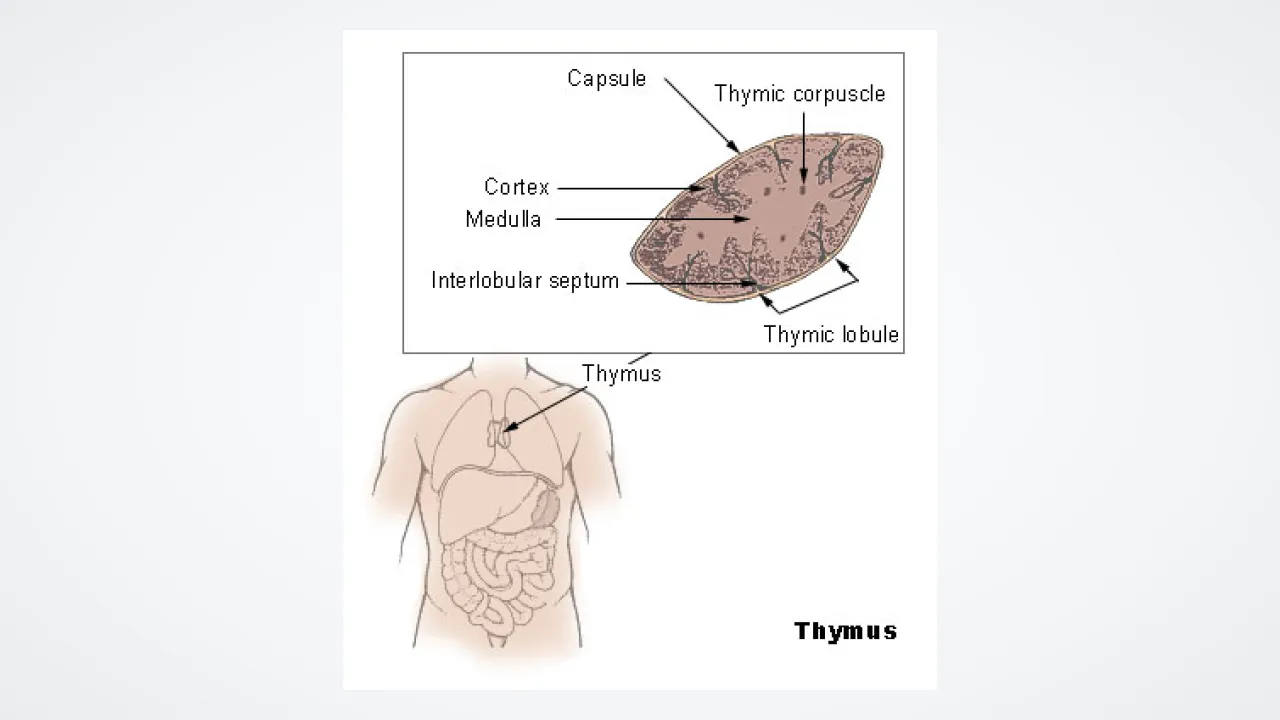
Resting snugly behind your breastbone just above your heart sits a soft, pinkish two-lobed organ called the thymus. Ancient Greek doctors thought its bumpy shape looked just like a bunch of fragrant thyme leaves from a kitchen garden!
2
Learning Friends From Germs
Rookie white blood cells born in bone marrow swim over to the thymus for boot camp. Teacher cells test every student to make sure they chase invading while leaving your own healthy body cells completely alone!
3
Job Well Done!
Once childhood finishes building a huge army of smart T-cells, your thymus slowly retires and shrinks!
1. What important rule must young T-cells pass before graduating from the thymus?
2. How does the size of your thymus change after your teen years?
🤯 Mind-Blowing Fact • Grade 3
Only about 2 to 5 percent of rookie cells entering your thymus pass both strict safety exams to graduate as trusted T-cells!
✨ Word Sparks (Grade 3 Glossary)
Tap 🔊 to hear
Thymocyte
Student immune cell training inside the thymus
Thymosin
Thymus hormone helping T-cells grow up strong
Lymph Nodes
Small immune checkpoints where T-cells stand guard
🪝
Why does one of the toughest schools on Earth let fewer than five out of a hundred cellular students graduate?
1
The Strictest Academy Inside You
Imagine a university so picky that ninety-seven percent of students do not pass the final exam! That is no joke inside your thymus gland. Unfinished cells called arrive from red bone marrow eager to become T-cells, and your thymus puts every single one through a two-part test.
2
Two Tough Exams
In Test One, must prove their surface antennas can read signals from your body's helper cells. In Test Two, nurse cells show off samples of your own heart, skin, eye, and pancreas proteins—any T-cell that tries to attack your own healthy tissue is safely recycled before it can ever leave!
3
Hormone Helpers
Why is it called the thymus gland? Special cells inside release helpful hormones like that coach maturing T-cells and boost immune teamwork.
4
Lifelong Memory
Graduating T-cells patrol your bloodstream and for decades, remembering past germs and vaccines so you stay well!
1. Roughly what percentage of rookie cells pass both strict tests to graduate from the thymus?
2. What does the thymus hormone 'thymosin' help do?
🤯 Mind-Blowing Fact • Grade 4
Until scientist Jacques Miller solved the mystery in 1961, biology textbooks had no idea what the thymus gland actually did—making it the last major human organ to have its main job discovered!
✨ Word Sparks (Grade 4 Glossary)
Tap 🔊 to hear
Positive Selection
First thymus test checking working cell antennas
Negative Selection
Second thymus test removing cells attacking you
Involution
Natural shrinking of the thymus after childhood
🪝
Why did doctors think the thymus was completely useless until a brilliant 1961 breakthrough?
1
Solving an Immunological Mystery
Believe it or not, as recently as the 1950s, scientists called the thymus an evolutionary 'graveyard' with no real job—mostly because adult thymus glands had already shrunk! Then, in 1961, scientist Jacques Miller discovered that newborn mice without a thymus couldn't build adaptive immunity at all. Overnight, medicine realized this two-lobed organ tucked behind the sternum in the superior mediastinum is the master cornerstone of vertebrate immunity!
2
Outer Cortex to Inner Medulla
Microscopically, each lobe divides into a crowded outer cortex and a calmer inner medulla. In the cortex, immature progenitors rearrange their DNA to invent millions of unique T-cell receptors—creating custom keys ready to match almost any future microbe on Earth—and undergo '' to ensure those receptors work.
3
A Mirror of Your Entire Body
Migrating inward to the medulla, students face '.' Using a remarkable master gene called AIRE, medullary thymus cells manufacture tiny preview snippets of proteins from organs all over your body—even insulin from the pancreas! Any T-cell reacting against 'self' is safely eliminated, preventing autoimmune mix-ups.
4
Thymic Involution
Peaking around thirty to forty grams near puberty, the thymus undergoes natural —gradually replacing active tissue with adipose fat while still trickling out select fresh T-cells well into adulthood.
1. Why did pre-1960s scientists mistakenly assume the thymus gland had no important function?
2. How do inner medulla thymus cells test T-cells against organs located far away, like the pancreas or eyes?
🤯 Mind-Blowing Fact • Grade 5
By shuffling tiny DNA puzzle pieces inside student cells, your childhood thymus can build unique T-cell detectors for more than a quadrillion different germ shapes—including germs you have never met yet!
✨ Word Sparks (Grade 5 Glossary)
Tap 🔊 to hear
V(D)J Recombination
DNA shuffling creating millions of T-cell detectors
Helper and Cytotoxic
Team-coordinating CD4+ and virus-clearing CD8+ T-cells
Central Tolerance
Thymus safety training protecting your own tissues
🪝
How does a 35-gram chest organ shuffle its own DNA to anticipate billions of microbes that haven't even evolved yet?
1
Primary Lymphoid Architecture of the Mediastinum
Nestled within the anterior superior mediastinum directly posterior to the manubrium of the sternum and anterior to the pericardium and great vessels, the bilobed thymus functions as a primary lymphoid and neuroendocrine organ. Protected by a selective blood-thymus barrier that shields developing lymphocytes from premature circulating antigens, each lobule segregates into a densely packed outer cortex and a pale central medulla.
2
V(D)J Recombination and Receptor Diversity
Bone-marrow-derived lymphoid progenitors enter at the corticomedullary junction lacking T-cell markers. Guided by Notch1 signaling and thymic epithelial peptides—thymosin, thymopoietin, and thymulin—thymocytes activate RAG enzymes to perform somatic V(D)J gene recombination. By shuffling variable, diversity, and joining DNA segments like a biological slot machine, your childhood thymus generates a repertoire capable of recognizing over a quadrillion potential pathogen shapes!
3
Central Tolerance: MHC Restriction and the AIRE Gene
In the outer cortex, cortical thymic epithelial cells test whether each thymocyte's newly minted receptor binds self-Major Histocompatibility Complex (MHC) molecules with Goldilocks affinity—positive selection—guiding lineage commitment into CD4+ helper T-cells or CD8+ cytotoxic T-cells. Surviving cells enter the medulla, where the Autoimmune Regulator (AIRE) transcription factor drives promiscuous expression of thousands of tissue-restricted self-antigens; strongly self-reactive clones undergo apoptosis or differentiate into peacekeeping regulatory T-cells (Tregs).
4
Age-Related Involution and Adult Health
Weighing twelve to fifteen grams at birth and peaking near thirty-five to forty grams around puberty, the thymus undergoes programmed sex-steroid-linked involution into adipose islets. Remarkably, large 2023 clinical studies revealed that even small islands of residual adult thymic tissue continue contributing to immune surveillance and long-term health!
5
Jacques Miller's 1961 Paradigm Shift
Long dismissed by Galen simply as a cushion protecting chest veins, the thymus remained medicine's 'mystery organ' until French-Australian immunologist Jacques Miller proved its master T-cell role in 1961—earning the 2019 Lasker Award alongside B-cell co-discoverer Max Cooper.