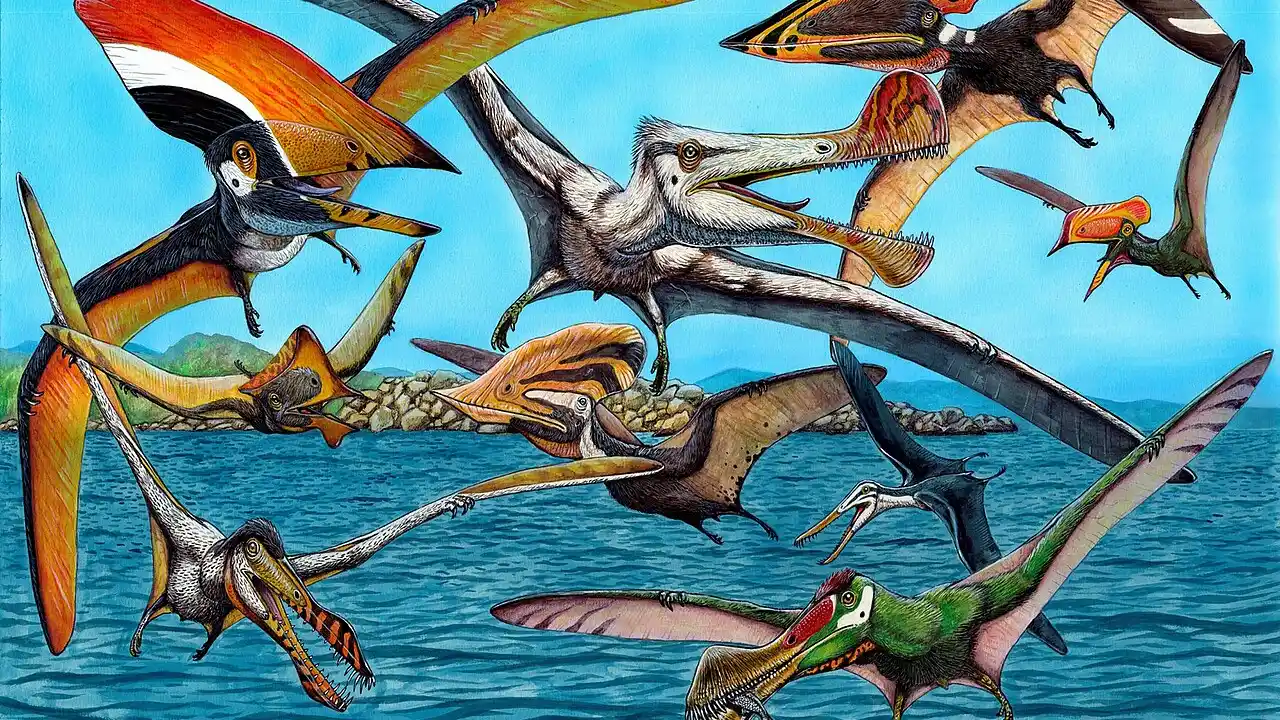
1. Which modern bird's beak looked a lot like Tapejara's short curved beak?
2. In which South American country were Tapejara's fossils discovered?
🤯 Mind-Blowing Fact • Grade 2
Brazilian paleontologist Alexander Kellner named Tapejara wellnhoferi in 1989 to honor Tupi heritage and German pterosaur expert Peter Wellnhofer!
✨ Word Sparks (Grade 2 Glossary)
Tap 🔊 to hear
Keel
Flat ridge sticking down underneath a jaw
Indigenous
Originating naturally among a region's first peoples
Nodule
Rounded lump of rock holding uncrushed fossils
🪝
Did flowering fruit trees and colorful crested pterosaurs help each other thrive in ancient Brazil?
1
Ancient Being of Brazil
Step into a sunny forest in northeastern Brazil 110 million years ago! Early flowering plants were blooming with new fruits and seeds. Hopping across branches with a four-and-a-half-foot wingspan was Tapejara, whose name means the old being in Brazil's Tupi language.
2
Double Crest Design
Tapejara wore not one crest, but two! A tall half-circle bone rose from the tip of its snout and stretched backward in a light skin sail, while a smaller bony jutted downward under its chin.
3
Seed Spreader of the Skies
By eating fruits and flying to distant groves, Tapejara may have helped spread early plant seeds across South America, much like toucans and parrots do today!
2. How might fruit-eating Tapejara have helped Early Cretaceous plants?
🤯 Mind-Blowing Fact • Grade 3
Related tapejarid fossils found in China were buried with actual plant seeds preserved right inside their stomachs, backing up the fruit-and-seed diet hypothesis!
✨ Word Sparks (Grade 3 Glossary)
Tap 🔊 to hear
Concretion
Hard mineral ball forming around buried remains
Semicircular
Shaped like half of a round circle
Flockmate
Member of the same flying social group
🪝
Why were Tapejara's delicate skull bones preserved in full 3D instead of squashed flat like pancakes?
1
3D Time Capsules of Araripe
Most pterosaur skeletons get flattened paper-thin by heavy rock layers over millions of years. Yet in Brazil's Romualdo Formation, limestone hardened rapidly around dead animals 110 million years ago—preserving Tapejara wellnhoferi skulls in crisp, uncrushed three-dimensional detail!
2
Built Like a Prehistoric Toucan
With a wingspan around four and a half feet, Tapejara was the smallest and most compact member of its crested family. Its toothless beak angled sharply downward at the tip, leaving a tiny gap between the jaws ideal for pinching berries, hard seeds, or small tree insects.
3
Signaling Through the Trees
Rising right off its snout was a bony crest reinforced by fibrous tissue reaching back toward a long neck spine. Because bright head sails stand out vividly among shady leaves, scientists think Tapejara flashed its crest to recognize !
4
Grip of a Percher
Curved foot claws show Tapejara could perch comfortably on sturdy branches and shrub limbs while feeding.
1. Why are Tapejara skulls from Brazil's Romualdo Formation so prized by paleontologists?
2. What fossil evidence from Chinese cousin Sinopterus supports the idea that tapejarids ate plants and seeds?
🤯 Mind-Blowing Fact • Grade 4
CT scans of Tapejara's skull revealed huge optic and balance brain centers bigger proportionally than a bird's, letting its eyes stay locked on fruit branches while darting through leaves!
✨ Word Sparks (Grade 4 Glossary)
Tap 🔊 to hear
Angiosperm
Plant that produces flowers and enclosed seeds
Binocular
Both eyes overlapping to judge exact depth
Flocculus
Brain region steadying gaze during fast motion
🪝
What did CT scans of Tapejara's inner ear reveal about how it held its sail-crested head in flight?
1
Blooming Forests of the Araripe Basin
Travel 110 million years back to the Aptian-Albian stages of the Early Cretaceous, when South America and Africa were slowly rifting apart to form the South Atlantic Ocean. Around lush coastal lagoons in Brazil's Araripe Basin, early —flowering plants—were radiating rapidly alongside conifers and gnetophytes. Flitting through these shrubs on 1.4-meter (4.5-foot) wings was Tapejara wellnhoferi.
2
Sorting Out True Tapejara from Giant Cousins
If you ever saw older books showing Tapejara with a giant two-pronged sail sixteen feet across, here is an important scientific update! Two larger species once placed in Tapejara—imperator and navigans—were moved into their own genus, Tupandactylus, in 2007. True Tapejara wellnhoferi was much smaller, about the size of a goose, with a rounded snout crest and no long bony rod shooting above its brow.
3
CT Scanning the Brain and Balance Organs
Because Romualdo limestone nodules preserve uncrushed 3D skulls, paleontologist Lawrence Witmer and colleagues used CT X-ray scans to reconstruct Tapejara's braincase! Enlarged floccular lobes—brain centers controlling eye stability during quick maneuvers—and tilted semicircular ear canals proved Tapejara flew with its snout tilted slightly downward to keep vision clear ahead.
4
Coevolution With Early Fruits
Armed with robust jaw adductors, a keratinous downturned beak, and grasping pedal claws, Tapejara functioned as an aerial seed disperser millions of years before parrots or toucans existed.
1. Why do older dinosaur books sometimes show Tapejara with a giant forked 16-foot wingspan?
2. What did CT scans of Tapejara's inner ear canals show about its head posture in the air?
🤯 Mind-Blowing Fact • Grade 5
CT endocasts show Tapejara's gaze-stabilizing brain lobes (flocculi) took up 7.5% of its entire brain volume—more than three times larger proportionally than in any living bird!
✨ Word Sparks (Grade 5 Glossary)
Tap 🔊 to hear
Endocast
3D model of a brain cavity inside skull
Edentulous
Completely lacking teeth inside the jaws
Gondwana
Ancient southern supercontinent including South America and Africa
🪝
How did 3D neuroanatomy, jaw biomechanics, and Gondwanan botany converge to reveal Tapejara as a Cretaceous parrot analog?
1
Exceptional 3D Preservation in the Santana Group
Approximately 112 to 108 million years ago during the late Aptian–early Albian of the Early Cretaceous, carbonate concretions in the Romualdo Formation of Ceará, Brazil, encapsulated fragile vertebrate skeletons prior to sediment compaction. Described in 1989 by Alexander W. A. Kellner as Tapejara wellnhoferi, this diminutive azhdarchoid pterosaur (~1.35 to 1.5 meters in wingspan and under two kilograms in mass) anchors the clade Tapejaridae, famed across and Eurasia for extravagant cranial crests.
2
Taxonomic Refinement and Cranial Crest Morphology
Early reconstructions frequently conflated T. wellnhoferi with massive Crato Formation relatives until Kellner and Diogenes Campos erected Tupandactylus in 2007. True Tapejara lacked a long supraoccipital prong or dorsal bony spar; instead, a steep semicircular premaxillary crest rose from its rostral tip, linked posteriorly by fibrous soft tissue to a modest parietal spine and balanced ventrally by a deep dentary keel.
3
Neuroanatomy and Gaze Stabilization
High-resolution X-ray computed tomography by Witmer et al. (2003) unlocked Tapejara's in three dimensions. Remarkably, its cerebellar floccular lobes occupied roughly 7.5 percent of total brain mass—vastly exceeding the 1 to 2 percent typical of modern birds! Integrating vestibular signals from enormous semicircular canals with neck and eye muscles, this neural circuitry stabilized Tapejara's visual field during agile maneuvers through cluttered forest canopies.
4
Biomechanics of Rostral Deflection and Frugivory
Finite-element and lever-arm studies of Tapejara's short, jaws reveal high mechanical advantage near the deflected rostral tip and occluding lateral margins. Paired with curved arboreal pedal unguals—and corroborated by angiosperm/gymnosperm seeds plus gastroliths preserved inside Chinese tapejarid Sinopterus—this apparatus functioned like a psittaciform (parrot) bill for plucking fleshy diaspores and cracking seeds.
5
Ecological Coevolution
Cruising between Early Cretaceous oases, Tapejara participated in the earliest waves of vertebrate-mediated seed dispersal just as flowering plants reshaped terrestrial ecosystems.