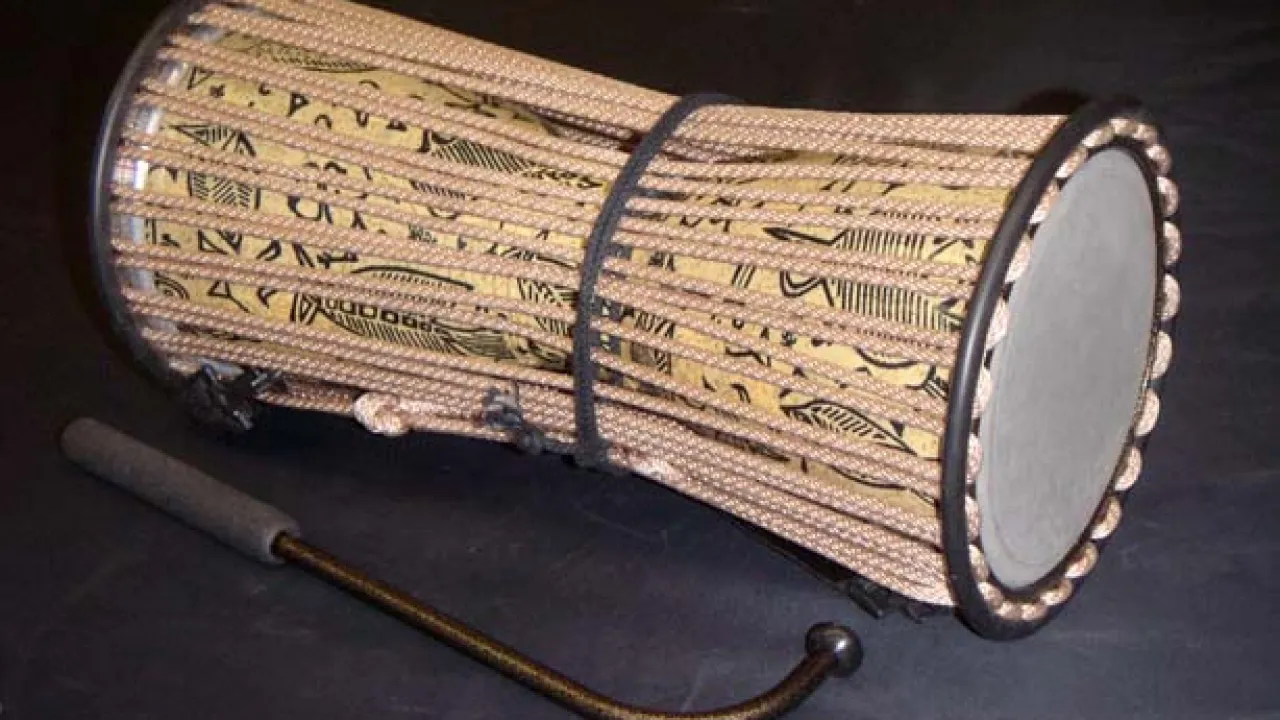
1. Where does a player hold a talking drum to squeeze its cords?
2. What happens to the sound when you squeeze the side cords tighter?
🤯 Mind-Blowing Fact • Grade 2
Small brass bells are often clipped around the rim of a Yoruba master talking drum so every strike adds a bright metallic shimmer!
✨ Word Sparks (Grade 2 Glossary)
Tap 🔊 to hear
hourglass
A shape with wide ends, narrow middle
drumhead
Tight skin stretched over a hollow drum
tonal
Using voice pitch to change word meanings
🪝
What would happen if squeezing a drum could make its voice glide like a singer?
1
A Voice Made of Wood and Skin
Thump, whirrr, boing! From across a sunny West African courtyard, a drum greets the crowd like an old friend. Its wooden body curves inward at the middle just like an , and thin animal skin covers both round ends.
2
How Arm Squeezes Bend Every Note
Dozens of leather cords connect the top to the bottom drumhead. A musician tucks the narrow waist under one arm and strikes the skin with a hooked wooden stick. When the player squeezes those cords, the skin stretches tight and sings a high note, and relaxing the arm drops the tone down low.
3
Sending Stories Far and Wide
Many West African languages use rising and falling voice tones to change what words mean. Because this drum copies both rhythm and sliding tones, master drummers could send clear messages from village to village long before telephones existed!
1. What shape is the carved wooden shell of a talking drum?
2. Why can a talking drum imitate West African languages so clearly?
🤯 Mind-Blowing Fact • Grade 3
In West Africa, a single drummed announcement relayed from drummer to drummer could travel over one hundred kilometers in less than an hour!
✨ Word Sparks (Grade 3 Glossary)
Tap 🔊 to hear
membrane
A thin stretched skin that vibrates musically
tension
How tightly a string or skin pulls
frequency
How fast something vibrates each single second
🪝
How does changing skin tension in the middle of a single beat make a drum 'talk'?
1
Echoes Across the Savanna
Imagine standing in a bustling marketplace in Nigeria when a deep, gliding drumbeat suddenly calls out a royal welcome. People turn and smile because they actually understand what the rhythm is saying! Known as the dùndún among the Yoruba people and the tama in Senegal, this hourglass percussion instrument turns vibration into speech.
2
Tension, Frequency, and Sliding Pitch
Every drum makes sound when a struck vibrates back and forth, pushing waves through the air. On most drums, membrane stays fixed during a song. Here, leather cords lace two goatskin heads together around a hollow wooden shell. Pressing those cords with your upper arm instantly increases tension, making the skin vibrate at a faster and raising its pitch.
3
Curved Stick, Clever Fingers
In one hand, the drummer swings a curved wooden beater whose flat tip hits the center of the head cleanly. Meanwhile, the fingers of the other hand tap, press, and mute the rim to shape crisp syllables and rich timbre.
4
A Living Musical Telegraph
Because languages like Yoruba and Twi rely on high, middle, and low voice pitches, a skilled drummer can weave proverbs, history, and celebration songs that travel for kilometers through the warm evening air.
1. When a drummer squeezes the leather cords harder, how does the drumhead vibration change?
2. What role do the free fingers of the drummer's non-stick hand play?
🤯 Mind-Blowing Fact • Grade 4
In Yoruba drum ensembles, the largest lead instrument is called the ìyáàlù—meaning 'mother drum'—because it directs all the smaller drums just like a parent guiding a family!
✨ Word Sparks (Grade 4 Glossary)
Tap 🔊 to hear
membranophone
Any instrument making sound with stretched skin
octave
Interval where sound frequency doubles or halves
overtones
Higher faint notes ringing above main pitch
🪝
How did ancient West African engineers build an acoustic instrument capable of bending pitch mid-vibration?
1
When Percussion Becomes Poetry
Before the melody of a West African festival even begins, a resonant voice rolls over the crowd—not from a loudspeaker, but from carved hardwood and taut leather tucked beneath a musician's arm. One sharp strike blooms into an upward swoop, dips into a warm murmur, and snaps off like a spoken syllable. Across West Africa, hourglass drums—called gángan and ìyáàlù in Yoruba communities, lunna among the Dagomba of Ghana, and kalangu among the Hausa—blur the boundary between rhythm and human speech.
2
The Physics of Dual-Head Coupling
Unlike kettle drums or snare drums that lock their pitch with metal screws before a concert, this hourglass alters its tuning millisecond by millisecond. Artisans carve a hollow cylinder with a narrow waist so air waves flow freely from one open end to the other. Thin, hairless goatskin or calfskin membranes stretch over both rims, linked by dozens of parallel rawhide cords. When the player's elbow compresses that web of cords inward, both membranes tighten together, raising the pitch across nearly a full —even while a single note is still ringing.
3
Translating Tonal Speech into Rhythm
To understand why listeners can decode drummed sentences, consider tonal languages such as Yoruba, which uses low, mid, and high pitch levels along with gliding contours to distinguish words that share identical consonants and vowels. By pairing exact syllable rhythms with matching pitch glides and subtle finger-muting , master drummers recite royal lineages, proverbs, and urgent warnings.
4
From Ancient Empires to Global Stages
Originating over a thousand years ago during the Ghana and Mali Empires, talking drums remain vital today, powering Nigerian jùjú bands, Afrobeat ensembles, and modern film scores around the globe.
1. How can a talking drum glide upward in pitch AFTER the wooden stick has already left the skin?
2. Why are both ends of the hourglass shell covered with linked drumheads instead of just one?
🤯 Mind-Blowing Fact • Grade 5
To raise a talking drum's fundamental frequency by one full octave, the drummer's arm squeeze must multiply the mechanical tension across the goatskin membrane by roughly four times!
✨ Word Sparks (Grade 5 Glossary)
Tap 🔊 to hear
organology
Scientific study of musical instruments and classification
glissando
A smooth continuous slide between two pitches
transient
Brief burst of sound starting a note
🪝
How do variable membrane tension, coupled air cavities, and linguistic tonality unite to turn carved wood into an expressive surrogate voice?
1
An Acoustic Bridge Between Music and Language
Listen closely as a master Yoruba drummer strikes a single stroke and flexes one elbow: the fundamental tone vaults from a mellow 95-hertz rumble to a bright 210-hertz cry in a fraction of a second, tracing the exact melodic contour of a spoken greeting. Classified by organologists as an hourglass variable-tension membranophone, the West African talking drum transforms mechanical pressure directly into speech-like inflection. Known by regional names—dùndún and gángan in Nigeria, lunna in northern Ghana, dondo among the Akan, and tama in Senegal and Mali—this ancient instrument has carried history, diplomacy, and celebration since the era of the Ghana Empire.
2
Craftsmanship of the Hourglass Resonator
Traditional makers hollow a single block of dense, seasoned hardwood such as mahogany, cedar, or iroko into two flaring cones joined by a constricted central neck. Supple, unhaired goatskin, sheepskin, or lizard-skin membranes—chosen for elasticity and rapid response—are wrapped over flesh hoops at each rim and laced end-to-end with pre-stretched leather thongs. That narrow waist serves a dual engineering purpose: it nestles comfortably beneath the player's upper arm and acts as an acoustic venturi coupling the internal air column between both vibrating heads.
3
Wave Mechanics of Real-Time Pitch Modulation
According to the physics of circular membranes, a drumhead's fundamental frequency rises in proportion to the square root of radial tension divided by surface density. When the musician squeezes the surrounding leather cords inward, tension climbs nearly fourfold, doubling the oscillation frequency across roughly one full octave. Striking off-center with a steam-bent wooden beater called an ọ̀pá excites asymmetric overtone modes, while the free hand damps or slaps the rim to sculpt consonant-like attacks.
4
Surrogate Speech and Tonal Ambiguity
In tonal languages like Yoruba, pitch registers and syllabic duration carry lexical meaning; for instance, three syllables with identical vowels signify completely different concepts depending on their low, mid, or high pitch pattern. Because a drum omits actual consonants, drummers disambiguate short words by embedding them inside familiar poetic stock phrases and royal epithets known as oríkì.
5
Global Resonance in Modern Music
From ceremonial courts across West Africa, the talking drum stepped onto international stages through pioneers like King Sunny Adé, Fela Kuti, and Youssou N'Dour. Today its speech-like glissandi energize Afrobeat horns, jazz improvisations, and award-winning film scores, proving that centuries-old acoustic ingenuity still speaks across every border.