1. How many strings does a standard acoustic guitar have?
2. What makes an acoustic guitar loud enough to hear without any electricity?
🤯 Mind-Blowing Fact • Grade 2
Four of the six strings on an acoustic guitar are actually thin steel wires wrapped tightly in bronze coil like tiny springs!
✨ Word Sparks (Grade 2 Glossary)
Tap 🔊 to hear
frets
Thin metal strips spaced along guitar necks
pickguard
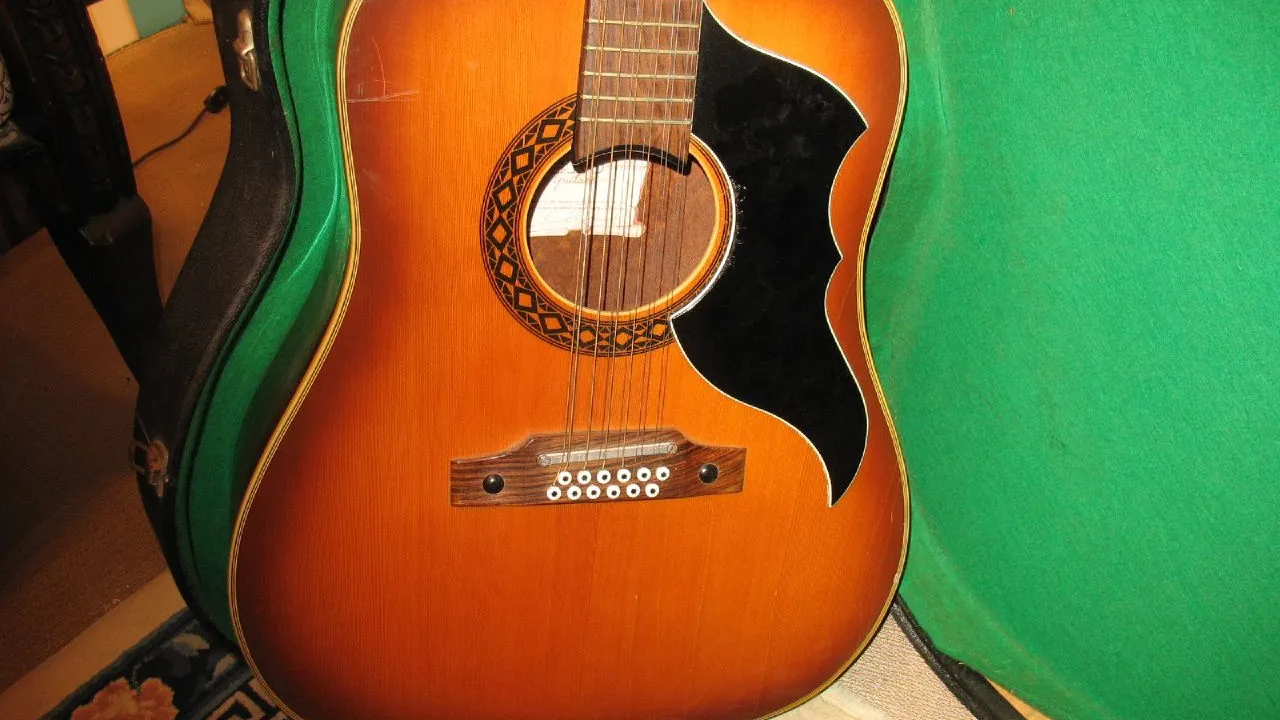
Smooth plate protecting wood from pick scratches
pick
Small flat triangle held to pluck strings
🪝
Why is a smooth shield glued right below the soundhole on most steel-string acoustic guitars?
1
Campfire Ring and Sparkle
Tap a tiny flat across six tight steel strings, and a bright wave of music fills the whole room! Unlike electric guitars that need cables, an acoustic guitar uses pure wood and trapped air to project its voice.
2
Metal Frets Along the Neck
Along the smooth wooden neck sit thin metal strips called , spaced carefully from wide to narrow. Pressing a string behind a fret shortens the part that wiggles, making the note jump higher!
3
Bridge, Guard, and Hollow Box
Six pins hold the strings into a wooden bridge glued on the spruce top, while a smooth protects the wood from energetic strumming. Inside the hollow body, bouncing air turns quiet string hums into rich songs.
1. What happens to a guitar note when you press a string closer to the body?
2. What job does the pickguard do on the front of an acoustic guitar?
🤯 Mind-Blowing Fact • Grade 3
In 1916, guitar makers named their biggest, booming acoustic body shape the Dreadnought after the giant British battleships of the era!
✨ Word Sparks (Grade 3 Glossary)
Tap 🔊 to hear
luthier
Craftsperson who builds or repairs stringed instruments
X-bracing
Crossed wood strips strengthening a guitar top
saddle
Hard strip on bridge supporting guitar strings
🪝
How does a paper-thin spruce top survive over one hundred fifty pounds of steel-string pull without snapping?
1
A Portable Wooden Stage
What would happen if you stretched six steel wires across a thin wooden lid and plucked them with a plectrum? Shimmering acoustic waves burst from the round soundhole, filling porches, studios, and concert halls with ringing warmth!
2
Secret X-Bracing Inside
Six steel strings pull forward with more than one hundred fifty pounds of tension—enough force to warp plain thin wood. glue crisscrossed strips of spruce called underneath the soundboard so it stays strong yet flexible enough for crisp vibration.
3
From Saddle to Resonance
Alone in open air, a thin vibrating string pushes almost no air molecules. Crossing a hard bone set into the bridge, string energy pumps the broad soundboard up and down, awakening rich resonance inside the hollow chamber.
4
Frets and Four Octaves
Metal frets divide the fingerboard into exact half-step pitches across nearly four octaves. Whether players strum bright folk chords or pluck delicate fingerstyle melodies, bronze-wound bass strings and plain steel trebles blend into balanced harmony.
1. Why does a vibrating steel string need a wooden soundboard to be heard clearly across a room?
2. What hidden feature underneath the top lets an acoustic guitar handle heavy steel-string tension?
🤯 Mind-Blowing Fact • Grade 4
Luthiers often shave small curves out of the internal wooden X-braces with a chisel—a craft called scalloping—tuning the bare top by tapping it with a knuckle and listening to its ring!
✨ Word Sparks (Grade 4 Glossary)
Tap 🔊 to hear
truss rod
Steel bar inside neck resisting string pull
tonewood
Selected wood prized for musical acoustic qualities
overtones
Higher faint pitches blending into one note
🪝
Why did switching from gentle gut strings to bright steel wires force nineteenth-century guitar builders to reinvent the guitar from the inside out?
1
Bright Metallic Ring, Warm Wooden Soul
Sweep a pick from the lowest bronze-wound E string up to the slenderest plain steel high E, and the air shimmers with crisp harmonic sparkle backed by chest-warming bass. Unlike classical nylon guitars or amplified electrics, the flat-top steel-string acoustic guitar acts as a self-contained mechanical loudspeaker.
2
Christian Martin's Structural Revolution
Early nineteenth-century guitars used low-tension animal gut strings over delicate fan-braced tops. After German-trained luthier Christian Frederick Martin immigrated to America in 1833, he engineered intersecting spruce struts underneath the soundboard known as X-bracing. Decades later, when loud country, blues, and Hawaiian ensembles demanded piercing steel strings pulling nearly one hundred seventy pounds of tension, Martin's X-brace proved strong enough to resist collapse.
3
Helmholtz Air Pump and Tonewoods
Every pluck triggers two partners working together. String vibrations rock the bone saddle and rosewood bridge, flexing the lightweight Sitka spruce top like a speaker cone, while trapped air inside the chamber bounces through the round soundhole like blowing across a bottle—an effect physicists call Helmholtz resonance that boosts deep low notes. Mahogany backs emphasize punchy midrange, whereas rosewood enriches shimmering .
4
Truss Rods and Body Voices
Inside the slender wooden neck runs an adjustable steel that counteracts forward string pull. From compact parlor guitars prized by fingerpickers to wide-waisted Dreadnought and Jumbo models built to cut through banjos and fiddles, body geometry shapes each instrument's voice.
1. Who pioneered the internal X-bracing design in nineteenth-century America that later made steel-string acoustic guitars possible?
2. What keeps the long wooden neck of a steel-string guitar from bowing forward under constant string pull?
🤯 Mind-Blowing Fact • Grade 5
To find the exact spot for each guitar fret, luthiers divide the remaining string length by 17.817—a centuries-old mathematical ratio close to the twelfth root of two that keeps chords in tune across every key!
✨ Word Sparks (Grade 5 Glossary)
Tap 🔊 to hear
Helmholtz resonance
Low booming tone of air inside cavities
quarter-sawn
Wood cut so grain lines stand vertical
impedance
How strongly a material resists vibration transfer
🪝
How do crossed spruce struts, bronze-wrapped steel cores, and a coupled air cavity transform finger energy into nearly four octaves of unamplified projection?
1
Self-Contained Acoustic Transducer
Strike an open E-major chord across six steel strings—spanning from low E2 at 82.4 hertz up to high E4 at 329.6 hertz, with fretted melodies climbing past E6 at 1,318.5 hertz—and witness pure mechanical matching in action. Classified organologically as a fretted flat-top box lute, the steel-string acoustic guitar converts concentrated wire kinetic energy into wide-band sound waves without consuming a single watt of electricity.
2
Tensile Forces and Scalloped X-Bracing
Standard light-to-medium steel string sets—combining high-carbon plain steel trebles with hexagonal steel cores wrapped in 80/20 bronze or phosphor-bronze wire—impose roughly 700 to 800 newtons of cumulative tension between headstock tuners and bridge pins. Pioneered in the 1840s by German-American luthier Christian Frederick Martin, an intersected sub-soundboard lattice of Sitka or Adirondack spruce called X-bracing distributes shear stress while permitting scalloped outer wings of the two-to-three-millimeter soundboard to flex.
3
Coupled Plate Modes and Helmholtz Resonance
Acoustic projection below 250 hertz relies on coupled oscillators: the vibrating top plate compresses and rarefies air trapped within the mahogany or Indian rosewood body, pumping an air piston through the circular soundhole at its frequency around 95 to 110 hertz. Above that bass region, complex dipole and multipole bending modes across the bridge plate and lower bout radiate crystalline harmonic partials that give steel strings their unmistakable bell-like sustain.
4
Equal-Tempered Frets and Ergonomic Evolution
Nineteen to twenty nickel-silver frets inlaid along an ebony or rosewood fingerboard follow the twelfth-root-of-two spacing ratio, dividing each octave into twelve equal semitones while a compensated bone saddle corrects pitch sharpening caused by string stretching. By 1916, C. F. Martin & Co. introduced the broad-shouldered Dreadnought body, maximizing air volume so acoustic rhythm guitarists could hold their own beside roaring banjos and fiddles.
5
Cornerstone of Global Vernacular Music
Across the twentieth and twenty-first centuries, this resilient wooden marvel anchored Delta blues slide playing, Appalachian flatpicking, Celtic DADGAD alternate tunings, singer-songwriter folk revivals, and modern percussive fingerstyle—where virtuosos simultaneously tap bass drums on the soundboard, snap snare accents on the ribs, and weave contrapuntal melodies on a single six-string stage.