1. How many strings does a standard bass guitar have?
2. Which bandmate works closest with the bass guitar to keep the beat steady?
🤯 Mind-Blowing Fact • Grade 2
A bass guitar sounds one full octave lower than the bottom four strings of an ordinary six-string guitar!
✨ Word Sparks (Grade 2 Glossary)
Tap 🔊 to hear
octave
Musical span of eight scale notes apart
horizontal
Held sideways across rather than straight upright
rhythm
Pattern of beats moving music through time
🪝
How did shrinking a giant six-foot upright bass into a guitar shape help traveling bands?
1
Deep Notes Over Your Shoulder
Pluck one heavy coiled string with two walking fingers, and a warm low pulse fills your chest! Before the electric bass guitar arrived, bass players had to wrestle an upright bass as big as a refrigerator into tiny cars.
2
Why the Word Precision?
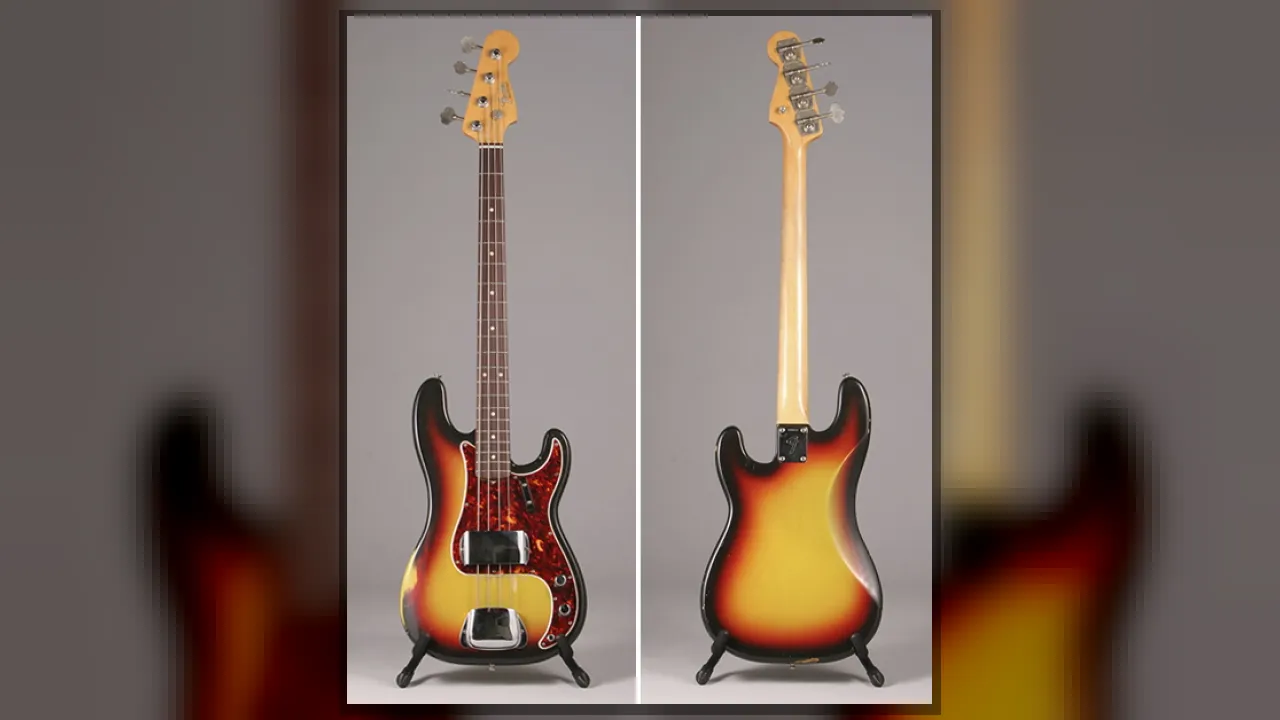
In 1951, inventor Leo Fender built a solid-body bass worn horizontally on a shoulder strap with shiny metal frets along its long neck. Those frets helped musicians play every low note cleanly in tune, while magnetic pickups made it loud enough to match drums!
3
Fingers, Picks, and Thumbs
Most bassists alternate their pointer and middle fingers like tiny walking legs across the strings. Funk players even bounce their thumb against low strings for a snappy, popping beat!
1. Why did metal frets on the 1951 electric bass help players so much?
2. How low are the four strings on a bass guitar tuned compared with a regular guitar's bottom four strings?
🤯 Mind-Blowing Fact • Grade 3
Motown legend James Jamerson played hundreds of famous soul hits using just ONE right-hand pointer finger he nicknamed 'The Hook'!
✨ Word Sparks (Grade 3 Glossary)
Tap 🔊 to hear
scale length
Vibrating string distance between nut and bridge
flatwound
Bass string wrapped in smooth flat ribbon
oscillation
Steady back-and-forth swinging motion of strings
🪝
Why does a bass guitar need both thicker strings and a longer neck than an electric guitar?
1
The Glue Inside Every Band
What would happen if the bass player suddenly stopped playing in the middle of your favorite song? Instantly the floor drops out—because the bass guitar locks the drummer's rhythm directly to the guitarist's chords!
2
Long Scale and Heavy Coils
To vibrate slowly enough for deep pitches without hanging loose like cooked spaghetti, bass strings need extra length and mass. Most bass necks measure thirty-four inches from nut to bridge—nearly nine inches longer than many electric guitars—carrying thick steel cores wrapped in nickel wire.
3
Pickups and Big Speakers
Because a solid alder or ash body has no hollow acoustic chamber, magnetic pickups sense the slow of the heavy strings. Strong amplifiers push big speaker cones to move waves of low-frequency air across the room.
4
Roundwound Zing or Flatwound Warmth
Ridged roundwound strings deliver bright rock and funk punch, while smooth ribbon-wrapped strings create the warm, mellow thump heard on classic Motown soul records.
1. What would happen if you tuned short, thin guitar strings down to bass guitar pitches?
2. Which string style gives classic soul records a smooth, warm, thumpy bass sound?
🤯 Mind-Blowing Fact • Grade 4
When funk pioneer Larry Graham's band lost its drummer in the late 1960s, he invented slap-and-pop bass by thumping low strings like a kick drum and plucking high strings like a snare!
✨ Word Sparks (Grade 4 Glossary)
Tap 🔊 to hear
intonation
Playing musical pitches accurately right in tune
split-coil
Two-halved bass pickup canceling electrical hum
syncopation
Accenting lively off-beats between main steady beats
🪝
How did Seattle inventor Paul Tutmarc and California builder Leo Fender solve the rhythm-section crisis of the mid-twentieth century?
1
Where Rhythm Meets Harmony
Listen beneath the vocals and sparkling guitar solos of almost any modern song, and you will hear a muscular pulse outlining every chord change on the beat. Sitting squarely between percussion and melody, the electric bass guitar defines both when your head nods and how the harmony feels.
2
From Seattle Prototypes to 1951 Breakthrough
As dance bands grew louder in the 1930s, acoustic double basses struggled to be heard and filled whole station wagons on tour. Around 1935 in Seattle, inventor Paul Tutmarc built the Audiovox Model 736—the first fretted solid-body electric bass held horizontally. Sixteen years later, Leo Fender and George Fullerton refined that concept for mass production with the 1951 Fender Precision Bass, naming it 'Precision' because twenty metal frets guaranteed accurate .
3
Split-Coil Pickups and String Physics
Stretching thirty-four inches from nut to heavy steel bridge saddles, four strings tuned E1–A1–D2–G2 balance high tension against dense wire mass. In 1957, Fender introduced a staggered two-piece pickup—one half under E and A, the other under D and G—canceling electrical hum while keeping every string punchy and articulate.
4
Slap, Pop, and Fretless Innovation
Soon bassists pushed far beyond simple root notes. Funk pioneer Larry Graham invented percussive 'slap-and-pop' playing—striking low strings with his thumb like a bass drum and snapping high strings like a snare—while jazz visionary Jaco Pastorius pried the frets off his bass neck to sing lyrical melodies and harmonics.
1. Who built the pioneering 1935 Audiovox Model 736 horizontal fretted electric bass in Seattle?
2. How did jazz bassist Jaco Pastorius achieve smooth, vocal-like sliding notes on an electric bass?
🤯 Mind-Blowing Fact • Grade 5
Studio bassist Carol Kaye played iconic picked basslines on an estimated ten thousand recording sessions in the 1960s and 1970s—making her one of the most recorded musicians in history!
Why does reproducing a 41.2-hertz fundamental on a strap-held solid-body instrument require precise trade-offs among scale length, linear mass density, and amplifier wattage?
1
Sub-Octave Anchor of Modern Ensembles
Pluck an open E1 string oscillating at 41.2 hertz—or drop to B0 at 30.9 hertz on an extended-range five-string model—and feel dense low-frequency pressure lock kick drum to harmonic progressions. Classified as a solid-body electromechanical contrabass chordophone, the bass guitar sounds one octave below written bass-clef notation on four-string standard tuning (E1–A1–D2–G2), matching the orchestral double bass pitch for pitch.
2
Mersenne's Laws and the 34-Inch Scale
According to of vibrating strings, halving fundamental frequency requires either doubling string length, quadrupling linear mass density, or reducing tension to a quarter. To keep the instrument playable on a shoulder strap without sluggish, inharmonic thick cables, Leo Fender standardized an 864-millimeter (34-inch) scale length paired with multi-layer nickel- or stainless-steel-wound strings exerting roughly 700 to 800 newtons across a truss-rod-reinforced bolt-on maple neck.
3
Historical Evolution of Pickup Topologies
Building upon Paul Tutmarc's mid-1930s Seattle Audiovox 736 prototype, Fender's 1951 Precision Bass evolved in 1957 to incorporate a staggered split-coil humbucking pickup for warm midrange authority. Three years later, the 1960 Jazz Bass introduced a narrower nut and dual single-coil pickups—reverse-wound to cancel hum when blended—unlocking scooped midrange clarity and articulate bridge-pickup growl.
4
Active Preamps and High-Headroom Amplification
Because human hearing loses sensitivity at low frequencies (as mapped by Fletcher-Munson equal-loudness contours), bass amplifiers require several times the wattage and speaker cone excursion of lead-guitar amps to sound equally present. Many modern instruments house onboard battery-powered active , letting players sculpt bass, midrange, and treble equalization right from the control plate.
5
Virtuosos Who Redefined the Low End
From Carol Kaye's crisp picked studio lines on thousands of pop recordings and James Jamerson's syncopated Motown counterpoint to Larry Graham's percussive thumb-slap funk, Jaco Pastorius's singing fretless harmonics, and contemporary six-string soloists, the electric bass transformed from a portable upright substitute into a fearless expressive voice.