1. How does sweat cool your body down on a hot day?
2. Does brand-new sweat coming out of your skin smell stinky by itself?
🤯 Mind-Blowing Fact • Grade 2
The soles of your feet and palms of your hands hold more sweat glands per inch than anywhere else on your body!
✨ Word Sparks (Grade 2 Glossary)
Tap 🔊 to hear
gland
a small organ that makes helpful body liquid
thermostat
a controller that keeps temperature steady and safe
evaporate
dry up from liquid into invisible gas
🪝
Why do dogs pant with their tongues out while humans sweat from head to toe?
1
Millions of Coiled Tubes
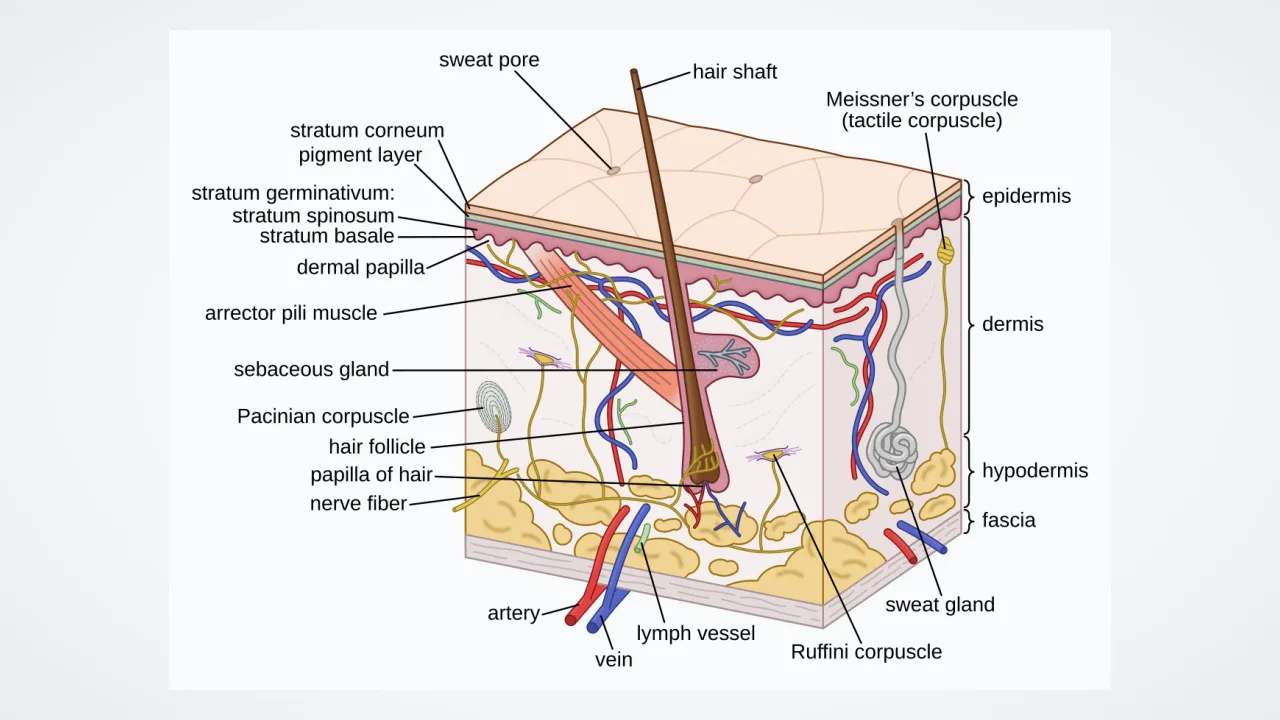
Pedal a bicycle up a steep hill on a warm afternoon! Tucked inside your middle skin layer sit two to four million tiny coiled tubes called sweat . Humans have far more skin sweat glands than furry dogs or cats.
2
Your Brain's Thermostat
A temperature sensor inside your brain notices whenever your blood warms above normal. Right away, it signals your sweat to pump out sweat—a mix that is ninety-nine percent water plus a pinch of salt.
3
Evaporation Magic
Each drop spreads across your warm skin and into the air, cooling you off. Remember to drink plenty of water afterward to refill what you sweated out!
2. Why is it super important to drink water when you sweat a lot?
🤯 Mind-Blowing Fact • Grade 3
Because humans shed thick fur and evolved millions of eccrine sweat glands, endurance runners on a hot day can outlast horses over marathon distances!
✨ Word Sparks (Grade 3 Glossary)
Tap 🔊 to hear
hypothalamus
brain center that regulates body heat and thirst
eccrine
main watery sweat gland cooling all skin
sodium chloride
scientific name for ordinary salt in sweat
🪝
Why do your palms get clammy right before you step onto a stage or take a big penalty kick?
1
Guided by the Hypothalamus
Lace up your sneakers for a summer soccer match! Deep inside your brain, an almond-sized control hub called the watches your core temperature like a hawk. If your body creeps even half a degree above 98.6°F (37°C), nerves command millions of dermal sweat glands into action.
2
Eccrine Glands Everywhere
Most of your glands are sweat glands, coiled like tangled yarn balls in the dermis with narrow ducts spiraling up to surface pores. They release clear fluid rich in water and —the exact reason sweat tastes salty if a drop trickles near your lip.
3
Nervous Palm Sweat for Grip
Ever notice sweaty palms before a recital? Excitement or nerves trigger a tiny burst of moisture on palms and soles—an ancient reflex that actually boosts skin friction so hands grip tree branches or sports gear tighter!
4
Apocrine Glands Later On
A second kind, called apocrine glands, opens into hair follicles in the underarms starting around the teen years, releasing thicker droplets that skin bacteria turn into body odor.
1. Which part of your brain acts as a thermostat to turn on sweat glands?
2. How can a tiny bit of nervous sweat on your palms actually help you?
🤯 Mind-Blowing Fact • Grade 4
During intense summer athletics, human sweat glands can produce over one to two liters of cooling sweat in a single hour!
✨ Word Sparks (Grade 4 Glossary)
Tap 🔊 to hear
vaporization
phase change turning liquid water into vapor
humidity
amount of water vapor already floating in air
electrolytes
dissolved mineral salts helping nerves and muscles fire
🪝
Why does an 85°F day feel cool in dry desert air, yet sticky and exhausting in humid swamp air?
1
Physics of Evaporative Cooling
Splash warm water onto one arm and wave it in the air—instantly, the wet skin feels degrees cooler than your dry arm! That chill comes from latent heat of . For liquid sweat molecules to break free as invisible water vapor, they must absorb heat energy directly from your epidermis and the dilated blood capillaries pulsing right beneath it.
2
Why High Humidity Slows the System
Notice that merely dripping sweat onto the floor does not cool you—the sweat has to evaporate! In dry desert air, sweat vaporizes almost immediately, whisking heat away fast. On a muggy summer afternoon when air is already saturated with moisture, evaporation stalls, leaving sweat beading on your skin while your body struggles to shed heat.
3
Salt Recycling Inside the Duct
Look closely at a single eccrine gland under a microscope and you will spot two clever parts: a secretory coil deep in the dermis and a straight duct climbing upward. As raw salty fluid travels up the duct, lining cells pump much of the precious sodium and chloride ions back into your bloodstream so you do not lose too many !
4
Athletic Heat Acclimation
Practice sports outdoors for two weeks and your sweat glands actually train up—starting to sweat sooner and recycling even more salt so your muscles resist cramping.
1. Why do you feel much hotter on a humid day than on a dry day at the exact same temperature?
2. What clever recycling job happens as sweat climbs up the eccrine gland duct?
🤯 Mind-Blowing Fact • Grade 5
Human sweat contains a natural antibiotic peptide called dermcidin, which punches microscopic holes in harmful invading bacteria right on your skin's surface!
✨ Word Sparks (Grade 5 Glossary)
Tap 🔊 to hear
hypotonic
having lower salt concentration than body blood
thermoregulation
physiological control keeping internal body temperature steady
dermcidin
germ-fighting protein naturally secreted inside human sweat
🪝
How do three million microscopic coiled tubules dissipate hundreds of watts of metabolic heat without boiling a single cell?
1
Thermoregulatory Champions of Mammalia
When you sprint hard, contracting skeletal muscles convert roughly seventy-five percent of burned fuel directly into thermal energy—enough heat to raise core body temperature to dangerous levels within twenty minutes if trapped inside. While furry mammals rely largely on panting, humans possess an unmatched cutaneous cooling grid: two to four million eccrine sweat glands distributed across nearly every square centimeter of skin, reaching peak densities above six hundred glands per square centimeter on palms and soles.
2
Two-Stage Secretion and Ion Conservation
Each eccrine gland consists of a coiled secretory acinus nestled in the deep dermis or upper subcutis, wrapped by contractile myoepithelial cells. Prompted by sympathetic cholinergic neurons activated by the preoptic hypothalamus, secretory clear cells pump sodium and chloride ions into the lumen, drawing water osmotically from surrounding capillaries. As this isotonic primary fluid ascends the spiraling intraepidermal duct (acrosyringium), epithelial ion channels—including CFTR channels—reclaim sodium and chloride, delivering sweat (99 percent water, trace urea, lactate, and antimicrobial peptides) to the skin surface.
3
Thermodynamics of Latent Heat
Evaporating just one gram of sweat consumes approximately 2,420 joules (580 calories) of thermal energy, chilling blood coursing through dilated superficial dermal plexuses before it returns to cool internal organs.
4
Eccrine, Apocrine, and Microbiome Chemistry
Unlike universal eccrine glands that function from birth, larger apocrine glands in axillary regions awaken at puberty, secreting lipid-rich droplets into hair follicles that resident Corynebacterium microbes metabolize into volatile odor compounds.
5
Medical Clues Hidden in a Drop of Sweat
In 1953, pediatrician Paul di Sant'Agnese noticed during a New York heat wave that children with cystic fibrosis lost abnormally salty sweat due to faulty CFTR chloride channels—leading to the painless pilocarpine sweat test still used worldwide for early medical diagnosis.