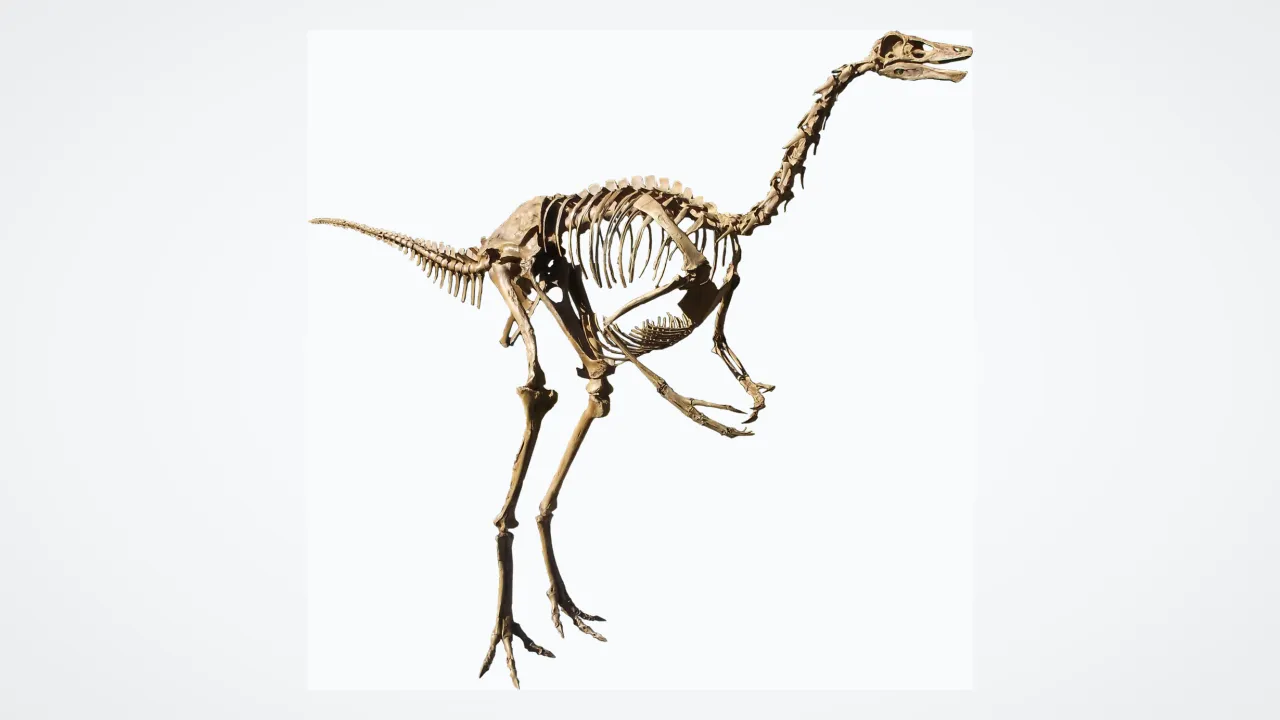
1. How many teeth did Struthiomimus have inside its beak?
2. How did Struthiomimus use its long, stiff tail?
🤯 Mind-Blowing Fact • Grade 2
All three fingers on each hand of Struthiomimus were almost the exact same length, turning its hands into giant branch hooks!
✨ Word Sparks (Grade 2 Glossary)
Tap 🔊 to hear
omnivore
an animal that eats both plants and meat
plumage
the layer of feathers covering a body
balance
staying steady on your feet without tipping over
🪝
Why did scientists name this speedy dinosaur the 'ostrich mimic'?
1
A Dinosaur Dressed Like a Bird
Picture an ostrich with a long dinosaur tail and clawed hands! Struthiomimus raced across ancient North America on two powerful legs. Fluffy feathers covered its body and arms like a soft coat.
2
Hooked Hands for Snacking
Each hand had three long fingers tipped with curved claws. Unlike fierce hunters, it used those hooks to pull leafy branches down to its toothless beak. It ate plants, seeds, insects, and small lizards.
3
Safety in Speed
Big eyes sat on the sides of its small head to watch for danger. When a hungry tyrannosaur crept near, Struthiomimus bolted away faster than a galloping racehorse!
2. What did Struthiomimus likely do with its three-fingered clawed hands?
🤯 Mind-Blowing Fact • Grade 3
Struthiomimus had shin bones longer than its thigh bones—the exact leg design seen in Earth's fastest sprinting animals today!
✨ Word Sparks (Grade 3 Glossary)
Tap 🔊 to hear
gastroliths
swallowed stones that help grind food inside stomachs
floodplain
flat land beside a river that sometimes floods
stride
one long step taken while walking or running
🪝
How could a dinosaur from the meat-eater family thrive without a single tooth?
1
Footsteps on the Floodplain
Sunlight filters through tall redwood trees in Late Cretaceous Canada as a flock of slender dinosaurs trots along a riverbank. Suddenly, a twig snaps! Heads pop up on long, curving necks, and the whole group rockets across the plain at over forty miles per hour.
2
Secrets of a Sprinter's Legs
Paleontologists know Struthiomimus was a champion runner just by measuring its leg bones. Its shin bone was noticeably longer than its thigh bone, and its foot bones were tightly pressed together to absorb shock on every giant .
3
Feathers and Strange Hands
Close relatives of Struthiomimus left fossil impressions of downy body feathers and long wing-like arm plumes. Its hands looked puzzling too, with three fingers of equal length that could not grasp like a thumb, acting instead like sloth-style hooks.
4
An All-Around Menu
Because it lacked teeth to chew tough plants, Struthiomimus likely swallowed small pebbles called . Inside its muscular stomach, those stones ground up seeds, shoots, beetles, and tiny amphibians.
1. Which bone clue proves that Struthiomimus was built for high-speed running?
2. How could a toothless Struthiomimus mash up tough seeds and plants?
🤯 Mind-Blowing Fact • Grade 4
Struthiomimus possessed special shock-absorbing foot bones where the middle ankle bone was pinched tightly between the outer two to act like a natural running spring!
✨ Word Sparks (Grade 4 Glossary)
Tap 🔊 to hear
theropod
a two-legged dinosaur group with hollow bones
vigilance
careful watching to spot danger right away
velocity
how fast something moves in a direction
🪝
What happens when evolution takes a fierce theropod body plan and rebuilds it into a speed-obsessed omnivore?
1
A Blur Across Ancient Alberta
Imagine standing beside a winding river in Alberta seventy-five million years ago when a herd of feathered, long-legged dinosaurs bursts from the horsetail reeds. Moving in synchronized leaps, each fourteen-foot Struthiomimus holds its neck in a graceful S-curve while its rigid tail streams behind like a tightrope walker's pole.
2
Biomechanical Engineering for Speed
Every part of the Struthiomimus skeleton was tuned to reduce weight and maximize . Hollow, air-filled bones kept its body around three hundred thirty pounds—roughly the mass of a modern adult ostrich. Three central foot bones fused into a spring-loaded structure called an arctometatarsus, returning elastic energy with every push off the ground.
3
Puzzling Forelimbs and Wing Fans
Although its legs screamed speed, its arms were surprisingly long and strong. Fossilized quill marks on fellow ornithomimids show broad pennaceous feathers lining the forearms. Too heavy to fly, Struthiomimus probably flashed these feathered fans during courtship displays or draped them over clutches of eggs to shield unhatched chicks from sun and rain.
4
Watchful Life on the Edge
Sharing forests with ambush predators like Gorgosaurus and Daspletosaurus meant constant . Large eye sockets housed keen eyes with wide side-to-side vision, while fossils of multiple individuals preserved together suggest Struthiomimus traveled in alert flocks where many eyes spotted danger early.
1. Why did Struthiomimus likely have broad feathers along its long forearms if it could not fly?
2. How did hollow bones and pinched middle foot bones help Struthiomimus survive?
🤯 Mind-Blowing Fact • Grade 5
Rare soft-tissue fossils of close Struthiomimus relatives reveal tiny comb-like ridges lining the inside of their beaks, allowing them to strain tiny water plants and invertebrates much like modern ducks!
✨ Word Sparks (Grade 5 Glossary)
Tap 🔊 to hear
convergent evolution
unrelated species evolving similar traits for similar jobs
pneumatic
filled with air pockets that reduce bone weight
keratinous
made of tough fingernail-like protein material
🪝
Why did two completely unrelated branches of life—Cretaceous dinosaurs and modern African ostriches—invent almost identical bodies tens of millions of years apart?
1
Convergent Evolution in Action
Step onto the lush coastal floodplains of Late Cretaceous Laramidia seventy-five million years ago, and you might swear an ostrich just sprinted past the gingko trees—until you spot its long, feathered tail and three-clawed hands. Struthiomimus altus is a textbook masterpiece of , demonstrating how distant lineages independently evolve remarkably similar anatomy to solve the same ecological challenges.
2
From Fossil Puzzle to Famous Skeleton
Canadian paleontologist Lawrence Lambe first described fragmentary remains from Alberta in 1902 as Ornithomimus altus. Fifteen years later, in 1917, Henry Fairfield Osborn studied a spectacularly complete skeleton unearthed along the Red Deer River and established the new genus Struthiomimus, Greek for 'ostrich mimic.' Because its delicate bones preserved so cleanly in Dinosaur Park Formation sandstones, Struthiomimus became one of science's clearest windows into ornithomimid anatomy.
3
High-Speed Locomotion Mechanics
Measuring roughly 4.3 meters (14 feet) from beak to tail tip yet weighing only about 150 kilograms (330 pounds), Struthiomimus combined vertebrae with elongated distal limb segments. Its tibia exceeded its femur in length, and its third metatarsal narrowed sharply toward the ankle—an adaptation called the arctometatarsalian condition that distributed impact stress and prevented ankle twisting at speeds estimated between 50 and 80 kilometers per hour.
4
Keratinous Rhamphotheca and Dietary Clues
CT scans and rare soft-tissue impressions from ornithomimid skulls reveal that a ridged sheath, or rhamphotheca, covered its toothless jaws. Inside that beak, tiny comb-like ridges could strain seeds, aquatic plants, and small invertebrates from shallow ponds, while its unusual equal-length metacarpals formed a rigid grappling hook for browsing low shrubs.
5
Thriving Until the End of an Era
Fossils spanning more than ten million years show that Struthiomimus and its close kin remained abundant across western North America right up to the Cretaceous-Paleogene boundary. By trading carnivore fangs for omnivorous flexibility, flock awareness, and blistering acceleration, this swift theropod carved out one of the Mesozoic Era's most enduring success stories.