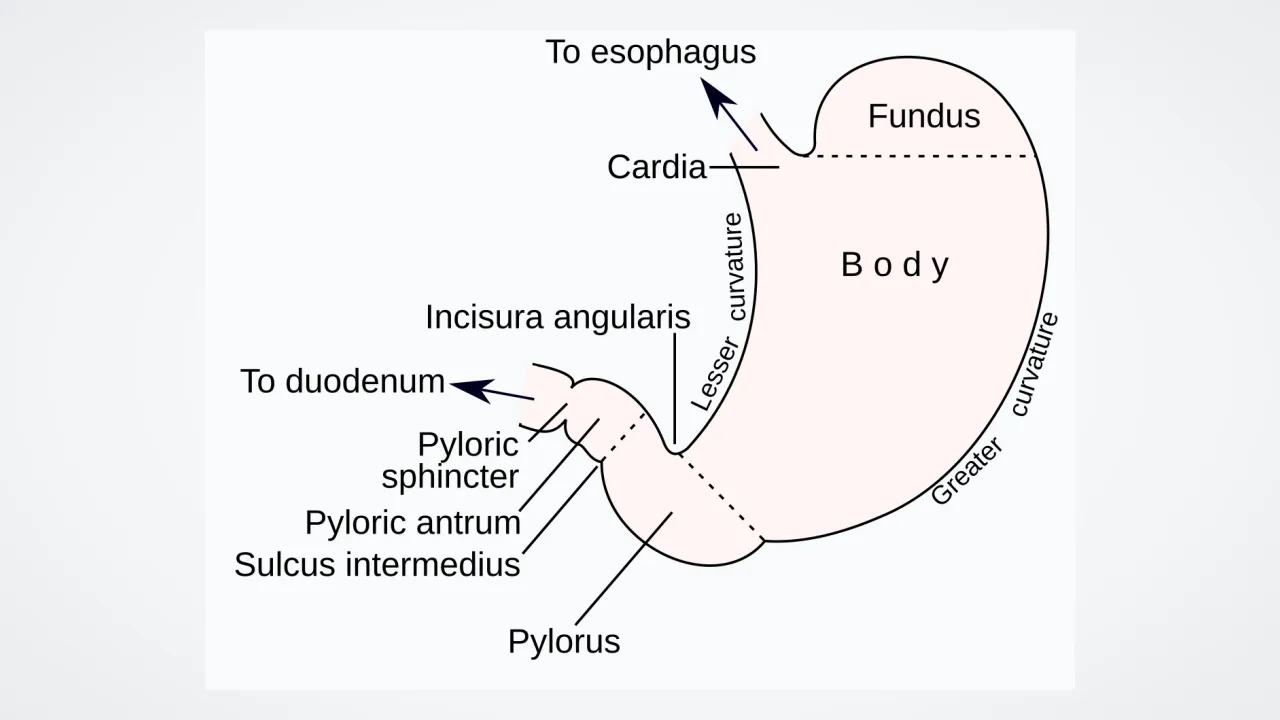
1. What keeps strong stomach acid from hurting the inside wall of your own stomach?
2. Besides mashing food into soup, what helpful safety job does stomach acid perform?
🤯 Mind-Blowing Fact • Grade 2
Pure stomach acid is sourer than vinegar or lemon juice—ranking right near battery acid on the science pH scale!
✨ Word Sparks (Grade 2 Glossary)
Tap 🔊 to hear
Churn
To mix, tumble, and stir around strongly
Pepsin
Stomach enzyme that snips protein foods apart
Gastric
Medical word meaning related to the stomach
🪝
How does your tummy turn a crunchy sandwich and an apple into smooth energy soup?
1
A Muscular Mixing Bowl
Gurgle, squish! Your J-shaped stomach is a stretchy muscular bag with three layers of muscle churning in every direction. As soon as food drops in, millions of tiny pits in the stomach wall spray out clear juice containing hydrochloric acid.
2
Waking Up Sleeping Scissors
Acid does not work alone! It wakes up a sleeping helper protein called , which acts like tiny scissors to snip meat, eggs, and beans into smaller building blocks.
3
Baking-Soda Mucus Shield
Meanwhile, neighbor cells coat the stomach wall in thick mucus mixed with natural baking-soda chemicals—canceling out any acid that gets too close!
1. Which helper enzyme wakes up inside stomach acid to snip proteins like eggs and beans apart?
2. How many muscle layers wrap your stomach to churn meals thoroughly?
🤯 Mind-Blowing Fact • Grade 3
Even while acid inside your stomach churns at a fiery-sour pH 2, the cells right underneath your mucus-bicarbonate blanket sit calmly at neutral pH 7!
✨ Word Sparks (Grade 3 Glossary)
Tap 🔊 to hear
pH scale
Zero-to-fourteen number scale measuring acids and bases
Hydrochloric acid
Powerful natural acid made inside stomach pits
Chyme
Creamy soup-like mix leaving the churning stomach
🪝
Why does scientists' acid scale give strong stomach acid a tiny number like 1.5 instead of 10?
1
Understanding the pH Scale
Chemists measure how sour or acidic a liquid is on the from 0 to 14. Plain water sits right in the middle at neutral 7, while smaller numbers mean stronger acid! Lemon juice measures around pH 2.2, and your stomach's sits between 1.5 and 3.5—nearly a hundred thousand times more acidic than pure water!
2
Unfolding Tangled Proteins
Proteins in foods like chicken, tofu, or peanut butter arrive wound up like tight balls of yarn. unravels those tangled coils so the enzyme pepsin can reach inside and snip them into short chains! Acid also frees minerals like iron and calcium from food so your body can absorb them.
3
Making Chyme
After two to four hours of churning with acid and enzymes, solid lunch transforms into creamy liquid called , ready to squirt slowly into the small intestine.
4
Built-In Neutralizer Shield
Goblet-like mucus cells coat the stomach lining in alkaline gel packed with bicarbonate—keeping the cells underneath at a comfortable neutral pH 7!
1. On the 0-to-14 pH scale, what does a low number like 1.5 to 3.5 tell you about stomach juice?
2. How does hydrochloric acid help pepsin digest tough food proteins?
🤯 Mind-Blowing Fact • Grade 4
To avoid digesting themselves, stomach cells build protein-cutting enzymes with a built-in safety cap (pepsinogen) that only unlocks AFTER touching stomach acid!
✨ Word Sparks (Grade 4 Glossary)
Tap 🔊 to hear
Parietal cell
Stomach gland cell that pumps acid ingredients
Pepsinogen
Safety-locked enzyme before stomach acid activates it
Borborygmi
Funny scientific word for rumbling tummy growls
🪝
How can living stomach cells manufacture hydrochloric acid without burning themselves from the inside out?
1
Separate Ingredients Until Launch!
If a cell brewed finished hydrochloric acid (HCl) inside its own cytoplasm, the acid would wreck the cell immediately! Deep inside microscopic gastric glands, specialized solve this puzzle with brilliant chemical safety: they pump positively charged hydrogen ions (H+) and negatively charged chloride ions (Cl-) out through SEPARATE microscopic channels into a tiny extracellular canal! Only outside the cell do H+ and Cl- meet to form full-strength hydrochloric acid.
2
Why Pepsin Starts Out Locked
Neighboring 'chief cells' use a similar safety lock when making protein-cutting enzymes! If they built active pepsin inside themselves, pepsin would digest the chief cells' own proteins. Instead, chief cells secrete an inactive safety-capped version called . Only after pepsinogen floats out into hydrochloric acid does the acid snip off its safety cap—turning on active pepsin safely inside the mucus-shielded stomach cavity!
3
Three Phases of Acid Control
Your body avoids wasting energy making full acid all day long. Smelling pizza triggers brain nerves (the cephalic phase), food stretching your stomach triggers the hormone gastrin (the gastric phase), and chyme entering your small intestine sends brake signals to dial acid back down!
4
Loud Tummy Rumbles!
What about embarrassing stomach growls before lunch? Scientists call them —harmless housekeeping waves sweeping leftover air and juice through an empty stomach!
1. How do parietal cells brew hydrochloric acid without harming their own insides?
2. Why do chief cells secrete inactive 'pepsinogen' instead of ready-to-cut pepsin?
🤯 Mind-Blowing Fact • Grade 5
Parietal cells pump hydrogen ions against a 3-million-to-1 concentration gradient—the steepest ion pump anywhere in the human body!
✨ Word Sparks (Grade 5 Glossary)
Tap 🔊 to hear
Proton pump
ATP-powered protein machine exporting acid hydrogen ions
Intrinsic factor
Stomach protein needed to absorb vitamin B12
Gastrin
Hormone telling parietal cells to brew acid
🪝
Why did an Australian doctor drink a flask of bacteria in 1984—and win the Nobel Prize for overturning a century of stomach science?
1
Proton Pumps and the Alkaline Tide
Parietal (oxyntic) cells lining the fundus and body of the human stomach execute one of biology's steepest ion gradients: concentrating hydrogen protons (H+) roughly three million times higher inside the gastric lumen (pH ~1.5) than inside blood plasma (pH 7.4)! Powered by abundant mitochondria, H+/K+-ATPase '' exchange intracellular H+ (generated from CO2 and water via carbonic anhydrase) for luminal K+, while chloride ions exit separately into canaliculi. Meanwhile, leftover bicarbonate ions (HCO3-) enter venous blood—creating a measurable post-meal 'alkaline tide' that also supplies surface foveolar cells with acid-buffering armor!
2
Intrinsic Factor and Neuroendocrine Regulation
Acid secretion integrates three messengers acting on parietal cells: vagal acetylcholine, paracrine histamine from ECL cells, and endocrine from antral G-cells (counterbalanced by somatostatin from D-cells when pH drops below 2). Crucially, human parietal cells also secrete —a glycoprotein essential for absorbing vitamin B12 down in the ileum so bone marrow can manufacture healthy red blood cells!
3
Beaumont's Window Into Digestion
Until the 1820s, many physicians assumed stomach digestion was purely mechanical grinding! Working with fur trapper Alexis St. Martin—whose healed frontier stomach wound left a small permanent opening—army surgeon William Beaumont lowered silk-tied food morsels into gastric juice, proving in 1833 that hydrochloric acid chemically dissolves food.
4
Marshall, Warren, and Helicobacter pylori
For over a century, doctors insisted no bacterium could survive stomach acid and blamed stomach ulcers on spicy food or stress. In the early 1980s, Robin Warren and Barry Marshall discovered corkscrew-shaped Helicobacter pylori burrowing under mucus using acid-neutralizing urease enzymes! When skeptics doubted them, Marshall famously drank a culture of H. pylori in 1984, developed gastritis, and cured it with antibiotics—earning the 2005 Nobel Prize!
5
Modern Proton-Pump Pharmacology
Understanding parietal H+/K+-ATPase pumps and H2 histamine receptors enabled targeted acid-reducing medicines that let irritated gastric or esophageal linings heal rapidly.