1. What everyday container did inventors in Trinidad recycle to build the first steelpans?
2. How does bump size inside the metal bowl change the note you hear?
🤯 Mind-Blowing Fact • Grade 2
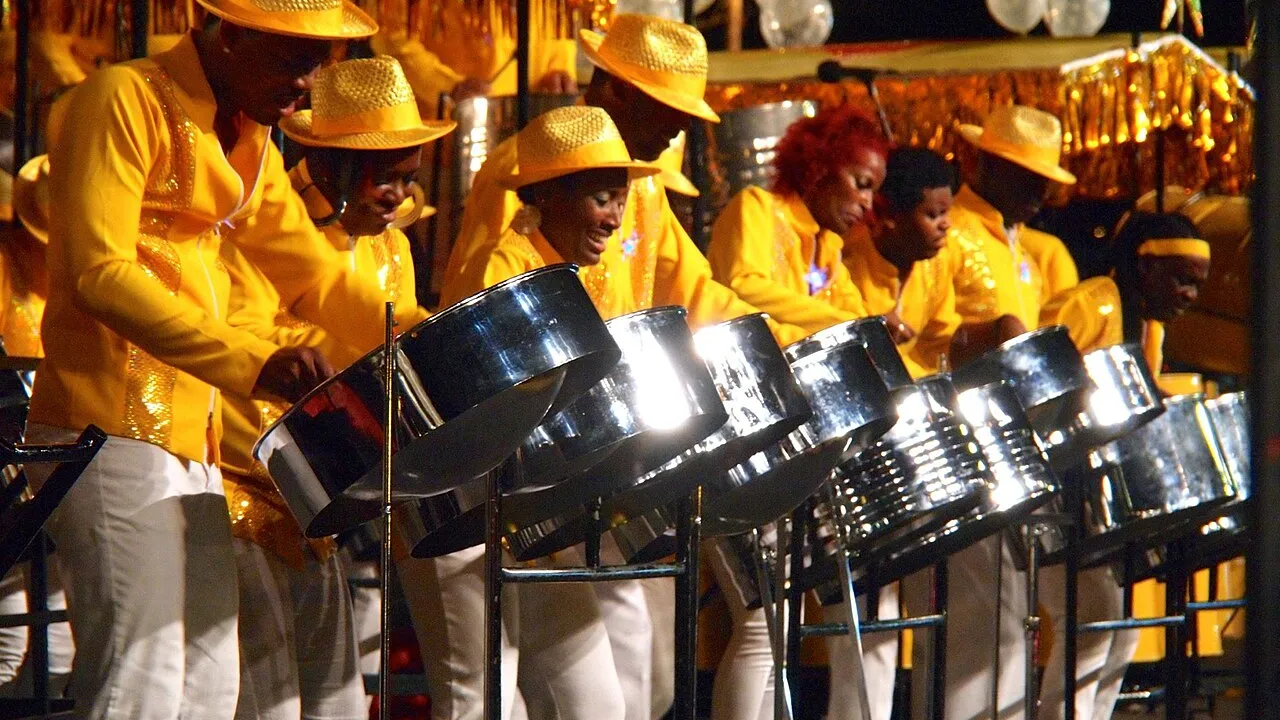
During Trinidad's famous Panorama competition, giant steelbands with over one hundred musicians perform thrilling ten-minute symphonies completely from memory!
✨ Word Sparks (Grade 2 Glossary)
Tap 🔊 to hear
concave
Curving inward like the inside of bowls
groove
Thin line chiselled around each metal note
melody
A sequence of notes making a tune
🪝
What would happen if you tuned twenty-nine different musical notes into one shiny steel bowl?
1
Music Born from Pure Creativity
Ting-a-ling, ding-dong! Across the twin islands of Trinidad and Tobago, joyful melodies float over a colorful Carnival parade. Dozens of gleaming silver bowls ring together like bells, harps, and organs all at once!
2
Sinking and Grooving the Pan
In the 1930s and 1940s, clever young Trinidadian musicians hammered the flat tops of discarded oil barrels downward into deep bowls. Next, they carved thin around oval bumps of different sizes, placing large bass notes around the outer ring and tiny high notes toward the middle.
3
Soft Tips for Sweet Chimes
If you hit bare steel with plain wood, it clanks harshly. Wrapping soft rubber around light bamboo or aluminum sticks lets each hammered bump bounce cleanly and sing with island warmth!
1. Why are steelpan sticks wrapped with soft rubber tips instead of left bare?
2. Where are the larger, lower-pitched note bumps usually placed inside a tenor steelpan?
🤯 Mind-Blowing Fact • Grade 3
Trinidadian pioneer Anthony Williams arranged the notes of the lead tenor pan in a clever circle-of-fifths 'spiderweb' pattern so neighboring notes always sound harmonious together!
✨ Word Sparks (Grade 3 Glossary)
Tap 🔊 to hear
idiophone
Instrument making sound when its body vibrates
chromatic
Musical scale including all twelve sequential pitches
temper
Heating and cooling metal to boost stiffness
🪝
Why do scientists say a steel drum is not actually a drum at all?
1
A Scientific Surprise in Shiny Chrome
Walk past a rehearsal yard in Port of Spain, Trinidad, and your ears meet a wall of shimmering tropical harmony. Visitors often call this instrument a steel drum, yet acousticians classify it as an —an instrument whose solid body vibrates without any stretched skin or strings!
2
From Bamboo Tubes to Oil Drums
After colonial laws banned African skin drums in Trinidad, Carnival paraders stamped hollow bamboo tubes called tamboo bamboo, then tested biscuit tins and paint cans before discovering fifty-five-gallon steel oil barrels. Innovators like Winston 'Spree' Simon and Ellie Mannette hammered smooth concave bowls holding every note of the scale.
3
Fire, Hammers, and Overtones
Building one pan takes remarkable physics: artisans sink the steel eight inches deep, chisel grooves to isolate each note zone, and heat the barrel over fire to stiffen the metal. Master tuners then tap each oval until its main pitch and higher overtones shimmer in tune.
4
A Full Steelband Orchestra
From soaring lead tenor pans down to sets of six giant floor-standing bass barrels, a steelband covers over four octaves—performing calypso, jazz, and classical masterpieces worldwide.
1. Why do musical scientists classify the steelpan as an idiophone rather than a membranophone?
2. Why do pan builders heat the hammered steel barrel over fire before final tuning?
🤯 Mind-Blowing Fact • Grade 4
To play the lowest notes in a steelband, a single bass player stands surrounded by six full-sized fifty-five-gallon barrels—called a Six-Bass—each holding just three giant, booming note domes!
✨ Word Sparks (Grade 4 Glossary)
Tap 🔊 to hear
convex
Curving outward like the back of spoons
harmonics
Higher companion frequencies ringing inside one note
sympathetic
Vibrating automatically when matching nearby notes ring
🪝
How did self-taught Afro-Trinidadian inventors engineer the twentieth century's only major new acoustic orchestra family?
1
Triumph of Ingenuity in Laventille
When carnival dawn breaks known as J'Ouvert in Port of Spain, waves of crystalline, bell-bright chords cascade down from the hills of Laventille. Remarkably, that lush orchestral sound rises from industrial fifty-five-gallon steel barrels once discarded near Trinidad's oil refineries and wartime naval bases! When British colonial authorities restricted skin drumming and later outlawed bamboo stamping tubes in the 1930s, Afro-Trinidadian youth refused to let their rhythms be silenced, turning scrap metal into Trinidad and Tobago's proud national instrument.
2
Sinking, Grooving, and Fire-Tempering
Transforming a flat barrel lid into a concert instrument demands immense skill and acoustic intuition. Using a heavy sledgehammer or rounded mallet, a builder stretches the 1.2-millimeter carbon-steel sheet downward nearly twenty centimeters into a smooth concave basin, thinning the metal as it expands. Next, a blunt punch scores narrow boundary grooves around twenty-eight to thirty-two upward-curving note facets, and controlled fire-tempering rearranges carbon atoms in the steel so those thin domes resist denting.
3
The Secret Shimmer of Sympathetic Harmonics
What gives a steelpan its unmistakable, sparkling warmth compared with a xylophone or bell? Inside every single note facet, a master tuner hammers both the fundamental pitch and two higher —usually one octave above and a musical fifth higher—right into the same metal oval! Striking one note also wakes up vibrations in neighboring octave facets across the bowl.
4
From Tenor Leads to Six-Bass Giants
Modern steelbands cut barrel skirts to varying lengths: shallow chrome-plated tenor pans sparkle on high melodies, mid-skirted double seconds weave rich chords, and towering sets of six full-length barrels thunder out bass lines as low as an orchestra's double bass. In 2023, the United Nations proclaimed August 11 as World Steelpan Day to celebrate this Caribbean marvel!
1. How does a master pan tuner give each individual note facet its rich, shimmering tone?
2. How does barrel skirt length affect the voices inside a full steelband?
🤯 Mind-Blowing Fact • Grade 5
Laser holography studies by acoustic physicists show that striking a loud note on a steelpan briefly flexes the thin convex dome enough to pump energy upward into shimmering harmonics five or six times higher than the fundamental pitch!
✨ Word Sparks (Grade 5 Glossary)
Tap 🔊 to hear
metallurgy
Science of shaping heating and strengthening metals
impedance
Resistance controlling how vibrations cross material boundaries
elliptical
Shaped like a smooth symmetrical oval curve
🪝
How do plastic deformation, carbon-interstitial tempering, and nonlinear modal coupling turn sheet steel into a multi-octave harmonic radiator?
1
Acoustic Birth in Port of Spain
Strike a single note on a concert tenor pan and high-speed laser interferometry reveals something astonishing: not only does the struck metal dome oscillate, but neighboring domes tuned an octave and twelfth higher erupt into shimmering motion without ever being touched! Invented in Trinidad and Tobago during the late 1930s and 1940s out of Afro-Trinidadian Carnival tamboo bamboo and metal-percussion ensembles, the steelpan stands as the preeminent non-electronic acoustic instrument family created in the twentieth century. Every glistening chrome curve carries both defiant cultural history and sophisticated wave physics.
2
Metallurgy of Sinking, Grooving, and Tempering
Fabrication begins with the 18-gauge (1.2-millimeter) low-carbon sheet-steel head of a 55-gallon industrial drum. Cold-working the circular lid with graduated hammers plastically stretches its center downward roughly 18 to 21 centimeters into a concave dish, thinning the apex to nearly half its original thickness. Artisans punch narrow perimeter grooves to establish mechanical boundaries around up to twenty-nine or thirty-two convex note facets, then fire-temper and quench the shell so diffusing carbon atoms pin crystal dislocations and maximize elastic yield strength.
3
Harmonic Mode Locking and Circle-of-Fifths Geometry
Unlike flat metal plates whose overtones clang inharmonically, each steelpan facet is meticulously peened until its three lowest vibrational modes lock into a 1:2:3 harmonic ratio: the fundamental pitch, the second harmonic along the long axis an octave higher, and the third harmonic across the short axis an octave plus a fifth higher. On Anthony Williams's classic 'spiderweb' fourths-and-fifths layout, concentric rings pair outer fundamentals with inner octave and double-octave facets, promoting rich inter-note coupling.
4
Nonlinear Energy Cascades and Skirt Resonance
Under a brisk strike from a latex-wrapped aluminum stick, slight curvature reversal triggers nonlinear mode coupling—pumping vibrational energy upward into high harmonic partials that produce the steelpan's bright calypso 'zing.' Meanwhile, cylindrical steel skirts—trimmed to roughly 15 centimeters on soprano tenor pans (~261.6 to 1,397 hertz, C4–F6) or left full length on Six-Bass pans (~55 hertz, A1)—tune surrounding air-cavity projection.
5
Symphonic Panorama and Global Legacy
Guided by visionary builders and arrangers such as Winston 'Spree' Simon, Ellie Mannette, Neville Jules, Jit Samaroo, and Len 'Boogsie' Sharpe, hundred-player Trinidadian Panorama orchestras and university ensembles worldwide perform intricate polyphonic calypso, soca, jazz, and classical works entirely by ear and memory. Recognized globally with United Nations World Steelpan Day every August 11, this triumph of Caribbean materials science proves that resilient artistry can forge symphonic beauty from everyday industrial steel.