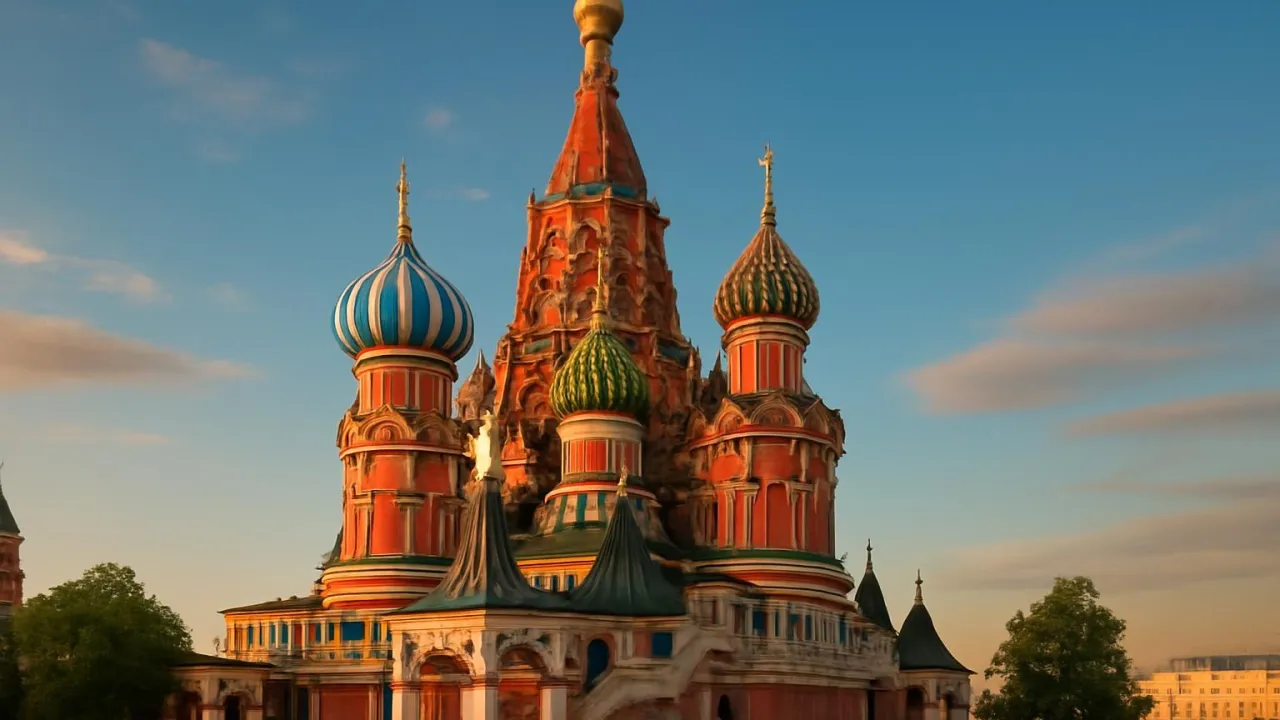
1. What colors can you see on St. Basil’s Cathedral?
2. What sound might you hear at St. Basil’s?
🤯 Mind-Blowing Fact • Grade 2
St. Basil’s Cathedral has nine colorful domes, each with a unique pattern and color.
✨ Word Sparks (Grade 2 Glossary)
Tap 🔊 to hear
onion dome
A roof shaped like an onion bulb
chapel
A small special room for prayer
pattern
A design that repeats again and again
🪝
Have you ever seen a building with swirly, colorful hats on top?
1
A Rainbow on Red Square
St. Basil’s Cathedral stands in Moscow’s busy Red Square, shining with bright colors. Its domes are shaped like onions and painted with stripes and swirls. People come from all over the world to see its amazing towers. The cathedral looks magical in the sunlight.
2
Inside the Cathedral
Inside, the walls are covered with beautiful and pictures. There are many small rooms called where people can pray. The ceilings are high and curved, making echoes when you talk. Visitors feel like they are stepping into a fairy tale.
3
How Was It Built?
Long ago, builders used bricks and strong arches to make the cathedral stand tall. The are made of wood and metal, painted in bright designs. It took many years and many workers to finish this special church. Today, it is a symbol of Russia’s history and art.
Each dome on St. Basil’s Cathedral is decorated differently, with no two exactly alike!
✨ Word Sparks (Grade 3 Glossary)
Tap 🔊 to hear
arch
A curved shape that holds up buildings
vibration
A shaking movement, like when you hum
monument
A famous building that honors something important
🪝
Can you imagine walking under striped domes that twist like ice cream cones?
1
A Colorful Landmark in Moscow
St. Basil’s Cathedral shines with rainbow domes on Moscow’s famous Red Square. Each dome is covered in swirling stripes, zigzags, and bold colors that catch the sunlight. The cathedral’s towers look like a group of giant candy treats. People from around the world visit to see its unique shapes and colors.
2
Inside the Cathedral’s Walls
When you step inside, you find nine chapels filled with painted patterns and golden icons. The ceilings rise in , making echoes and soft when people sing or speak. Narrow hallways twist and turn, connecting each small chapel together. The walls are thick, keeping the inside cool in summer and warm in winter.
3
How Did Builders Create It?
Builders used bricks, stone, and wooden frames to support the cathedral’s tall towers. The onion domes are made with special metal sheets, shaped and painted in bright designs. Strong help the building stand up and resist weather and erosion. The cathedral was finished in 1561, after many years of careful work.
4
A Symbol of Russian Art
St. Basil’s Cathedral is a that shows Russia’s history and creativity. Its design mixes different styles, with each dome representing a separate chapel. The cathedral’s bright colors and shapes inspire artists and visitors alike. Today, it stands as a symbol of Moscow and Russian culture.
Legend says the cathedral’s architect was ordered never to build anything as beautiful again!
✨ Word Sparks (Grade 4 Glossary)
Tap 🔊 to hear
resonance
When sound echoes and fills a space
erosion
Wearing away by wind, rain, or time
Byzantine
A style from old Eastern Roman times
🪝
What secrets hide inside a cathedral that looks like a burst of fireworks?
1
A Wonder of Color and Shape
St. Basil’s Cathedral stands at the heart of Moscow’s Red Square, dazzling visitors with its swirling, candy-colored onion domes. Each dome is decorated with a unique pattern—some are striped, some zigzagged, and others spiraled in bright reds, greens, blues, and golds. The cathedral’s design is unlike any other, making it one of the most photographed landmarks in the world. Its playful shapes and colors have inspired countless artists and architects.
2
Inside: Echoes and Chapels
Inside, the cathedral is a maze of nine chapels, each built to honor a different saint or event. The thick brick walls and high arches create acoustic echoes and gentle when choirs sing or bells ring. Narrow passageways connect the chapels, and the walls are painted with intricate patterns and religious icons. The cathedral feels both mysterious and welcoming, with sunlight streaming through small, arched windows.
3
Engineering Marvels of the Past
Constructed between 1555 and 1561 by order of Ivan the Terrible, the cathedral’s builders used bricks, stones, and wooden frameworks to create its unique shape. The onion domes are made from metal sheets, carefully hammered and painted, then placed atop tall towers supported by strong arches. These arches distribute the building’s weight, allowing it to withstand centuries of harsh Russian winters and . The cathedral’s design was so unusual that legends say the tsar wanted it to be one-of-a-kind.
4
A Symbol for Russia and the World
St. Basil’s Cathedral is more than just a church—it is a symbol of Russian identity and creativity. Its bold design blends Russian, , and Asian influences, making it a monument to cultural exchange. Today, it is protected as a UNESCO World Heritage Site and draws millions of visitors each year. The cathedral’s image appears in art, books, and even Olympic ceremonies, showing its lasting impact on the world.
1. How do arches help the cathedral stand for centuries?
2. Why is St. Basil’s a symbol for Russia?
🤯 Mind-Blowing Fact • Grade 5
St. Basil’s Cathedral was once nearly demolished by Stalin but was saved by architect Pyotr Baranovsky, who refused to approve its destruction.
✨ Word Sparks (Grade 5 Glossary)
Tap 🔊 to hear
vault
A curved ceiling that supports weight
gilding
A thin layer of gold for decoration
UNESCO
A group that protects world treasures
🪝
If you stepped onto Red Square, would you expect to see a cathedral with domes like swirling jewels?
1
A Masterpiece of Color and Architecture
St. Basil’s Cathedral rises at the southern end of Moscow’s Red Square, instantly recognizable by its nine riotously colored onion domes. Each dome is uniquely patterned with spirals, stripes, and chevrons in vivid reds, greens, blues, and gold, making the cathedral appear almost like a cluster of fireworks frozen in time. The cathedral’s asymmetrical layout and whimsical shapes set it apart from any other religious structure in the world. Its architectural style is a dramatic blend of Russian, Byzantine, and Asian influences, reflecting centuries of cultural exchange.
2
Inside: Labyrinths, Echoes, and Sacred Art
Step inside, and you enter a labyrinth of interconnected chapels, each dedicated to a saint or a victory. The thick brick walls and soaring arches create remarkable acoustic resonance, amplifying the sound of bells and choirs throughout the cathedral. Frescoes and icons cover the walls with scenes of saints, battles, and miracles, painted in rich golds and deep reds. Narrow, winding corridors connect the chapels, making the interior feel mysterious and full of hidden stories. Sunlight filters through small arched windows, casting colorful patterns on the ancient stone floors.
3
Engineering Feats of the 16th Century
Constructed from 1555 to 1561 under the orders of Tsar Ivan IV (Ivan the Terrible), St. Basil’s was engineered with remarkable ingenuity for its time. Builders used over 6,000 tons of brick and stone, supported by robust arches and that distribute the cathedral’s immense weight. The onion domes, crafted from metal and wood, were designed to shed heavy Russian snow and resist wind, while their bright paints and protected them from weathering and erosion. The cathedral’s foundations are so solid that, despite fires and centuries of harsh winters, it still stands almost unchanged.
4
A Living Symbol of Russian Identity
St. Basil’s Cathedral is not only an architectural marvel but also a powerful symbol of Russian national identity. Its design was intended to commemorate the conquest of Kazan and Astrakhan, with each dome representing a victorious battle. Over time, the cathedral has become a global icon, featured in literature, art, and international events like the Olympic Games. As a World Heritage Site, it is carefully preserved and studied by historians, architects, and engineers from around the world.
5
Legacy and Inspiration Across Centuries
The cathedral’s influence extends far beyond Russia, inspiring architects and artists worldwide with its inventive use of color, form, and symbolism. Legends claim that Tsar Ivan blinded the architect, Postnik Yakovlev, to ensure nothing so beautiful would ever be built again, though historians believe this is only a myth. Today, St. Basil’s continues to attract millions of visitors annually, serving as both a place of worship and a museum. Its enduring beauty reminds us how creativity and engineering can shape a nation’s spirit for generations.