🎵 INSTRUMENTS
🎶 Wearable Helical Conical Brass Aerophone (Hornbostel-Sachs 423.232)
VA Music, Fine Arts & Sound Physics SOL 5.5
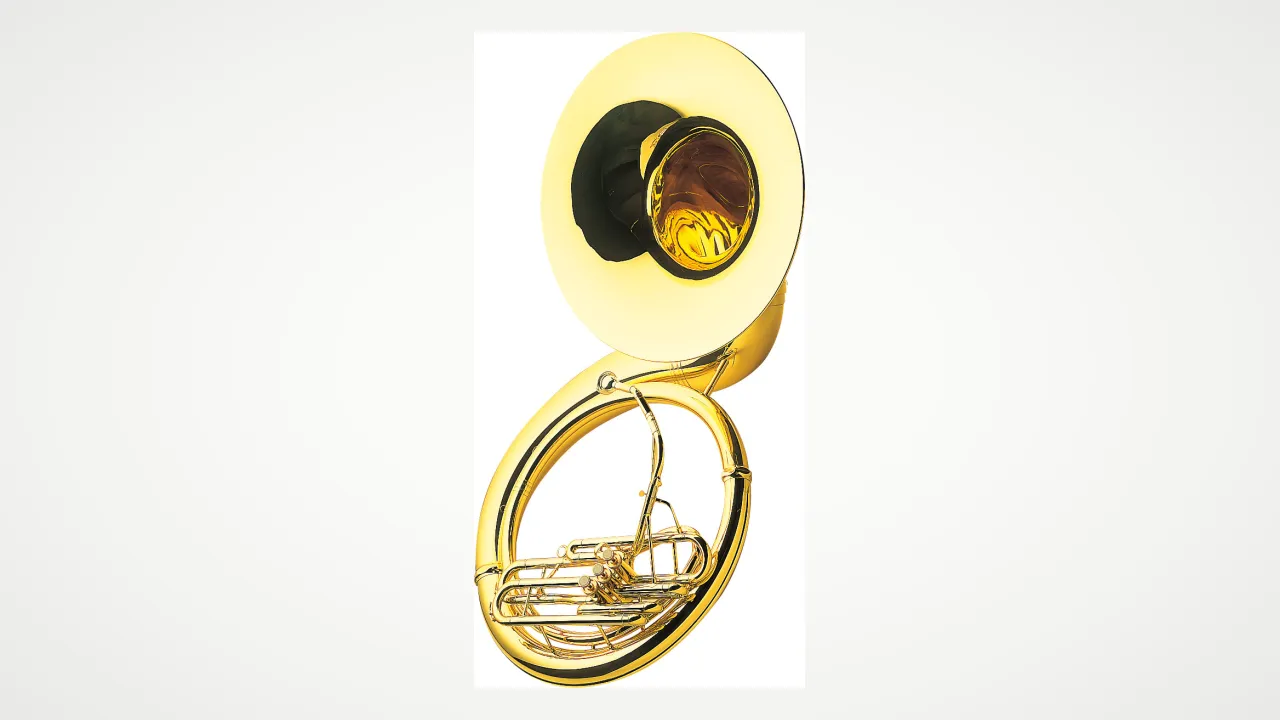
Sousaphone
The Wearable Tuba Built to March
Grade 4 • Expanding • 213 words
🎶 Instrument Family & OriginBrass family; conceived by American bandmaster John Philip Sousa in 1893 and perfected with a forward bell in 1898
🪵 Materials & RangeBrass or fiberglass body; ~18 ft (5.5 m) of coiled BB-flat tubing with a giant 24-to-26-inch detachable forward bell
🔊 How Sound Is MadeDeep lip buzz through an S-shaped gooseneck and bits drives booming bass waves straight ahead over marching bands
⚡ Signature Sound SparkWraps comfortably around a marcher's body so thirty pounds of contrabass brass can parade down streets and stadiums
🤯 Mind-Blowing Fact • Grade 1
A sousaphone's giant bell is over two feet wide—big enough to cover an entire bicycle wheel!
✨ Word Sparks (Grade 1 Glossary)
Tap 🔊 to hear
march
Walk in steady rhythm with a band
balance
Keep weight steady so nothing tips over
parade
Festive street walk with music and cheers
🪝
Have you ever seen a musician wear a giant shiny horn like a hula hoop?
1
Step Inside the Horn!
BOOM, BOOM, ! Down the sunny street comes a giant golden circle! A band player wears the big round tube right on one shoulder. Its huge shiny bell gleams high overhead.
2
Built for Walking
A lap tuba is way too bulky to carry far. Wrapping the brass pipes around the body the weight. Now the player can and turn with ease!
3
Big Forward Blast
Loose lips buzz into a curved metal pipe. Three finger buttons change the deep bass notes. The giant bell sends sound booming across the field!
1. How does a musician hold a sousaphone while marching in a parade?
2. Which way does a modern parade sousaphone's huge bell face?
🤯 Mind-Blowing Fact • Grade 2
New Orleans brass bands made the sousaphone a joyful street-music star, pairing its funky, syncopated bass lines with trumpets, trombones, and snare drums!
✨ Word Sparks (Grade 2 Glossary)
Tap 🔊 to hear
fiberglass
Strong, lightweight material used for marching horns
project
Send sound far out across open space
gooseneck
Curved mouthpipe bringing the mouthpiece close
🪝
Why were the very first sousaphones nicknamed 'rain-catchers'?
1
Named for the March King!
Strike up the drums and watch the gleaming brass bells sway above the marching band! In 1893, famous American bandleader John Philip Sousa asked instrument makers for a wearable bass horn that could march smoothly yet sound warm indoors.
2
From Rain-Catcher to Stadium Star
Sousa's earliest horn pointed its huge bell straight up at the sky, earning the funny nickname 'rain-catcher'! Five years later, makers curved the giant twenty-six-inch bell forward so marching bands could booming bass across outdoor fields.
3
Brass or Featherlight Fiberglass
Inside that circular frame hides eighteen feet of tubing, matching a full-sized tuba's low voice. Some marching bands even use white sousaphones so young players can march for miles without tired shoulders!
1. Who inspired the invention of the sousaphone in the 1890s?
2. Why did people jokingly call the very first 1893 sousaphone a 'rain-catcher'?
🤯 Mind-Blowing Fact • Grade 3
In high school and college marching bands, an entire line of sousaphone players often choreographs synchronized bell swings called 'flashing' while booming bass lines in step!
✨ Word Sparks (Grade 3 Glossary)
Tap 🔊 to hear
helicon
Circular cavalry horn that inspired the sousaphone
detachable
Made to unscrew cleanly for easy travel
tuning bits
Small angled brass connectors adjusting mouthpiece reach
🪝
How do you wrap eighteen feet of booming tuba tubing comfortably around a human torso?
1
Upgrading the Cavalry Helicon
Picture horseback soldiers in the 1800s wearing circular brass horns called slung across their shoulders! Bandleader John Philip Sousa admired how easy helicons were to carry, yet disliked how sharply they blasted sound in one direction during indoor concerts.
2
A Detachable Bell That Turns
Working with Philadelphia maker J.W. Pepper in 1893 and C.G. Conn in 1898, builders reshaped those coils into the sousaphone. Today's twenty-six-inch bell locks onto the body collar with thumbscrews, aiming low bass energy straight over the band in front.
3
Gooseneck, Bits, and Piston Valves
Because the main brass coil circles the player's chest and left shoulder, a curved pipe called a gooseneck and tiny angled tubes called bring the cup mouthpiece right to the player's lips. Meanwhile, the right hand works three piston valves positioned neatly in front.
4
Heartbeat of Global Street Brass
From collegiate football halftimes to Mexican banda ensembles and New Orleans second-line parades, this wearable contrabass drives unstoppable outdoor grooves!
1. What earlier horseback brass instrument inspired the circular shape of the sousaphone?
2. What job do the curved gooseneck and small tuning bits perform on a sousaphone?
🤯 Mind-Blowing Fact • Grade 4
In Mexican *banda* music, the sousaphone (simply called *la tuba*) plays rapid, bouncing syncopated bass solos so athletic that it anchors dances for hours without any bass guitar!
✨ Word Sparks (Grade 4 Glossary)
Tap 🔊 to hear
ergonomics
Designing shapes to fit human bodies comfortably
center of gravity
Balance point where object weight feels centered
syncopated
Placing lively rhythmic accents between steady beats
🪝
Why does a sousaphone center its thirty pounds around your spine instead of exhausting your arms?
1
Ergonomics Meets Contrabass Acoustics
Carrying a thirty-pound concert tuba in front of your chest shifts your dangerously forward, straining wrists and lower back within minutes. By coiling eighteen feet of wide BB-flat conical brass tubing into an open loop resting over the left shoulder and curving around the waist, the sousaphone aligns its mass directly along the marcher's vertical spine.
2
Pepper's 1893 Prototype Versus Conn's 1898 Classic
Ironically, John Philip Sousa never intended his namesake horn for street parades! Dissatisfied with the directional bark of military helicons inside concert halls, he asked J.W. Pepper in 1893 to build a circular horn with an upward-flaring bell that diffused bass softly upward. Five years later, C.G. Conn engineered the elbowed, forward-facing bell—a version Sousa dubbed less refined indoors, yet one that conquered outdoor stadiums worldwide.
3
Wide-Flare Impedance and Outdoor Projection
Outdoors, there are no concert-hall walls or ceilings to reflect omnidirectional bass waves back toward listeners. The sousaphone's oversized 24-to-26-inch bell flare acts like an acoustic megaphone for mid-bass harmonics between 120 and 600 Hz, helping listeners' ears reconstruct pitch clarity across noisy hundred-yard football fields.
4
Cultural Reinvention from Sinaloa to New Orleans
Far beyond American marching bands, the sousaphone became indispensable in Mexican banda sinaloense—where virtuoso players execute blazing sixteenth-note corrido bass lines—and in modern New Orleans brass-band funk, proving this wearable giant can groove faster than an electric bass guitar.
1. Why did John Philip Sousa originally prefer an upward-facing bell in 1893?
2. How does wrapping the coils around the torso make marching with thirty pounds of brass practical?
🤯 Mind-Blowing Fact • Grade 5
Thanks to your brain's 'missing fundamental' trick, when a stadium sousaphone beams crisp overtones at 116 Hz, 175 Hz, and 233 Hz across a noisy field, your auditory cortex automatically reconstructs the booming 58 Hz low B-flat!
✨ Word Sparks (Grade 5 Glossary)
Tap 🔊 to hear
free field
Open outdoor space without sound-reflecting walls
cutoff frequency
Threshold above which waves radiate efficiently outward
psychoacoustic
How ears and brains interpret physical sounds
🪝
How does a 66-centimeter forward-facing bell overcome open-air bass loss across a roaring stadium?
1
Organology of the Helical Contrabass Aerophone
Classified under Hornbostel-Sachs 423.232, the standard BB-flat sousaphone is a wearable helical contrabass tuba measuring approximately 5.5 meters (18 feet) in open conical tube length. Sharing the exact harmonic series of a concert BB-flat tuba—from a fundamental pedal BB-flat0 at 29.1 Hz and practical low E1 (41.2 Hz, or C1 at 32.7 Hz on four-valve models) up to F4 (349.2 Hz)—it reconfigures orchestral plumbing for ambulatory performance.
2
Free-Field Outdoor Acoustics and Psychoacoustic Pitch
In an unenclosed stadium, sound radiates into a '' where intensity drops by six decibels with every doubling of distance and low frequencies below 80 Hz disperse spherically. Because human ears struggle to localize weak outdoor fundamentals, C.G. Conn's 61-to-66-centimeter (24-to-26-inch) forward bell lowers the horn's acoustic and beams second- through eighth-harmonic energy (116–466 Hz) forward. Through the 'missing fundamental' effect, listeners perceive thunderous bass pitch even fifty meters away.
3
Materials Science: Sheet Brass Versus FRP Composites
Traditional brass sousaphones formed from 0.7-millimeter yellow-brass sheet weigh 12 to 16 kilograms (26–35 pounds), delivering rich resonance and crisp nonlinear punch at fortissimo dynamics. Since the 1960s, glass-reinforced polymer (fiberglass) bodies paired with brass valve clusters have trimmed weight to ~8 kilograms (18 pounds); although slightly drier in upper-harmonic ring because stiffer damping alters bell-wall coupling, fiberglass withstands rain, dents, and multi-mile parades.
4
Short-Action Pistons and Articulation Agility
Many professional sousaphones employ offset short-action pistons whose elliptically shaped valve ports shorten finger stroke by twenty percent, enabling clean staccato articulation during brisk 120-beats-per-minute marches.
5
Transcultural Legacy from Sousa to Brass-House
Born for American wind bands, the sousaphone catalyzed early New Orleans jazz transition from marching bass to string bass, powered Sinaloa bandas, and today headlines acoustic brass-funk ensembles worldwide.