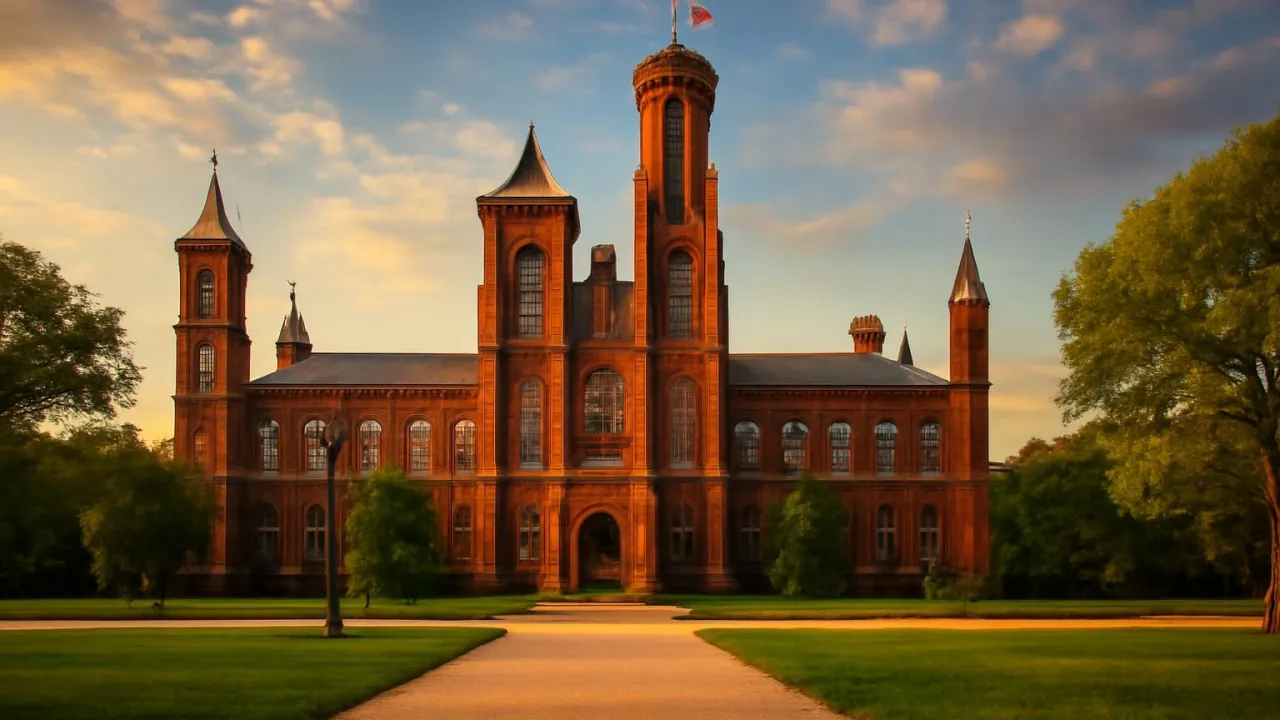
The Smithsonian Castle’s towers are made from red sandstone brought all the way from Maryland!
✨ Word Sparks (Grade 2 Glossary)
Tap 🔊 to hear
sandstone
A soft, reddish rock
treasure
Something special or valuable
explore
To look around and find new things
🪝
Can you imagine walking into a castle full of treasures?
1
A Castle in the City
The Smithsonian Castle sits in Washington, D.C., and shines bright red. Its towers stand tall above the green grass, and people see it from far away. The castle looks old and special, like a fairy tale in real life.
2
Rooms of Wonders
Inside, there are big rooms filled with amazing things from history and science. Visitors see dinosaur bones, sparkling rocks, and even moon rocks from space. Every room has something new to or learn.
3
A Place to Discover
Families and school groups come to visit and learn together. The castle is part of the Smithsonian museums, which are free for everyone. People leave with new ideas and fun memories from their visit.
The Smithsonian Castle has a secret room called the 'Crypt' where the Smithsonian’s founder is buried!
✨ Word Sparks (Grade 3 Glossary)
Tap 🔊 to hear
Romanesque
A style with round arches and thick walls
erosion
When wind or water wears things away
exhibit
A display you can look at and learn from
🪝
Have you ever heard your footsteps echo inside a castle’s stone halls?
1
The Castle’s Red Walls
The Smithsonian Castle stands out with its deep red sandstone walls and tall towers. Built in the 1800s, its design is called Revival, which means it has rounded arches and thick walls. The stone came from Seneca Creek in Maryland, giving the building its famous color. The castle’s towers were made to look like old European castles, but with an American twist.
2
Inside the Castle
Walking inside, you’ll notice the sound of your voice bouncing off the high, arched ceilings. The castle holds about science, history, and art, including fossils, meteorites, and ancient inventions. Some rooms have secret passageways and hidden doors, adding to the mystery. The castle also serves as the headquarters for all Smithsonian museums.
3
Building a Landmark
Workers used strong sandstone and clever engineering to build the castle so it would last. The thick walls help protect treasures from weather and over time. The castle’s arches and towers are not just pretty—they help support the heavy roof. Today, the castle is a symbol of learning and discovery in America.
4
A Place for Everyone
Every year, thousands of people visit the Smithsonian Castle from all over the world. School groups and families come to explore its and learn together. The castle’s gardens are filled with flowers and birds, making it a peaceful spot in the busy city. It’s a place where curiosity leads to new adventures.
The castle’s architect, James Renwick Jr., also designed the famous St. Patrick’s Cathedral in New York City!
✨ Word Sparks (Grade 4 Glossary)
Tap 🔊 to hear
turret
A small tower on a building
quarry
A place where stone is dug out
crypt
A hidden room for important burials
🪝
What secrets might you discover if you wandered the Smithsonian Castle’s echoing halls at dawn?
1
A Castle of Science and Stories
The Smithsonian Castle’s striking red towers rise above the National Mall, inviting visitors to step inside a world of discovery. Designed by architect James Renwick Jr. in the Victorian Romanesque Revival style, the castle’s thick sandstone walls and rounded arches were inspired by medieval European castles. The stone was quarried from Seneca Creek, Maryland, and its rich color makes the castle a landmark in Washington, D.C. Its towers and serve both as decoration and as structural supports for the heavy roof.
2
Building with Strength and Style
Construction began in 1847, using over 7,000 tons of local sandstone and innovative engineering for the time. The castle’s arches distribute weight evenly, preventing collapse and allowing for spacious, open halls. Its thick walls protect the priceless collections inside from weather and erosion, while the tall towers provide sweeping views of the city. The building’s design combines beauty with practical engineering, making it both strong and elegant.
3
A Headquarters for Curiosity
Inside, the castle is filled with fascinating exhibits, secret passageways, and even a where James Smithson, the Smithsonian’s founder, is buried. The castle serves as the main information center and headquarters for all nineteen Smithsonian museums. Visitors can explore displays of fossils, meteorites, inventions, and art, learning about science and history in every room. The echoing halls and hidden doors add a sense of adventure to each visit.
4
A Landmark for the World
The Smithsonian Castle welcomes millions of visitors from around the world each year, making it a symbol of learning and discovery. Its gardens are home to native plants and birds, offering a peaceful retreat in the heart of the city. The castle’s blend of history, science, and architecture inspires curiosity in people of all ages. As part of the Smithsonian Institution, it helps share knowledge and preserve treasures for future generations.
1. Why did the builders use thick sandstone walls?
2. Who is buried in the castle’s crypt?
🤯 Mind-Blowing Fact • Grade 5
The Smithsonian Castle’s red sandstone was once transported by horse-drawn boats along the C&O Canal—a journey of over 20 miles!
✨ Word Sparks (Grade 5 Glossary)
Tap 🔊 to hear
Romanesque Revival
A style with round arches and castle shapes
buttress
A support that helps hold up a wall
manuscript
A handwritten or old book or paper
🪝
If you explored every hidden corner of the Smithsonian Castle, what astonishing stories might you uncover about its past and its science?
1
A Vision in Red Sandstone
At sunrise, the Smithsonian Castle glows with a warm, reddish hue, its towers casting long shadows across the National Mall. Designed by renowned architect James Renwick Jr. and constructed between 1847 and 1855, the building is a masterpiece of Victorian architecture. The distinctive red sandstone was quarried from Seneca Creek, Maryland, and transported by canal to Washington, D.C., specifically for this project. The castle’s twin towers rise to 91 feet (28 meters), while the central structure stretches 165 feet (50 meters) in length, making it a dominant visual landmark. Its unique combination of medieval European design and American innovation set the standard for public architecture in the city.
2
Engineering Marvels and Structural Secrets
The castle’s thick sandstone walls, some over two feet thick, provide exceptional insulation and protection for the priceless collections housed within. Renwick’s use of Romanesque arches and load-bearing walls allowed for spacious interiors without the need for internal columns or supports. The towers and turrets are not merely decorative; they serve as structural , distributing the immense weight of the roof and upper floors. Ingenious ventilation shafts and hidden passageways were integrated into the design, reflecting a blend of artistry and practical engineering. Over time, the building has undergone careful restoration to repair damage from fire and natural erosion, ensuring its continued stability.
3
A Center of Science, History, and Mystery
Today, the Smithsonian Castle functions as the administrative headquarters for the entire Smithsonian Institution, which includes nineteen museums and the National Zoo. Inside, visitors encounter a dazzling array of exhibits, from dinosaur fossils and meteorites to inventions and rare . One of the castle’s most intriguing features is the crypt, where James Smithson—the English scientist whose bequest founded the Smithsonian—is interred. The castle’s echoing halls and secret doors inspire curiosity, while its exhibits showcase humanity’s quest for knowledge across science, art, and culture.
4
Cultural Impact and Global Legacy
The Smithsonian Castle is more than a building; it is a symbol of America’s dedication to free public education and the preservation of world heritage. Each year, millions of visitors from every continent flock to its gardens and galleries, drawn by its history and the promise of discovery. The castle’s gardens, designed to reflect both native and exotic species, provide habitats for birds, pollinators, and city wildlife. Through its role as a gateway to the Smithsonian’s vast collections, the castle helps foster global understanding and inspires future generations of scientists, artists, and explorers.
5
Evolution and Preservation Through Time
Since its completion, the Smithsonian Castle has witnessed the evolution of museum science, public architecture, and American culture. Restoration projects have preserved its intricate stonework, repaired fire damage, and protected it from the effects of pollution and weathering. Today, the castle stands as a testament to the enduring power of curiosity and the importance of preserving our shared history. Its blend of engineering, artistry, and educational mission continues to make it a beacon for learners and dreamers from around the world.