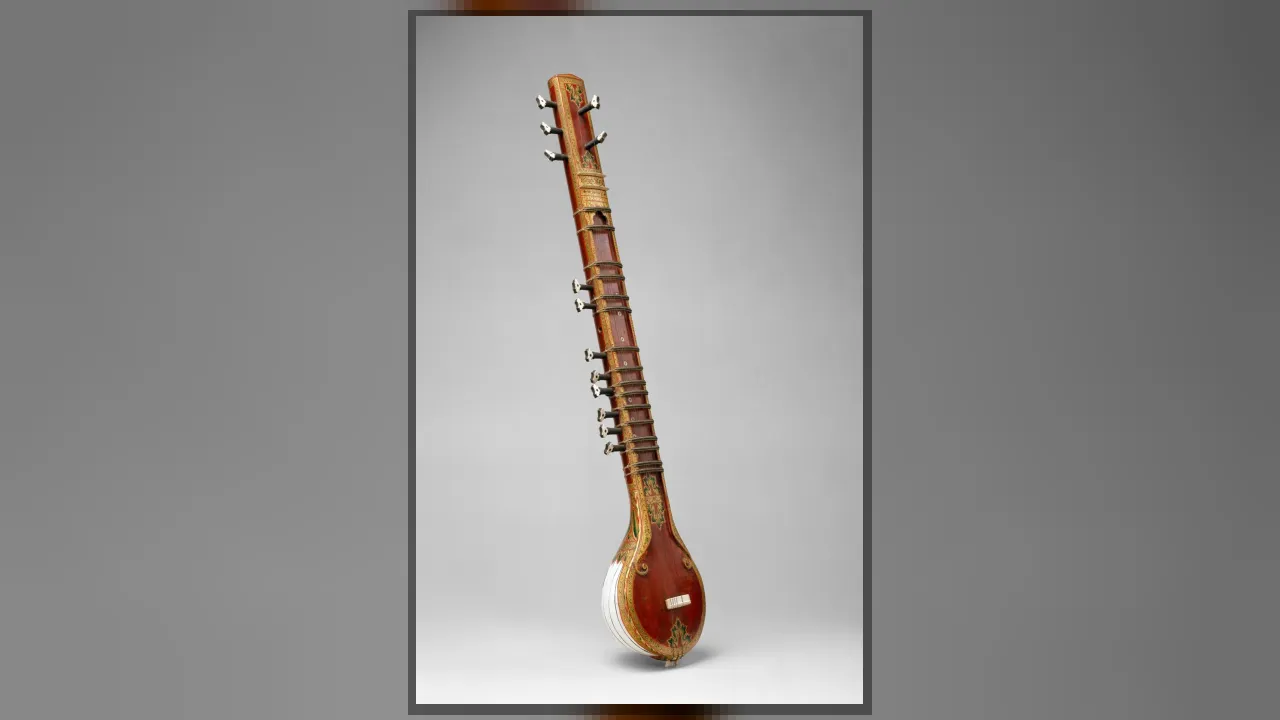
1. What natural plant shell forms the big round bottom bowl of a sitar?
2. What happens to the secret lower strings when you pluck a matching note on top?
🤯 Mind-Blowing Fact • Grade 2
Sitar frets aren't glued down—they are tied on with strong cord so musicians can slide them slightly to match different musical scales!
✨ Word Sparks (Grade 2 Glossary)
Tap 🔊 to hear
mizrab
Twisted wire pick worn on fingertip
arched
Curved upward like a rounded rainbow bridge
glide
To slide smoothly from note to note
🪝
Why do sitar players pull strings sideways across tall curved brass bars?
1
Sliding Notes From North India
Slip a twisted wire pick called a onto your pointer finger, strike one steel string, and hear a silvery buzz shimmer through the air! Standing four feet long, the sitar is a star of North Indian classical music.
2
Two Stories of Strings
Its wide hollow neck carries two layers of strings stacked like a two-story house. Six or seven playing strings sit on top of tall brass frets, while up to thirteen echo strings tunnel right underneath those frets!
3
Pulling Strings Like a Voice
Because those brass frets curve up high above the wood, players can tug a melody string sideways across a smooth fret. That sideways pull the note smoothly upward just like a singer sliding between pitches!
1. What is a mizrab, and how does a sitar player use it?
2. Why are the brass frets on a sitar tied with cord instead of glued into slots?
🤯 Mind-Blowing Fact • Grade 3
Some concert sitars have a second smaller gourd screwed underneath the top of the neck to boost deep bass resonance even further!
✨ Word Sparks (Grade 3 Glossary)
Tap 🔊 to hear
sympathetic
Vibrating automatically in answer to matching pitches
raga
Indian classical scale pattern with expressive mood
meend
Smooth vocal-like pitch glide by pulling strings
🪝
What makes a sitar bridge buzz with sparkling overtones instead of sounding like an ordinary guitar?
1
Sympathetic Strings in Harmony
What would happen if plucking one note woke up a dozen hidden strings tuned to your exact musical scale? Sit cross-legged on a stage rug, cradle a sitar's seasoned gourd against your foot, and hear pure acoustic magic unfold!
2
Resonance Without Touch
Beneath the tall arched brass frets run eleven to thirteen thin metal strings called taraf, meaning strings. Whenever a top melody string vibrates at the exact pitch of a taraf string below, energy travels through the bridge and sets that hidden string ringing untouched!
3
The Curved Jawari Bridge
Instead of resting on a sharp narrow edge, sitar strings cross a wide, gently curved bridge called the jawari. As a plucked string swings up and down, it lightly grazes that curved surface, creating a rich, shimmering harmonic buzz.
4
Ragas and Expressive Meend
North Indian classical compositions follow melodic frameworks called , each evoking a time of day or mood. Pulling strings sideways across wide brass frets creates fluid pitch bends called spanning several steps from one fret!
1. How does the wide, curved jawari bridge shape the sitar's famous sound?
2. What triggers the hidden taraf strings underneath the frets to start ringing?
🤯 Mind-Blowing Fact • Grade 4
Master sitar makers shape the curve of the jawari bridge by sanding away microscopic layers with emery paper while plucking—because changing the curve by the thickness of a sheet of paper transforms the entire voice!
Dried calabash gourd forming sitar's main resonator
alap
Slow, unpulsed opening exploration of a raga
🪝
How did Persian three-stringed lutes and ancient Indian veenas come together in eighteenth-century courts to create the dazzling multi-stringed sitar?
1
An Unfolding Sonic Sunrise
A concert begins in hushed stillness with an unhurried solo exploration called : one plucked steel wire bends upward across four whole notes in a single breath, surrounded by an ethereal cloud of ringing echoes. Across North India and concert halls worldwide, few instruments mirror the human voice's sighs and leaps as intimately as the sitar.
2
Fusing Indian Veenas and Persian Setars
Although its name echoes the Persian setar ('three strings'), the modern instrument crystallized in eighteenth-century Mughal and North Indian courts by uniting long-necked Persian lutes with indigenous Indian tritantri veena wisdom. Over the nineteenth and twentieth centuries, master luthiers and virtuoso dynasties added rhythmic chikari drone wires and rows of sympathetic taraf strings.
3
Two Bridges, Gourd Chambers, and Jawari Artistry
Carved from light, resonant tun wood (Indian red cedar) or teak joined to a sun-dried calabash gourd , the sitar actually carries two tiered bridges! Playing and drone strings cross the large upper camel-bone or deer-horn bridge, while sympathetic taraf strings pass through tiny bone eyelets onto a miniature lower bridge—both sanded to micron precision so grazing strings bloom with silvery overtones.
4
Ravi Shankar and Global Musical Bridges
Paired onstage with the rhythmic tabla drums and shimmering tanpura drone, twentieth-century maestros such as Pandit Ravi Shankar and Ustad Vilayat Khan carried Hindustani raga improvisation to international festivals, inspiring collaborations from violinist Yehudi Menuhin and composer Philip Glass to The Beatles.
1. Why does a sitar actually have TWO bridges mounted on its wooden tabli soundboard?
2. Which twentieth-century sitar maestro introduced Hindustani classical ragas to global audiences alongside Yehudi Menuhin and The Beatles?
🤯 Mind-Blowing Fact • Grade 5
Nobel Prize-winning Indian physicist Sir C. V. Raman was so fascinated by the sitar and tanpura that he conducted pioneering laboratory studies proving how curved jawari bridges generate harmonics that shouldn't exist on flat bridges!
✨ Word Sparks (Grade 5 Glossary)
Tap 🔊 to hear
gayaki ang
Instrumental style imitating expressive human singing
chikari
High-pitched side strings punctuated for rhythm
parabolic
Shaped in a smooth symmetrical mathematical curve
🪝
How does periodic grazing contact against a parabolic horn bridge generate high-order harmonic cascades up to forty times the fundamental frequency?
1
Nonlinear Overtones and Microtonal Flight
Strike the main steel melody string (baaj tar, typically tuned to F3 at 174.6 hertz or C3 at 130.8 hertz) with a wire mizrab, then deflect it laterally across an elliptical brass fret to soar five semitones seamlessly without re-plucking! Classified as a long-necked composite sympathetic chordophone spanning roughly four octaves (C2 to E6), the Hindustani sitar turns nonlinear string-bridge physics into vocal transcendence.
2
Jawari Grazing Physics and Spectral Enrichment
First analyzed mathematically by Nobel laureate physicist C. V. Raman, the sitar's luminous timbre originates at the jawari ('life-giving' bridge). Rather than terminating abruptly against a knife-edge saddle, each string exits tangent to a gently cambered deer-horn or ebony surface. During every oscillation cycle, the vibrating wire wraps and unwraps across that contour, shifting its effective termination point and continuously regenerating high-frequency overtones long after initial plucking.
3
Dual-Tier Architecture and Sympathetic Coupling
Built from seasoned Toona ciliata (tun wood) or teak mated to a hemispherical Lagenaria siceraria calabash tumba, a concert sitar carries eighteen to twenty-one strings across two planes. Above sixteen to twenty tied, movable brass frets sit main melody, harmony, and high rhythmic drone wires; beneath the frets tunnel eleven to thirteen thin steel taraf strings tuned to the raga's precise scale degrees, excited via bridge-borne mechanical coupling.
4
Kharaj-Pancham Versus Gandhar-Pancham Lineages
Two celebrated twentieth-century structural schools shaped modern performance: Pandit Ravi Shankar's Maihar-lineage kharaj-pancham configuration—incorporating deep bronze bass strings down to C2 (65.4 hertz) and an upper neck gourd for four-octave symphonic breadth—and Ustad Vilayat Khan's streamlined gandhar-pancham ('singing style') sitar, omitting heavy bass courses to maximize nimble vocal inflection.
5
Living Architecture of Raga and Tala
Unfolding from meditative, unmetered alap and rhythmic jor-jhala pulses into intricate gat compositions locked to cyclical tabla talas of ten, twelve, or sixteen beats, the sitar embodies centuries of North Indian acoustic science, poetic devotion, and fearless realtime improvisation.