🏢 WorkplaceSchools, hospitals, courtrooms, concert stages, and video studios
⚡ Everyday Impact SparkConnects Deaf and hearing neighbors in real time through expressive movement
🤯 Mind-Blowing Fact • Grade 1
Sign language uses your eyebrows, cheeks, and shoulders—not just your hands—to show whether a sentence is a question or an exclamation!
✨ Word Sparks (Grade 1 Glossary)
Tap 🔊 to hear
sign
A hand movement that means a word
Deaf
Unable to hear some or all sounds
expression
Looks on your face that show feelings
🪝
How can two hands, ten fingers, and a bright smile share a whole story without a single sound?
1
Hands That Talk!
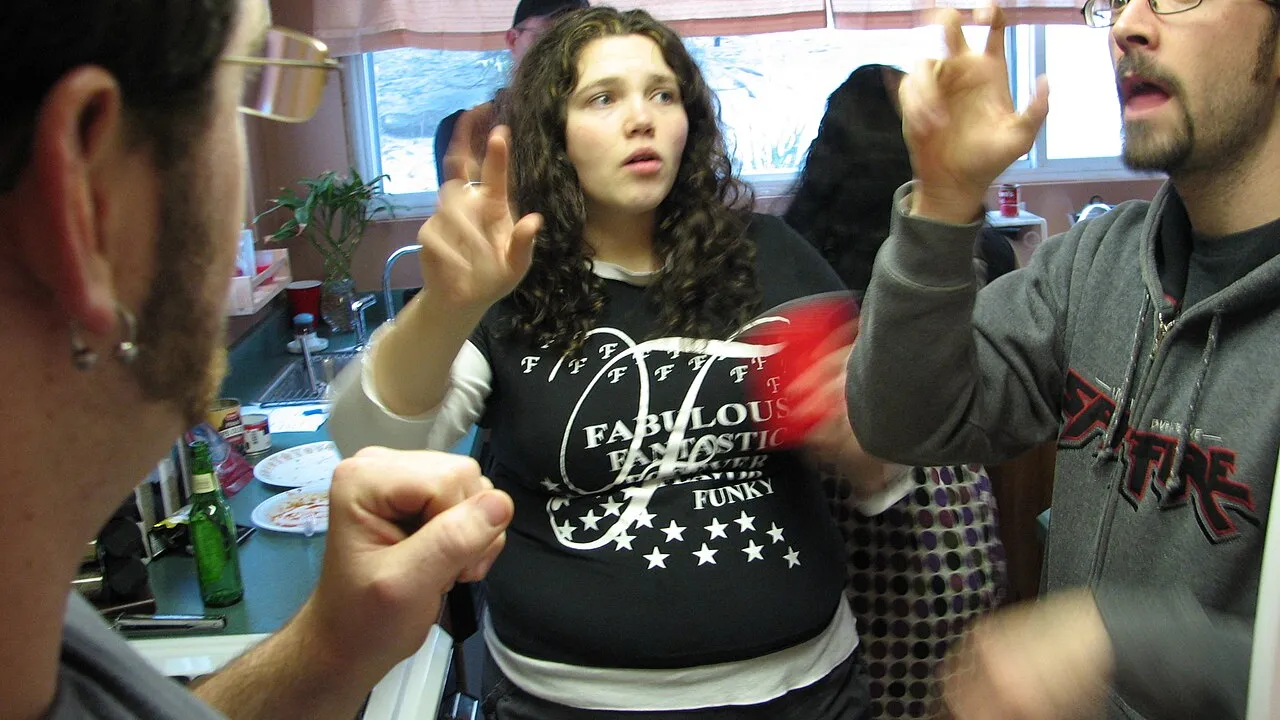
Watch closely as quick fingers dance through the air! Eyebrows lift up for a question. A warm grin shows joy. Every move carries real words.
2
Helping Friends Connect
people talk with their eyes and hands using language. Hearing people often talk with voices. An interpreter switches spoken words into signs right away.
3
Everywhere We Go
You can spot interpreters in classrooms, doctor offices, and concerts. Thanks to them, nobody misses out on the fun!
1. How does a sign language interpreter share spoken words with a Deaf person?
2. Where might you see a sign language interpreter helping people?
🤯 Mind-Blowing Fact • Grade 2
Countries around the world do not all share the same sign language—British Sign Language and American Sign Language are completely different languages!
✨ Word Sparks (Grade 2 Glossary)
Tap 🔊 to hear
interpreter
Someone who switches live speech between languages
fingerspelling
Forming alphabet letters with your fingers
bridge
Something that connects two groups together
🪝
Why do sign language interpreters often wear plain, solid-colored shirts at work?
1
Clear Hands in Motion
Picture a speaker stepping up to a microphone at a school assembly. Beside the podium stands a teammate wearing a dark, solid shirt so moving hands stand out clearly from across the room.
2
Two Directions at Once
Interpreting works like a two-way . When a teacher speaks English aloud, the signs in American Sign Language, or ASL. When a Deaf student signs back, the interpreter speaks those ideas aloud.
3
Fast Brains and Teamwork
Listening in one language while signing in another takes super focus! For long events, two take turns every twenty minutes so their hands and minds stay fresh.
1. Why do sign language interpreters choose solid-colored clothing without busy stripes?
2. Why do two interpreters often switch places every twenty minutes during a long lecture?
🤯 Mind-Blowing Fact • Grade 3
Gallaudet University in Washington, D.C.—whose charter President Abraham Lincoln signed in 1864—is the world's premier university designed specifically for Deaf and hard-of-hearing students!
✨ Word Sparks (Grade 3 Glossary)
Tap 🔊 to hear
grammar
Rules for putting words together into sentences
visual
Understood by seeing with your eyes
confidentiality
Keeping someone's private information completely secret
🪝
Does American Sign Language follow the exact same word order as spoken English?
1
More Than Word-for-Word Matching
Watch a concert or emergency weather broadcast on television, and notice the expressive professional beside the speaker. Rather than matching English words one by one, an interpreter translates full ideas into American Sign Language (ASL), a complete language with its own .
2
Space, Speed, and Grammar
In ASL, signing 'store I go' sets up the topic first! Raising eyebrows asks a yes-or-no question, while leaning forward or moving hands faster shows excitement or urgency. Names and brand-new science terms are spelled out using the one-handed manual alphabet.
3
Video Relay and Community Settings
Today, many interpreters work inside high-tech video relay studios, helping Deaf callers phone doctors, small businesses, or grandparents over crystal-clear video screens. Others specialize in K–12 classrooms, busy hospitals, county courtrooms, or university science laboratories.
4
Respect and Privacy
Professional interpreters follow a strict code of ethics and , meaning private medical checkups, school meetings, or legal conversations are never repeated outside the room.
1. What makes American Sign Language (ASL) a true independent language?
2. Which U.S. President signed the 1864 charter for Gallaudet University?
🤯 Mind-Blowing Fact • Grade 4
Music festival interpreters study dozens of song lyrics weeks ahead of a concert so they can convey pulsing bass beats, rhymes, and instrument solos visually!
✨ Word Sparks (Grade 4 Glossary)
Tap 🔊 to hear
simultaneous
Happening at the exact same moment
tactile
Connected with the physical sense of touch
accessibility
Designing spaces and services everyone can use
🪝
How did civil rights laws make sign language interpreting an essential public career across America?
1
Equal Access Under the Law
Imagine arriving at a hospital emergency room, a town hall meeting, or a Virginia courthouse and having no reliable way to understand the doctor or judge. When Congress passed the landmark Americans with Disabilities Act (ADA) in 1990, federal civil-rights law guaranteed Deaf and hard-of-hearing citizens effective communication access across hospitals, courts, classrooms, workplaces, and public venues.
2
Simultaneous Mental Gymnastics
Unlike written book translators who can pause to check a specialized dictionary, sign language interpreters perform interpretation in real time. They listen to incoming spoken English, hold a deliberate three-to-five-second mental buffer called 'processing time' to grasp the speaker's true intent, restructure the idea into accurate ASL grammar, and sign smoothly—all while already listening to the speaker's next sentence!
3
Tactile Signing for DeafBlind Citizens
Some specialized interpreters train in signing and ProTactile communication for citizens who are both Deaf and blind. By resting their hands lightly over the interpreter's moving hands and wrists, DeafBlind individuals feel every handshape, movement speed, and spatial clue directly through touch.
4
Partnering With Certified Deaf Interpreters
During televised emergency weather briefings or complex courtroom trials, hearing interpreters frequently team up side by side with Certified Deaf Interpreters—native ASL specialists whose cultural fluency ensures every critical detail is unmistakable.
1. Which 1990 federal law guaranteed communication access for Deaf citizens in hospitals and courts?
2. Why do interpreters intentionally keep a few seconds of 'processing time' behind a speaker?
🤯 Mind-Blowing Fact • Grade 5
More than 300 distinct natural sign languages thrive across the planet today, plus an auxiliary system called International Sign used at events like the Deaflympics and United Nations!
✨ Word Sparks (Grade 5 Glossary)
Tap 🔊 to hear
parameter
A specific building block defining a sign
syntax
The structural arrangement of words and phrases
impartiality
Remaining completely neutral without adding personal bias
🪝
What linguistic discoveries proved that visual-spatial languages engage the human brain just like spoken ones?
1
Three-Dimensional Linguistics in Real Time
Under the bright stage lights of a state governor's hurricane briefing, an interpreter shapes crisp three-dimensional concepts in the signing space between waist and forehead. Far from simple pantomime or English-on-the-hands, American Sign Language—tracing its institutional roots to 1817, when Thomas Hopkins Gallaudet and Deaf French educator Laurent Clerc founded the American School for the Deaf in Hartford, Connecticut—blended French Sign Language with indigenous signing communities such as Martha's Vineyard Sign Language.
2
Five Parameters of Every Sign
In 1960, Gallaudet University professor William Stokoe published groundbreaking linguistic research proving that ASL possesses full phonology, morphology, and equal to any spoken tongue. Every individual sign is constructed from five exact building blocks, or : handshape, palm orientation, physical location, movement path, and non-manual markers (grammatical facial expressions such as eyebrow tilt, cheek puff, and head nod). Altering even one parameter—like shifting a handshape from the chin to the forehead—creates an entirely different word.
3
Spatial Classifiers and Cognitive Load
During a university organic chemistry lab, software engineering sprint, or federal appellate oral argument, an interpreter establishes invisible three-dimensional reference points in air—called spatial loci—to track multiple molecules, speakers, or cause-and-effect timelines simultaneously. Functional MRI brain scans reveal that this rapid bimodal code-switching engages classical left-hemisphere language regions alongside right-hemisphere visual-spatial networks.
4
Specialized Credentials and Ethics
Professional interpreters uphold the Registry of Interpreters for the Deaf (RID) Code of Professional Conduct, maintaining strict confidentiality and so they neither inject personal advice nor alter a speaker's register. Courtroom and medical interpreters pursue advanced specialist certifications to handle technical surgical or statutory vocabulary accurately.
5
Academic Preparation
Aspiring interpreters typically complete a four-year bachelor's degree in ASL-English Interpretation, log hundreds of supervised practicum hours immersed in Deaf community events, and pass demanding national knowledge and live-performance certification exams.