1. What kind of doctor checks your eyesight and helps fit you with glasses?
2. How do blinking eyelids help your eyes all day long?
🤯 Mind-Blowing Fact • Grade 2
The cool multi-lens machine optometrists flip while asking 'Better one, or better two?' is called a phoropter and can test thousands of lens combinations!
✨ Word Sparks (Grade 2 Glossary)
Tap 🔊 to hear
phoropter
Multi-lens instrument used during eye exams
pupil
Dark circle letting light enter your eye
blurry
Fuzzy and unclear around the edges
🪝
What does '20/20 vision' actually mean when an optometrist checks your eyes?
1
Inside the Eye Exam Room
Click-whirrr goes a giant mask-like machine packed with dozens of round glass lenses! That cool tool is called a . As you look through it, the optometrist flips lenses and asks, 'Which looks clearer—number one or number two?'
2
Cracking the 20/20 Code
Reading the wall chart measures sharpness from twenty feet away. Having 20/20 vision means you can read clearly at twenty feet what a typical sharp eye sees at twenty feet! If faraway classroom boards look or close-up books look fuzzy, curved glasses bend light right into focus.
3
Checking Eye Health Too
Optometrists also check color vision, how well both eyes team up together, and the healthy back wall of your eye!
1. What is the name of the lens-flipping instrument used when an optometrist asks 'Which is clearer, one or two?'
2. What does the first '20' in '20/20 vision' stand for?
🤯 Mind-Blowing Fact • Grade 3
The back of your eye is the ONLY place in the entire human body where a doctor can see living blood vessels and nerves directly without making a single cut!
✨ Word Sparks (Grade 3 Glossary)
Tap 🔊 to hear
cornea
Clear dome covering the front of eyes
retina
Light-sensing layer lining the back eyeball
refraction
Bending of light passing through lenses
🪝
Why are some eyes nearsighted and others farsighted—and how do curved lenses bend light to fix both?
1
How Your Eye Works Like a Camera
Follow a sunbeam bouncing off a soccer ball right into your eye! Light passes through a clear front window called the , squeezes through the dark pupil, and bends through an adjustable inner lens to land on the —a carpet of millions of light sensors lining the back of your eyeball.
2
Nearsighted vs. Farsighted
If an eyeball grows slightly too long from front to back, light focuses just in front of the , making distant whiteboards look blurry—a condition called myopia, or nearsightedness. If the eyeball is slightly too short, close-up reading looks blurry, called farsightedness!
3
Bending Light With Physics
Optometrists use —the science of bending light—to prescribe concave or convex lenses in glasses or soft contact lenses so light lands sharply on the .
4
A Window Into Body Health
Using a special camera and microscope, Doctors of Optometry (O.D.) look right through the pupil to inspect living blood vessels and the optic nerve!
1. Which layer at the back of the eyeball catches light and sends picture signals to the brain?
2. What causes nearsightedness (myopia), where faraway classroom boards look blurry?
🤯 Mind-Blowing Fact • Grade 4
Optometrists teach the easy '20-20-20 Rule' for computer and tablet users: every 20 minutes, look at something 20 feet away for at least 20 seconds to relax your eye-focusing muscles!
✨ Word Sparks (Grade 4 Glossary)
Tap 🔊 to hear
diopter
Unit measuring focusing power of lenses
astigmatism
Uneven eye curve making light focus unevenly
optic nerve
Cable carrying visual signals to the brain
🪝
What is the difference between an optometrist, an ophthalmologist, and an optician—and how does light physics guide an eye exam?
1
Three 'O' Careers Working Together
People often mix up three vision careers that start with the letter O! An optometrist earns a four-year Doctor of Optometry (O.D.) degree after college to serve as your primary eye doctor—examining vision, prescribing lenses, and diagnosing and treating many eye conditions. An ophthalmologist is a medical doctor (M.D. or D.O.) who performs delicate eye surgeries, while an optician crafts and fits eyeglass frames and lenses to match the doctor's prescription.
2
Optical Instruments in Action
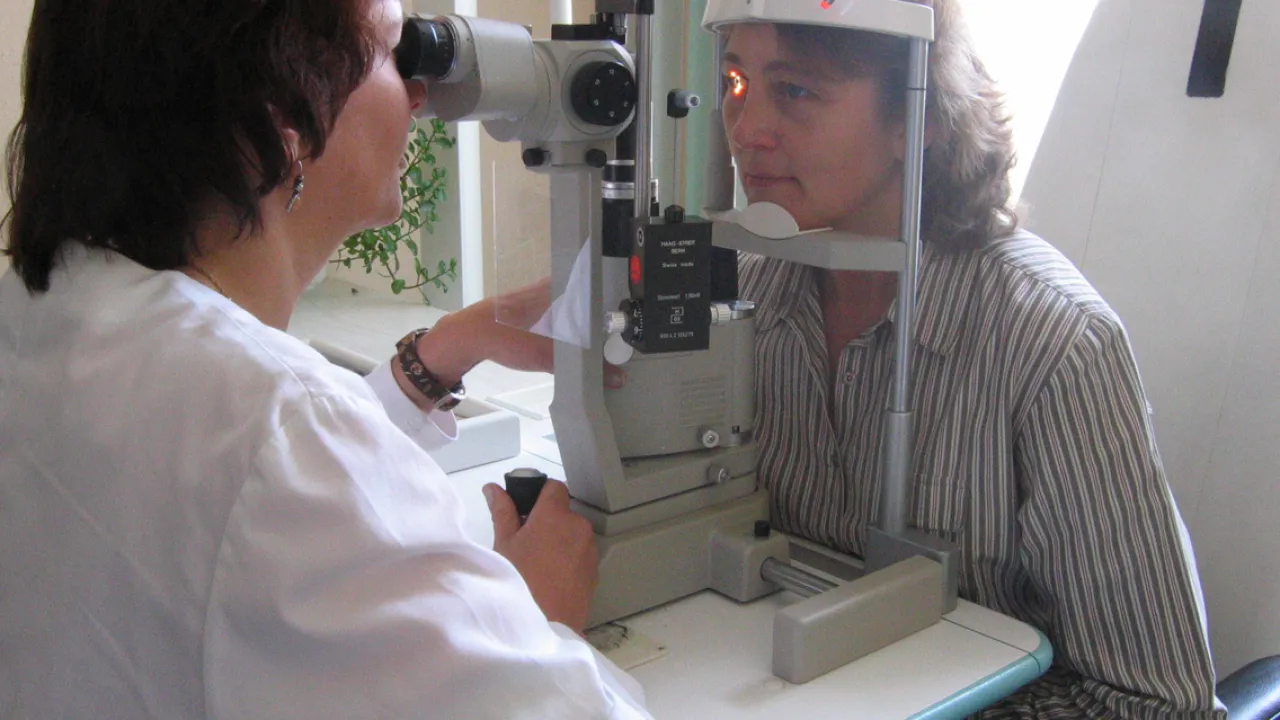
Even if a young child cannot read letters yet, an optometrist can measure focus objectively by shining a retinoscope beam into the eye and watching how the light reflection moves! Next comes the slit-lamp biomicroscope, which projects a thin sheet of light to inspect the cornea, iris, and crystalline lens under high magnification.
3
Rods, Cones, and Diopters
Lens prescriptions are measured in units called . Minus (-) diopter lenses diverge light for myopia, plus (+) diopter lenses converge light for hyperopia, and cylindrical lenses smooth out caused by a football-curved cornea.
4
Outdoor Play Helps Growing Eyes
Modern optometry research shows a fun discovery for kids: spending time outdoors in natural daylight every day and taking regular screen breaks—looking twenty feet away for twenty seconds every twenty minutes—helps protect growing eyes!
1. What does the '20-20-20 Rule' recommend when reading on screens?
2. What kind of lens curvature causes astigmatism?
🤯 Mind-Blowing Fact • Grade 5
Each human retina packs roughly 126 million light-sensing rod and cone cells into a delicate tissue layer thinner than a postage stamp!
✨ Word Sparks (Grade 5 Glossary)
Tap 🔊 to hear
photoreceptor
Specialized rod or cone cell sensing light
glaucoma
Eye pressure condition affecting the optic nerve
macula
Central retina zone for sharpest color vision
🪝
How do geometric optics, retinal neurobiology, and non-invasive laser imaging allow optometrists to protect both eyesight and systemic health?
1
Geometric Optics of the Human Eye
Every waking second, your eyes perform rapid optical calculations! Incoming photons refract first across the tear film and curved cornea—which supplies roughly two-thirds of the eye's sixty-diopter focusing power—and then pass through the crystalline lens, whose curvature flexes via tiny ciliary muscles to shift focus from distant horizons to book pages. Along the retina, approximately 120 million rod detect dim light and peripheral motion, while six million red-, green-, and blue-sensitive cone photoreceptors packed into the central resolve crisp color detail before sending action potentials down the million-fiber optic nerve.
2
Correcting Refractive Errors With Snell's Law
Guided by Snell's law of refraction, Doctors of Optometry (O.D.) measure axial length and corneal topography to correct refractive errors to quarter-diopter precision. Concave diverging lenses shift focal points posteriorly for myopia (nearsightedness); convex converging lenses shift focal points anteriorly for hyperopia (farsightedness); and toric lenses align two perpendicular meridians to neutralize astigmatism. Pediatric optometrists also prescribe specialized myopia-control lenses and vision therapy for binocular convergence challenges.
3
Optical Coherence Tomography and Systemic Clues
Modern optometric diagnostics extend deep behind the iris. Non-contact tonometers check intraocular fluid pressure to screen for —a silent threat to optic nerve fibers—while Optical Coherence Tomography (OCT) uses safe near-infrared light waves to capture cross-sectional images of all ten microscopic retinal layers at micrometer resolution! Because retinal arterioles and venules are directly visible, optometrists frequently detect the very first vascular signs of hypertension or diabetes before a patient feels a single symptom.
4
Eight Years of Doctoral Preparation
After completing a bachelor's degree in physics, biology, chemistry, and calculus, future optometrists attend a four-year accredited college of optometry studying ocular anatomy, neuro-ophthalmic pathways, pharmacology, and clinical optics, passing multi-part National Board of Examiners in Optometry (NBEO) exams.
5
Empowering Learning and Discovery
Because roughly eighty percent of classroom learning enters through visual pathways for sighted students, a single pediatric eye exam can transform a child's confidence in reading, sports, art, and science overnight.