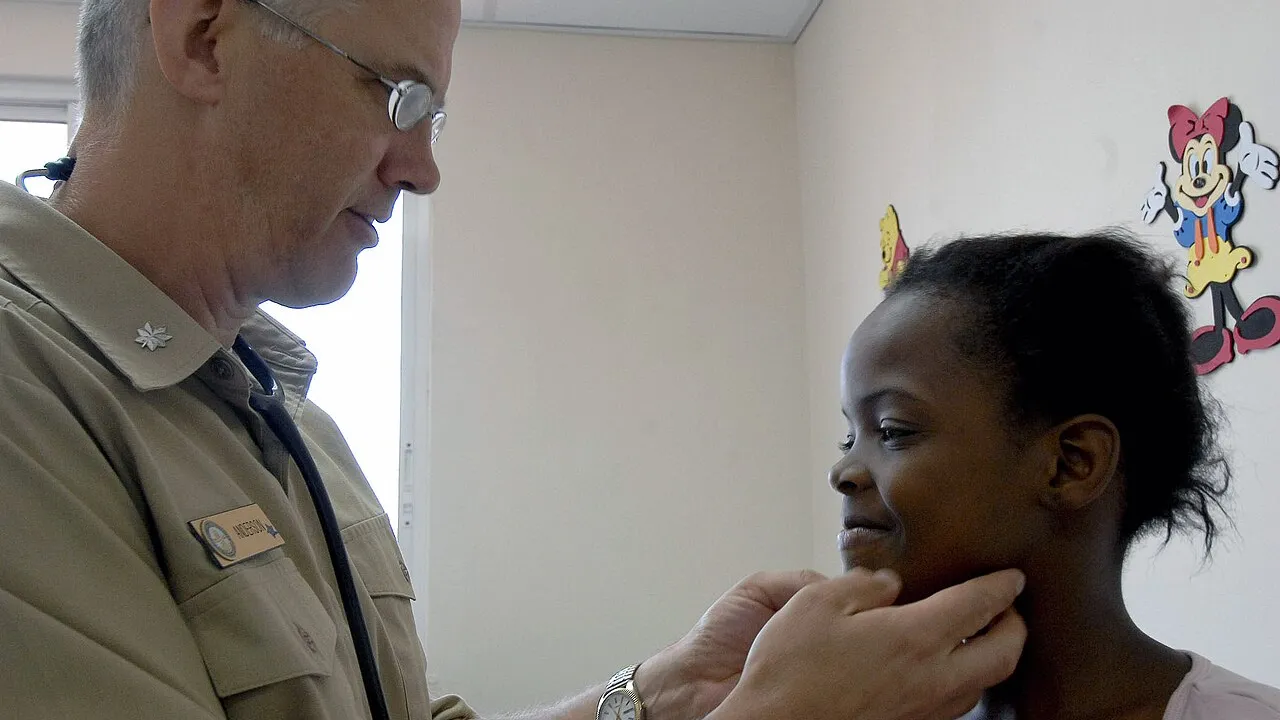
1. Which tool does a pediatrician place on your chest to hear your heart and lungs?
2. Whom does a pediatrician specialize in caring for?
🤯 Mind-Blowing Fact • Grade 2
Babies are born with about 300 bones, and as you grow up some fuse together until adults have 206 bones!
✨ Word Sparks (Grade 2 Glossary)
Tap 🔊 to hear
otoscope
Small lighted tool for looking in ears
reflex
Quick automatic body movement like knee kicks
dose
Exact measured amount of medicine needed
🪝
Why do growing kids need a special kind of doctor instead of just seeing an adult doctor?
1
Growing Bodies Change Fast
Step onto the clinic scale and see how many inches you grew since last year! Children's bones, brains, and immune systems change every single month, so pediatricians train specially to understand growing bodies from tiny newborns to high school teens.
2
Tools Inside the Exam Room
During a checkup, the doctor shines a tiny lighted inside your ears, taps your knees to test , and listens to your lungs. If you catch an earache, fever, or asthma cough, they choose the exact medicine for your body weight.
3
Teamwork With Families
Pediatricians also cheer you on with tips about sleep, helmets, veggies, and play!
1. Which tool shines a gentle beam of light so a pediatrician can check your eardrum?
2. Why must a pediatrician measure a child's weight carefully before prescribing medicine?
🤯 Mind-Blowing Fact • Grade 3
The word 'pediatrician' comes from two ancient Greek words—'pais' meaning child and 'iatros' meaning healer!
✨ Word Sparks (Grade 3 Glossary)
Tap 🔊 to hear
immunization
Protective shot helping immune systems fight disease
preventive
Stopping sickness before it ever starts
residency
Years of hospital training for new doctors
🪝
How does a pediatrician solve medical mysteries when a baby is too young to explain what hurts?
1
Medical Detectives for Young Patients
Imagine trying to help a crying six-month-old baby who cannot say 'My ear hurts!' Pediatricians work like gentle detectives, observing breathing patterns, skin color, tummy sounds, and tiny smiles to spot clues about a child's health.
2
Preventive Care and Immunizations
Much of a pediatrician's job happens during well-child visits when kids feel great. Doctors plot height and weight on growth charts, check vision and hearing milestones, and give that train white blood cells to defeat dangerous viruses and bacteria.
3
Treating Illnesses and Injuries
When kids wake up with strep throat, wheezing lungs, rashes, or sprained ankles, pediatricians run quick lab swabs, read X-rays, and design treatment plans so children bounce back quickly.
4
Years of Training
Becoming a pediatrician takes dedication: four years of college, four years of medical school, and three years of hands-on training in children's hospitals and clinics.
1. What do the ancient Greek root words behind 'pediatrician' mean?
2. How many years of pediatric residency training do doctors complete after finishing medical school?
🤯 Mind-Blowing Fact • Grade 4
Dr. Virginia Apgar invented the famous zero-to-ten 'Apgar Score' in 1952, giving doctors and nurses a sixty-second checklist to check every newborn baby's health right after birth!
✨ Word Sparks (Grade 4 Glossary)
Tap 🔊 to hear
growth plate
Developing cartilage zone where young bones lengthen
neonatologist
Pediatric specialist caring for newborn babies
metabolism
Chemical processes turning food into body energy
🪝
Why are children physiologically different from miniature adults—and how do pediatricians tailor science to every stage of growth?
1
Why Kids Are Not Just Small Adults
Listen through a stethoscope inside a bustling pediatric clinic: a toddler's resting pulse races near 110 beats per minute, while a teenager's beats closer to 70! From infancy through age twenty-one, human organs, bones, , and brain circuits remodel continuously. Children even have soft cartilaginous near the ends of long bones that allow skeletons to lengthen—meaning an injury or medication affects a eight-year-old very differently than a forty-year-old.
2
Diagnostic Tools and Clinical Clues
During comprehensive checkups, pediatricians combine vital signs—temperature, heart rate, respiratory rate, blood pressure, and pulse oximetry—with developmental screenings for speech, motor coordination, and emotional well-being. Rapid antigen swabs identify streptococcal bacteria in minutes, while peak-flow meters measure how freely air moves through a child's lungs.
3
Generalists and Pediatric Subspecialists
While primary-care pediatricians care for families in neighborhood offices, others complete extra fellowship training to become caring for premature newborns, pediatric cardiologists mending tiny hearts, or pediatric oncologists treating childhood illnesses in specialized children's hospitals.
4
Public Health Champions
Over the past century, pediatric science—from clean infant nutrition and bicycle helmet advocacy to childhood vaccines against polio and measles—has helped make childhood safer and healthier across every community.
1. What special zones near the ends of children's long bones allow their skeletons to grow taller?
2. What kind of pediatric subspecialist cares specifically for fragile or premature newborn infants?
🤯 Mind-Blowing Fact • Grade 5
During the first year of life alone, a healthy human baby typically triples its birth weight and grows roughly ten inches longer while forming more than one million new brain connections every second!
✨ Word Sparks (Grade 5 Glossary)
Tap 🔊 to hear
physiology
Science of how living body systems function
percentile
Chart comparison showing typical growth patterns
pathogen
Microscopic virus or bacterium causing illness
🪝
How did pediatrics emerge as its own scientific field, and what blend of physiology, empathy, and precision medicine guides today's pediatricians?
1
The Birth of Pediatric Science
Step into a modern children's hospital where murals brighten sunlit hallways and miniature blood-pressure cuffs fit wrists no wider than a thumb. Until the mid-nineteenth century, medical schools rarely separated children's medicine from adult care, even though infants and children metabolize medications at different rates and face distinct developmental conditions. Pioneering physicians such as Abraham Jacobi—who opened America's first dedicated children's clinic in New York in 1860—demonstrated that childhood required its own research, hospital wards, and preventive public-health standards.
2
Tracking Milestones Across Twenty-One Years
Modern pediatricians monitor rapid biological transformation across infancy, early childhood, middle childhood, and adolescence. Using curves developed by the World Health Organization and Centers for Disease Control and Prevention, clinicians evaluate head circumference, linear growth velocity, body-mass index, vision acuity, audiometry, and neurodevelopmental milestones. Subtle shifts on a growth curve often give a vigilant pediatrician the earliest clue to thyroid, nutritional, or genetic conditions long before major symptoms appear.
3
Precision Dosing and Immunology
Because a patient in a single afternoon schedule may weigh four kilograms as a newborn or seventy kilograms as a varsity athlete, pediatricians calculate pharmacotherapy in exact milligrams per kilogram of body mass, accounting for immature liver enzymes and kidney filtration in infants. Equally vital is guiding families through evidence-based immunization schedules that prime memory B cells and T cells against such as measles, pertussis, meningitis, and polio.
4
Education Path and Collaborative Teams
Earning board certification in pediatrics requires a bachelor's degree rich in biology, chemistry, and physics, four years at an accredited medical school earning an M.D. or D.O. degree, and at least three years of pediatric residency totaling thousands of clinical hours, followed by a rigorous national board examination. Many physicians then pursue three-year fellowships in fields like pediatric neurology, pulmonology, emergency medicine, or cardiology.
5
Communication Built on Trust
Great pediatricians pair scientific rigor with warmth—kneeling at eye level so a nervous four-year-old can listen to a teddy bear's heartbeat first, while empowering teenagers to ask thoughtful questions about nutrition, sports recovery, mental wellness, and lifelong health.