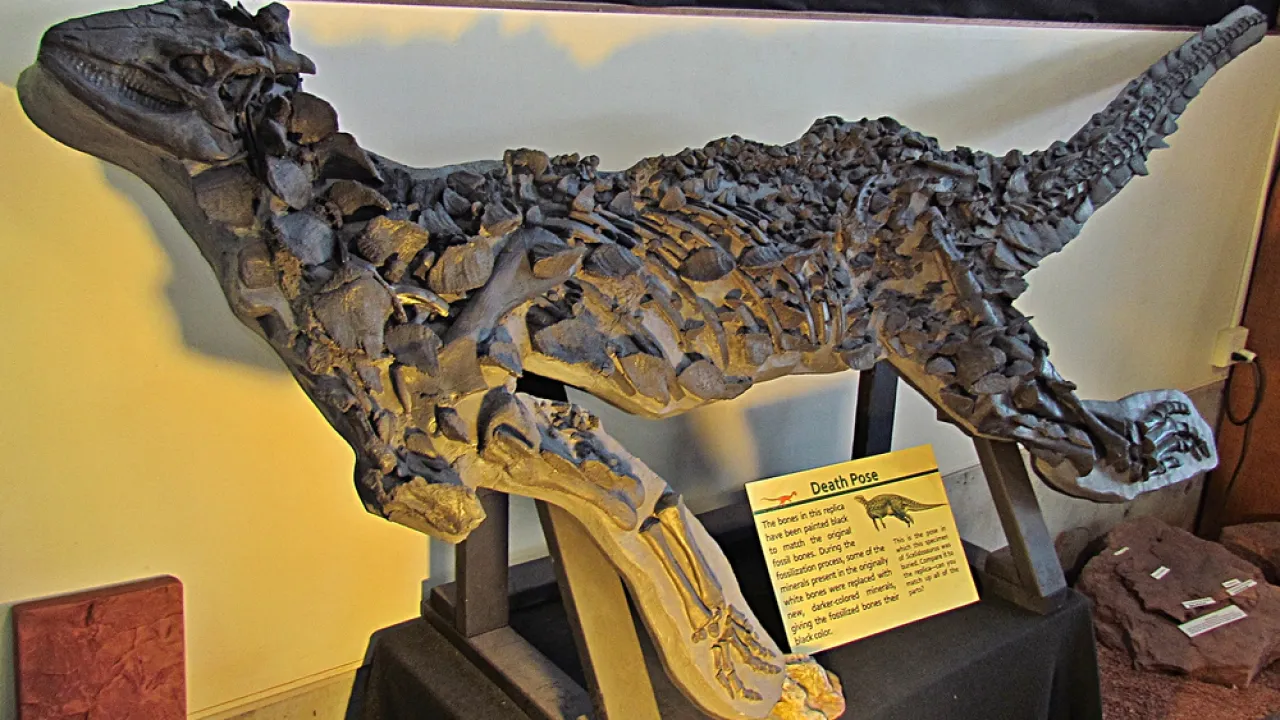
⚡ Survival SuperpowerHundreds of horn-covered bony studs from neck to tail plus three-pointed neck hornlets
🤯 Mind-Blowing Fact • Grade 1
Scelidosaurus was the very first nearly complete dinosaur skeleton ever studied by scientists anywhere on Earth!
✨ Word Sparks (Grade 1 Glossary)
Tap 🔊 to hear
armor
a hard outer covering that protects bodies
stud
a raised hard bump set in skin
browser
an animal that nibbles leaves off bushes
🪝
Which dinosaur wore a bumpy coat of bony armor from its neck to its tail?
1
Suit of Bony Bumps
Clack, thud, clack! Along an ancient rocky beach walks a living tank. Scelidosaurus wore neat rows of hard bony bumps embedded right inside its tough skin!
2
Tiny Neck Horns
Right behind its small head poked out two three-pointed horns! Hungry hunters could not easily bite through its spiky shield.
3
Seaside Leaf Muncher
Walking low on four sturdy legs, this gentle snipped ferns and bushes beside warm Jurassic seas.
1. What protected the back and sides of Scelidosaurus?
2. What made the discovery of Scelidosaurus famous in dinosaur history?
🤯 Mind-Blowing Fact • Grade 2
Fossilized skin impressions around Scelidosaurus bones show tiny pebble-like scales filling the spaces between its big armor plates!
✨ Word Sparks (Grade 2 Glossary)
Tap 🔊 to hear
quarry
a place where stone is dug out
limestone
hard gray rock formed on sea floors
scute
a bony armor plate set in skin
🪝
How did coastal waves in southern England wash out the world's first complete dinosaur skeleton?
1
Cliffs of Ancient Dorset
Listen to ocean waves crashing against gray cliffs in Charmouth, England! In the 1850s, worker James Harrison split open heavy boulders from the beach and uncovered almost every bone of an armored dinosaur. Sir Richard Owen named it Scelidosaurus in 1859.
2
Cousin to Plates and Clubs
Living 193 million years ago, Scelidosaurus stood near the beginning of the armored dinosaur family. Millions of years later, its relatives branched into plate-backed Stegosaurus and club-tailed Ankylosaurus!
3
Simple Snip-and-Swallow Bite
Its small triangular skull held narrow, leaf-shaped teeth that snipped ferns cleanly up and down without sideways chewing.
2. Which famous later dinosaurs were distant armored cousins of Scelidosaurus?
🤯 Mind-Blowing Fact • Grade 3
Although named in 1859, Scelidosaurus did not receive its complete, bone-by-bone anatomical monograph until paleontologist David Norman published it in 2020!
✨ Word Sparks (Grade 3 Glossary)
Tap 🔊 to hear
osteoderm
a bony deposit forming plates inside skin
nodule
a rounded lump of hard mineral stone
thyreophoran
a member of the armored shield-bearer dinosaurs
🪝
Why did the world's first complete dinosaur skeleton wait more than 150 years for its full scientific description?
1
Washed Out to an Ancient Sea
Picture wooded islands dotting a warm shallow sea across Early Jurassic Europe 193 million years ago. Along sandy shores plodded thirteen-foot Scelidosaurus harrisonii, cropping low cycads and ferns. Occasionally, seasonal floods swept an individual offshore, where fine seafloor mud sealed its entire body—armor plates still in place—inside protective limestone !
2
Horns and Keeled Osteoderms
Acid-prepared fossils discovered later on the Dorset coast revealed astonishing details that nineteenth-century chisels missed. Rows of ridged bony plates called wore sharp outer sheaths of tough keratin, while two curved, three-pointed hornlets jutted from the back corners of its neck like a spiked collar!
3
Shield-Bearer Blueprint
Paleontologist David Norman published a landmark four-part study in 2020 completing Richard Owen's 1861 work, showing Scelidosaurus walked on all fours with sturdy hooves.
4
Ancestral Armor
As an early —meaning shield-bearer—Scelidosaurus shows how humble rows of skin studs launched 130 million years of spectacular dinosaur armor.
1. What extra protection sat right behind the skull of Scelidosaurus?
2. How were Scelidosaurus armor plates preserved right where they belonged in life?
🤯 Mind-Blowing Fact • Grade 4
Gentle acid baths dissolved Dorset limestone tightly enough to reveal fossilized horn caps still outlining the bony armor studs of Scelidosaurus!
✨ Word Sparks (Grade 4 Glossary)
Tap 🔊 to hear
articulated
joined together in natural living bone positions
keeled
having a raised central ridge like boats
carbonate
mineral rock that dissolves in mild acid
🪝
How did gentle chemical baths dissolve solid rock to reveal keratin sheaths on a 193-million-year-old armored dinosaur?
1
A Victorian Fossil Revisited
When quarryman James Harrison sent fossil-packed limestone blocks from Charmouth, Dorset, to Sir Richard Owen—the scientist who coined the word Dinosauria—Scelidosaurus harrisonii became the first dinosaur known from an skeleton. Yet mechanical chisels in the 1860s could not expose every delicate surface, leaving key mysteries unsolved until freshly discovered Dorset skeletons underwent gentle acetic-acid preparation more than a century later.
2
Layered Skin and Keratin Armor
Dissolving the surrounding rock grain by grain unveiled exquisite soft-tissue halos around the bony osteoderms. In life, each hollow-based, scute carried an even sharper outer cap of horn—just like modern crocodile scutes or cattle horns—making its armor taller and deadlier than bare bone alone! Tiny polygonal scales carpeted the flexible skin between rows.
3
Quadrupedal Island Browser
Measuring four meters long and weighing roughly 250 kilograms, Scelidosaurus walked habitually on all fours, balancing a wide ribcage over stocky five-fingered hands and four-toed hind feet. Its small skull bore rough cranial armor fused to the bone and serrated, leaf-shaped teeth that sheared coastal ferns and conifers.
4
Root of the Ankylo-Stegosaur Tree
Recent phylogenetic studies place Scelidosaurus either near the common ancestor of stegosaurs and ankylosaurs or as one of the earliest cousins on the ankylosaur branch.
1. Why was Scelidosaurus armor even sharper in life than bare fossil bones suggest?
2. How did modern scientists remove hard limestone from new Scelidosaurus skeletons without scratching them?
🤯 Mind-Blowing Fact • Grade 5
Unlike later duck-bills or horned dinosaurs, Scelidosaurus still kept teeth right at the tip of its upper snout alongside a small horny beak!
✨ Word Sparks (Grade 5 Glossary)
Tap 🔊 to hear
orthal
moving jaws straight up and down
ungual
the tip toe bone bearing a hoof
archipelago
a cluster or chain of ocean islands
🪝
What makes Early Jurassic Scelidosaurus the Rosetta Stone for understanding how armored dinosaurs evolved?
1
From Dorset Quarry to Paleontological Milestone
In 1858, coastal quarry operator James Harrison recovered hindlimb fragments and subsequently a nearly intact four-meter dinosaur skeleton encased in Sinemurian-age calcareous marls of the Charmouth Mudstone Formation at Black Ven, Dorset. Described by Sir Richard Owen between 1859 and 1863 as Scelidosaurus harrisonii, the specimen represented history's first substantially complete dinosaur skeleton—predating famous American Bone Wars mounts by decades.
2
Dermal Skeleton and Epidermal Preservation
Subsequent skeletons collected along England's Jurassic Coast and prepared via dilute formic and acetic acid immersion transformed understanding of basal thyreophoran integument. Longitudinal rows of hollow-based, keeled osteoderms ran down the neck, trunk, flanks, and tail, flanked by mosaic interstitial scales. Dark organic halos preserved around individual scutes confirm thick epidermal keratin sheaths amplified every ridge, while paired tricuspate occipital hornlets protected the vulnerability of the neck.
3
Cranial Anatomy and Puncturing-Crushing Bite
Its small, triangular cranium carried rugose exostoses—rough bony armor fused across the skull roof and brow—and retained five premaxillary teeth ahead of leaf-shaped maxillary and dentary crowns bordered by coarse denticles. Lacking complex sideways jaw kinesis, Scelidosaurus employed simple (up-and-down) puncture-crushing strokes to crop tough coastal cycads, bennettitaleans, and ferns, aided by a broad hindgut fermentation barrel.
4
Locomotion and Phylogenetic Placement
Comprehensive monographic reassessment by David Norman in 2020 demonstrated obligate quadrupedalism in mature individuals, with robust forelimbs and hoof-like supporting a barrel-shaped torso. Cladistic analyses recover Scelidosaurus either just outside Eurypoda—the split between Stegosauria and Ankylosauria—or at the very base of Ankylosauromorpha.
5
Island Archipelagos of Early Jurassic Europe
Inhabiting subtropical islands bordering shallow epicontinental seas, Scelidosaurus relied on passive dermal armor to deter early large theropods patrolling Jurassic coastlines.