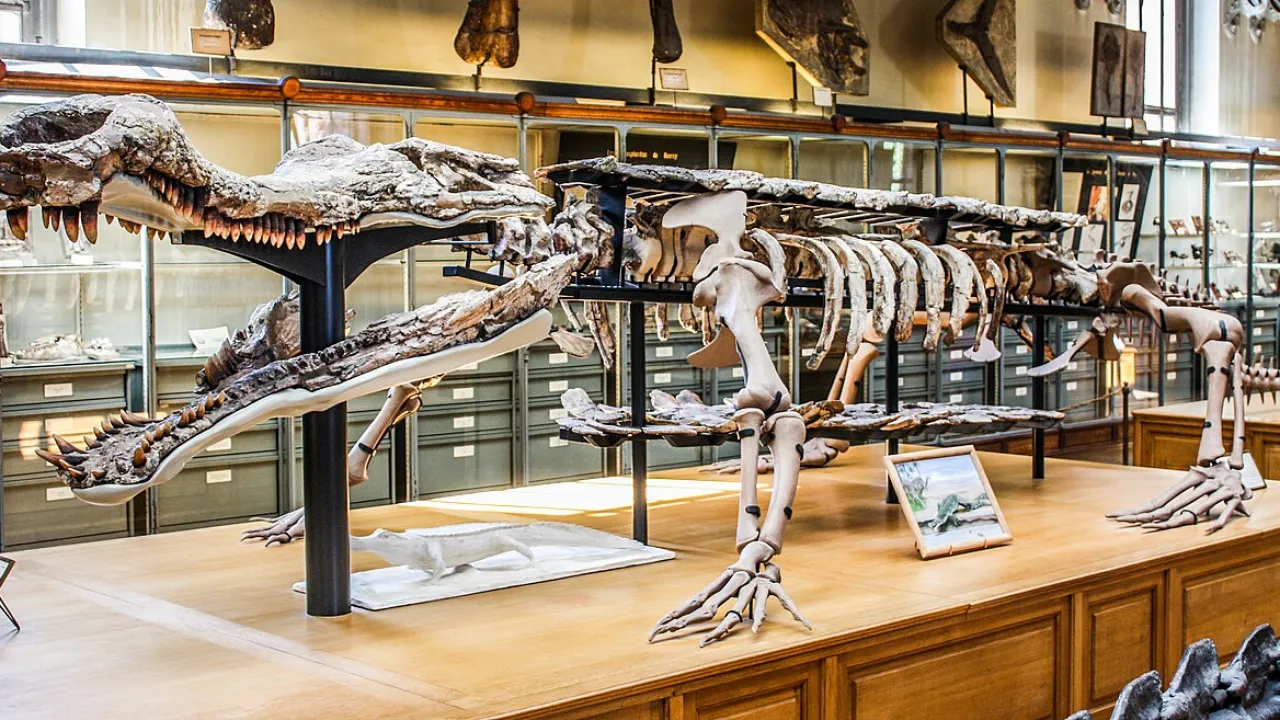
⚡ Survival SuperpowerFive-foot skull tipped with a booming sound bulb and armor plates from neck to tail
🤯 Mind-Blowing Fact • Grade 1
Fossils of this giant water beast were dug out of dry sand dunes in the Sahara Desert—which used to be a green land of huge rivers!
✨ Word Sparks (Grade 1 Glossary)
Tap 🔊 to hear
Snout
Long front nose and jaw of crocodilians
Submerged
Hidden completely underneath the surface of water
Bellow
A deep, loud booming call
🪝
Could a crocodile cousin grow longer than a moving truck?
1
Two Eyes Above the River
Ripple, bubble, hush! Two bumpy eyes peek above a wide warm river. Underneath the water hides giant Sarcosuchus! Its head alone was taller than a first grader.
2
A Funny Nose Bulb
At the very tip of its long sat a big round bump! That hollow nose chamber helped it make deep booming sounds across the water.
3
Fish and Thirsty Dinosaurs
Over a hundred cone teeth lined its jaws. Sarcosuchus caught giant river fish and surprised careless dinosaurs coming for a drink!
1. How tall was just the skull of an adult Sarcosuchus if stood upright?
2. Why were Sarcosuchus river fossils found inside the hot, dry Sahara Desert?
🤯 Mind-Blowing Fact • Grade 2
Growth rings in Sarcosuchus armor plates show it took thirty-five to forty years to reach full adult size and lived up to sixty years!
✨ Word Sparks (Grade 2 Glossary)
Tap 🔊 to hear
Bulla
Expanded bony chamber at the snout tip
Scute
Bony armor plate set in crocodilian skin
Cretaceous
Third and final period of the dinosaur era
🪝
What is a five-foot crocodile skull doing out in the middle of desert sand dunes?
1
Emperor of Ancient Rivers
Picture standing beside a winding tropical river in Africa 115 million years ago! Gliding silently beneath lily pads and ferns is Sarcosuchus imperator, whose name means 'flesh crocodile emperor.' Stretching roughly thirty feet long and weighing four tons, it weighed twice as much as today's biggest saltwater crocodile!
2
Periscope Eyes and a Sound Chamber
Sarcosuchus had telescope-like eye sockets pointing upward rather than sideways. It could watch thirsty dinosaurs on shore while keeping almost its whole armored body hidden underwater! At its snout tip sat a hollow bony bowl called a that amplified deep rumbles.
3
Seamless Back Shield
Unlike modern crocodiles that have flexible gaps in their neck armor, Sarcosuchus wore overlapping rectangular bone plates all the way from head to tail!
1. How did upward-pointing 'telescoping' eye sockets help Sarcosuchus hunt?
2. How long did Sarcosuchus keep growing to reach its giant thirty-foot adult size?
🤯 Mind-Blowing Fact • Grade 3
When Africa and South America were just starting to drift apart in the Early Cretaceous, a closely related species, Sarcosuchus hartti, swam in rivers of northeastern Brazil!
✨ Word Sparks (Grade 3 Glossary)
Tap 🔊 to hear
Piscivore
Predator adapted mainly for catching and eating fish
Pholidosaur
Extinct long-snouted cousin family of modern crocodilians
Gharial
Modern slender-snouted crocodilian with a nose bulb
🪝
Why did paleontologists nickname Sarcosuchus 'SuperCroc'—and why wasn't it actually a true modern crocodile?
1
Expeditions Into Gadoufaoua
French paleontologist Félix de Broin and Philippe Taquet first described giant crocodile-like teeth and scutes from Niger in 1966. Decades later, expeditions led by Paul Sereno into Gadoufaoua—whose Tuareg name means 'the place where camels fear to go'—unearthed nearly complete five-and-a-half-foot skulls from 112-million-year-old sandstone!
2
Cousin, Not Direct Ancestor
Despite the 'SuperCroc' nickname, Sarcosuchus belonged to an extinct cousin family called Pholidosauridae rather than modern crown crocodilians. Its snout made up seventy-five percent of its 1.6-meter skull—narrow like a fish-catching in youngsters, then widening dramatically in older adults.
3
Changing Menu as It Grew
That widening snout reveals a clever diet shift! Young and teenage Sarcosuchus snapped up six-foot armored garfish and giant coelacanths like Mawsonia, while thirty-foot adults added riverside iguanodont dinosaurs like Ouranosaurus to their menu.
4
Sharing Waters With Spinosaurus Relatives
Sarcosuchus shared Niger's Early Cretaceous rivers with fish-eating spinosaurid dinosaurs such as Suchomimus—proving those ancient waterways teemed with gigantic fish!
1. How did Sarcosuchus's snout and diet change as it grew from a youngster into a thirty-foot adult?
2. Why are fossils of Sarcosuchus found in both Niger in Africa and Bahia in Brazil?
🤯 Mind-Blowing Fact • Grade 4
Sarcosuchus had an overbite where its upper front jaw hung past its lower jaw, creating a formidable fish-hook trap armed with 132 thick conical teeth!
✨ Word Sparks (Grade 4 Glossary)
Tap 🔊 to hear
Torsion
Twisting force applied along a bone or snout
Finite-element
Computer engineering method testing stress on 3D shapes
Nares
Bony nostril openings inside a vertebrate skull
🪝
Could thirty-foot Sarcosuchus perform a crocodile 'death roll,' and why did scientists revise its famous forty-foot size estimate?
1
Recalibrating a Cretaceous Giant
Journey to the Aptian-Albian river channels of Niger's Elrhaz Formation 115 million years ago. Resting beneath overhanging ferns is Sarcosuchus imperator. When Paul Sereno's team unveiled new skeletons in 2001, scaling from modern gharials and saltwater crocodiles yielded headline estimates near 11.6 meters (38 feet) and eight metric tons. In 2019, Haley O'Brien and colleagues applied broader crocodyliform cranial-width scaling equations, refining realistic maximum size to 9 to 9.5 meters (30–31 feet) and 3.5 to 4.5 metric tons—still nearly double the mass of the largest living crocodile!
2
Twist Limits in biomechanical Skull Models
Did Sarcosuchus spin submerged dinosaurs apart using a classic crocodile death roll? In 2014, biomechanical modeling by Blanco and colleagues tested skull stress during twisting versus straight biting. Unlike broad-snouted Deinosuchus or Purussaurus, Sarcosuchus's elongated tubular rostrum experienced high torsional stress if twisted violently—indicating it caught giant Mawsonia lobe-fins with quick lateral sweeps and dragged larger prey straight underwater rather than death-rolling!
3
Acoustic Bulla and Continuous Armor
Expanding around huge external at the tip of the premaxillae sat a hollow bony bulla analogous to the soft cartilaginous ghara of adult male Indian gharials, likely enhancing low-frequency infrasonic water vibrations and olfaction. Meanwhile, peg-and-socket dorsal osteoderms formed a rigid continuous shield.
4
Coexisting River Giants
Partitioning deep channels alongside the eleven-meter spinosaurid Suchomimus, Sarcosuchus anchored one of history's richest freshwater ecosystems before rising mid-Cretaceous seas drowned its river basins.
1. What did 2014 computer stress models reveal about whether Sarcosuchus used a twisting 'death roll' on huge dinosaurs?
2. Why did paleontologists refine Sarcosuchus's estimated length from ~39 feet down to ~30–31 feet in recent studies?
🤯 Mind-Blowing Fact • Grade 5
Each interlocking armor scute along Sarcosuchus's back locked into its neighbor with a forward-pointing bony peg-and-groove joint—stiffening its spine like an medieval knight's brigandine!
✨ Word Sparks (Grade 5 Glossary)
Tap 🔊 to hear
Longirostrine
Having a notably long, narrow fish-catching snout
Skeletochronology
Estimating animal age from annual rings inside bones
Neosuchia
Clade containing modern crocodilians and close fossil relatives
🪝
How do osteoderm histology, cranial finite-element analysis, and Gondwanan paleogeography illuminate the true biology of Niger's thirty-foot pholidosaur?
1
Discovery Across Trans-Atlantic Gondwana
First named in 1966 by Félix de Broin and Philippe Taquet from Aptian-Albian fluvial sandstones of the Elrhaz Formation at Gadoufaoua, Niger (with sister taxon Sarcosuchus hartti recognized in the Recôncavo Basin of Bahia, Brazil), Sarcosuchus imperator stands as the largest known member of Pholidosauridae—a clade of neosuchian crocodyliforms outside crown-group Crocodylia. Expeditions led by Paul Sereno between 1997 and 2000 recovered half a dozen skulls up to 1.6 meters long alongside articulated vertebrae, appendicular elements, and dermal osteoderms.
2
Allometric Recalibration and Skeletochronology
Initial 2001 extrapolations pairing skull length against Indian gharial and saltwater crocodile regressions yielded totals of 11 to 12 meters and 8 metric tons. Subsequent femoral regressions and trans-crocodyliform cranial-width scaling (O'Brien et al., 2019) corrected for Sarcosuchus's disproportionately long rostrum (75% of skull length), converging on realistic adult dimensions of 9.0 to 9.5 meters and 3.5 to 4.5 metric tons. Histological lines of arrested growth (LAGs) in paravertebral osteoderms indicate sustained active growth across 35 to 40 years without an abrupt juvenile plateau.
3
Rostral Biomechanics and Feeding Ontogeny
Bearing 35 premaxillary-maxillary teeth per upper side and 31 dentary teeth per lower side (132 total), Sarcosuchus exhibited pronounced ontogenetic snout broadening accompanied by a hooked premaxillary overbite. Finite-element structural analyses (Blanco et al., 2014; McHenry et al.) demonstrate that while adult jaws generated formidable straight-line adductor forces, the tubular pholidosaur rostrum lacked the torsional resistance required for rotational dismemberment ('death rolling') of multi-ton prey—pointing toward generalized piscivory on giant Mawsonia coelacanths and Lepidotes gars supplemented by straight-pull drowning of juvenile or medium ornithopod dinosaurs.
4
Nasal Bulla and Articulated Dermal Carapace
Surrounding cavernous external nares, an expanded premaxillary bulla formed a vascularized acoustic and olfactory resonator analogous to the male Gavialis ghara. Postcranially, overlapping rectangular osteoderms linked by anterior articular pegs stiffened the trunk from occiput to mid-tail—trading onshore agility for armored aquatic stability.
5
Mid-Cretaceous Marine Transgressions
Sharing Gadoufaoua channels with spinosaurids (Suchomimus) and nigersaurine sauropods, freshwater pholidosaurs declined during Cenomanian sea-level rises as eusuchian crocodylians radiated worldwide.