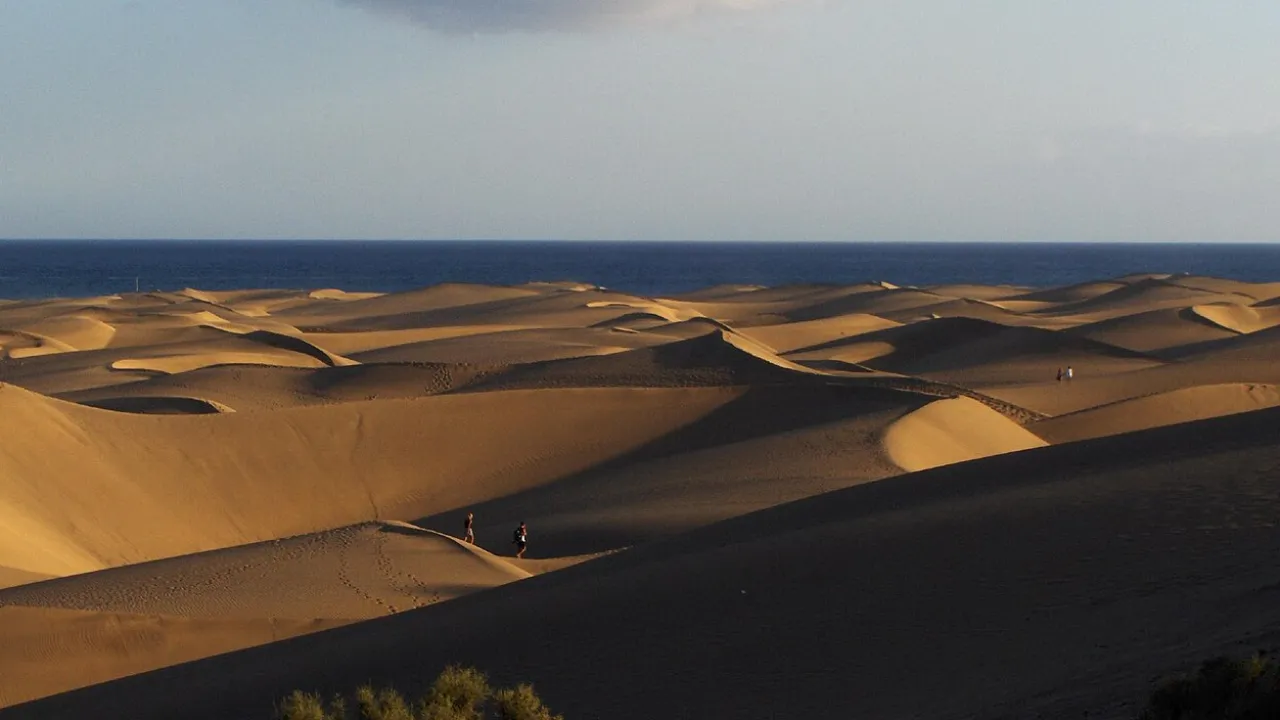
1. What natural force builds and moves sand dunes?
2. Why does blowing wind drop sand to start a new dune?
🤯 Mind-Blowing Fact • Grade 2
Colorado's Great Sand Dunes National Park boasts North America's tallest dunes, rising 750 feet high right beside snowy mountains!
✨ Word Sparks (Grade 2 Glossary)
Tap 🔊 to hear
Quartz
Hard shiny mineral that makes most beach sand
Crest
Highest sharp ridge along the top of a dune
Obstacle
Object like a rock or bush blocking wind
🪝
How can blowing sand carve strange stone mushrooms out of solid desert rock?
1
Nature's Sandpaper Blast
Squint across a sunny desert as gusts of wind whip dry sand above the ground! When wind carries millions of sharp grains, it acts like flying sandpaper. This wind erosion scrapes and polishes desert boulders into wild mushroom shapes.
2
Bouncing Up the Ramp
Every sand dune has two different sides. Wind bounces sand grains up the gentle, rippled front slope until they reach the sharp top ridge. Then gravity tumbles the sand down the steeper back slope.
3
Coastal Storm Guards
Sand dunes do not just belong in dry deserts! Grassy dunes line sandy ocean beaches too, standing like brave walls that block big storm waves from flooding coastal towns.
1. How does windblown sand carve desert boulders into mushroom shapes?
2. How do grassy beach dunes help people who live near the ocean?
🤯 Mind-Blowing Fact • Grade 3
Tiny specks of mineral dust blown out of Africa's Sahara Desert float all the way across the Atlantic Ocean to fertilize the Amazon Rainforest!
✨ Word Sparks (Grade 3 Glossary)
Tap 🔊 to hear
Saltation
Bouncing frog-like hops of windblown sand grains
Slip Face
Steep sheltered downwind side where sand slides
Desert Pavement
Tight pebble surface left after wind removes dust
🪝
Why do jumping sand grains stay close to your ankles while fine dust crosses entire oceans?
1
Three Ways Wind Moves Sediment
Listen to the soft hiss of sand skimming across a windy beach! Wind moves loose particles in three distinct ways depending on weight. Tiny dust specks float high in the sky, heavy pebbles roll slowly along the ground, and medium sand grains leap like tiny frogs.
2
The Hopping Dance of Saltation
Scientists call that frog-hopping sand motion , from a Latin word meaning 'to leap.' Each falling sand grain smacks into other grains on the ground, kicking them upward into the breeze to keep the chain reaction hopping.
3
Windward Slopes and Slip Faces
Saltating grains bounce up a dune's gentle windward slope and pile along its crest. Once the pile grows too steep, sand avalanches down the sheltered downwind side, called the . Grain by grain, the entire dune migrates downwind!
4
Abrasion and Desert Pavement
Because hopping sand rarely bounces higher than one meter, wind abrasion carves boulders heaviest near their bases. Meanwhile, wind blows away loose dust and sand—leaving behind a tight armor of pebbles called .
2. What do geologists call the steep downwind side of a dune where sand avalanches downward?
🤯 Mind-Blowing Fact • Grade 4
Fast-moving crescent barchan dunes in windy deserts can march forward up to one hundred feet in a single year—fast enough to swallow highways and desert outposts!
✨ Word Sparks (Grade 4 Glossary)
Tap 🔊 to hear
Aeolian
Shaped, carried, or deposited by blowing wind
Deflation
Wind erosion lifting away loose dust and sand
Ventifact
Rock polished and flattened by windblown sandblasting
🪝
Why are boardwalks built over coastal dunes in Virginia Beach instead of letting visitors walk straight across the sand?
1
Aeolian Sculptors of Dry and Coastal Lands
Step onto the wooden walkway at Cape Henry along Virginia's Chesapeake Bay entrance, where towering sandy ridges once guided colonial ships! Geologists call wind-driven erosion, transport, and deposition processes, named after Aeolus, the Greek keeper of the winds. Wherever dry sand lacks thick plant cover—whether in the Sahara Desert or along Atlantic barrier islands—wind becomes a master sculptor.
2
Deflation Hollows and Ventifacts
Wind erodes landscapes through two distinct mechanisms: and abrasion. Deflation lifts and carries away loose silt and sand, sometimes scooping out shallow desert basins called blowouts until moisture at the water table stops further digging. Meanwhile, abrasion blasts exposed stones with hopping quartz crystals, carving flat, polished facets into wind-shaped rocks known as .
3
Crescent Barchans and Star Dunes
Wind direction and sand supply control a dune's shape. Steady one-way winds with limited sand sculpt crescent-shaped barchan dunes whose pointed horns point downwind. Where winds blow from shifting seasonal directions, sand piles upward into towering, multi-armed star dunes that stay nearly in one spot.
4
Why Sea Oats Need Boardwalks
Along Virginia's Outer Banks and Eastern Shore, deep-rooted American beachgrass and sea oats trap windblown sand to build protective foredunes. Because footsteps crush fragile grass roots and carve wind tunnels that blow a protective dune apart, raised wooden boardwalks keep both beachgoers and storm-blocking dunes safe.
1. Why do coastal parks ask visitors to use wooden boardwalks instead of walking directly on grassy sand dunes?
2. What kind of wind pattern builds a tall, multi-armed star dune?
🤯 Mind-Blowing Fact • Grade 5
China's Badain Jaran Desert hosts the tallest stationary megadunes on Earth, towering nearly 500 meters (1,640 feet) high—taller than the Empire State Building's roof!
✨ Word Sparks (Grade 5 Glossary)
Tap 🔊 to hear
Angle of Repose
Steepest stable slope dry sand holds before sliding
Cross-Bedding
Tilted rock layers preserved from ancient dune slip faces
Loess
Thick fertile blanket of wind-deposited fine silt
🪝
How can geologists tell which way ancient desert winds blew 200 million years ago just by looking at solid sandstone cliffs?
1
Fluid Physics of Aeolian Transport
Stand beneath the towering Navajo Sandstone cliffs of Zion National Park in Utah, and sweeping diagonal lines crisscross nine-hundred-meter walls of solid rock. Those tilted stripes are fossilized desert sand dunes! Aeolian geomorphology operates through precise fluid physics: because air is roughly eight hundred times less dense than liquid water, wind sorts sediment far more selectively than rivers, separating airborne silt dust (<0.06 millimeters) from saltating fine-to-medium quartz sand (0.1 to 0.5 millimeters) and creeping gravel.
2
Angle of Repose and Cross-Bedding
As wind shear drives saltating sand up a gentle ten-to-fifteen-degree stoss (windward) slope, grains accumulate just beyond the brink until dry sand exceeds its maximum stable slope—the , approximately thirty-four degrees. Grainflows then cascade down the leeward slip face, burying thin angled sheets of sand one atop another. When mineral-rich groundwater later cements the dune into sandstone, those angled slip-face layers remain frozen as cross-beds pointing directly downwind!
3
A Global Lexicon of Dune Morphology
Dune architecture maps wind regimes with remarkable precision. Unidirectional winds over sparse sand form crescentic barchans; abundant sand merges ridges into wavy transverse dunes perpendicular to the wind; coastal vegetation anchors U-shaped parabolic dunes whose horns point upwind; and converging trade winds sculpt parallel linear seif dunes stretching more than one hundred kilometers across the Arabian Empty Quarter and Namibia's Namib Erg.
4
Yardangs, Loess Blankets, and the Dust Bowl
Beyond sand seas, wind abrasion carves streamlined bedrock ridges called yardangs, while windblown glacial silt settles downwind in fertile blankets of yellow tens of meters thick across China's Loess Plateau and America's Midwest. Conversely, when 1930s drought met plowed-up native prairie grasses on the Great Plains, catastrophic wind deflation stripped hundreds of millions of tons of topsoil during the Dust Bowl.
5
Alien Dunes Across the Solar System
Anywhere an atmosphere meets granular particles, dunes arise: dark basaltic barchans march across Mars's thin carbon-dioxide breeze, hydrocarbon dunes circle Saturn's moon Titan, and nitrogen-ice winds sculpt methane-ice dunes across distant Pluto.