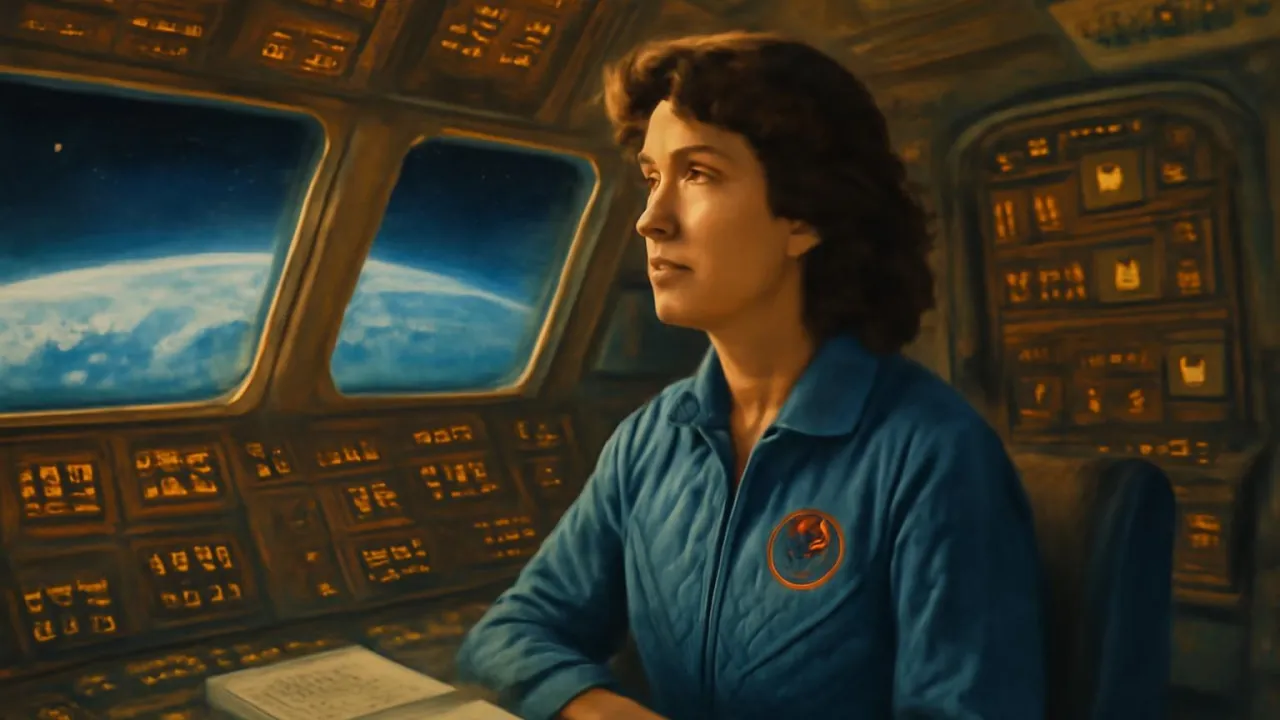
Sally Ride was only 32 years old when she went to space!
✨ Word Sparks (Grade 2 Glossary)
Tap 🔊 to hear
NASA
America’s space travel group
planets
Big round worlds in space
inspire
Make others want to try too
🪝
Have you ever wondered what it’s like to float in space?
1
A Sky Full of Dreams
When Sally was a girl, she loved to watch the stars. She imagined flying through space and learning about the . She read many books about science and rockets.
2
Working to Be an Astronaut
Sally studied science and math very hard in school. She learned to fly special jets and trained with . She kept trying, even when things were tough.
3
A Historic Space Journey
Sally rode the space shuttle Challenger in 1983. She became the first American woman in space. She inspired many kids to dream big and love science.
Sally Ride operated the space shuttle’s robotic arm to help launch satellites!
✨ Word Sparks (Grade 3 Glossary)
Tap 🔊 to hear
physics
The science of how things move
gravity
A force that pulls things down
legacy
What someone leaves for the future
🪝
Imagine looking out a window and seeing our whole planet below you!
1
A Curious Mind
As a child, Sally Ride was fascinated by science and loved reading about the universe. She played tennis and dreamed of exploring faraway places. Her curiosity made her ask big questions about how things worked. She wanted to see what was beyond the sky.
2
Training for Space
Sally studied at college and became very skilled in science. She joined NASA and trained with other astronauts, learning about rockets, , and teamwork. Training was tough, but Sally’s perseverance helped her succeed. She learned to fly jets and solve problems quickly.
3
A Giant Leap
In 1983, Sally rode the Challenger space shuttle into orbit around Earth. She became the first American woman in space and performed important science experiments. Sally helped operate the shuttle’s robotic arm to launch satellites. Her achievements showed that women could be leaders in science and space.
4
Inspiring the Next Generation
After her missions, Sally worked to encourage kids, especially girls, to study science. She wrote books and started programs to make science fun for everyone. Sally believed anyone could be a scientist with hard work and curiosity. Her continues to inspire students today.
Sally Ride was chosen from over 8,000 applicants to become an astronaut!
✨ Word Sparks (Grade 4 Glossary)
Tap 🔊 to hear
simulator
A machine that copies real-life training
STEM
Science, technology, engineering, and math
orbited
Traveled around something in space
🪝
What challenges would you face if you were the first woman astronaut from your country?
1
A Girl with Big Questions
Growing up in California during the 1960s, Sally Ride was always curious about the world and the stars above. She loved reading science books and playing competitive tennis, which taught her discipline and focus. Sally often wondered how rockets worked and what Earth looked like from space. Her family encouraged her curiosity, even when few girls dreamed of becoming astronauts.
2
Breaking Barriers at NASA
After studying physics at Stanford University, Sally applied to NASA’s new astronaut program in 1977, which finally accepted women. She trained alongside men, mastering flight , survival skills, and teamwork under pressure. Sally’s perseverance and intelligence helped her stand out among hundreds of applicants. She proved that women could handle the physical and mental challenges of spaceflight.
3
A Historic Mission
On June 18, 1983, Sally blasted off aboard the space shuttle Challenger, making history as the first American woman in space. She spent six days orbiting Earth, conducting experiments and operating the shuttle’s robotic arm to deploy satellites. Sally’s calm problem-solving and scientific skill impressed her crew and the world. Her journey inspired millions to believe that space was for everyone.
4
Champion for Science Education
After her missions, Sally became a professor and wrote science books for children, eager to share her love of discovery. She founded Sally Ride Science to encourage girls and boys to explore fields and break down barriers. Sally’s life showed that with curiosity, courage, and hard work, anyone could reach for the stars. Her legacy continues to shape science education today.
1. How did Sally’s tennis skills help her as an astronaut?
2. Why did Sally start Sally Ride Science?
🤯 Mind-Blowing Fact • Grade 5
Sally Ride was the youngest American astronaut ever to fly in space at age 32.
✨ Word Sparks (Grade 5 Glossary)
Tap 🔊 to hear
microgravity
Very weak gravity, like floating in space
simulator
A machine that lets you practice for real
diversity
Having many different kinds of people
🪝
How does it feel to break a barrier that changes history for everyone after you?
1
Curiosity Ignites a Dream
As a young girl in Los Angeles, Sally Ride was endlessly curious about the universe, often gazing at the night sky and reading science fiction novels. She excelled in both academics and tennis, competing nationally, which taught her resilience and strategic thinking. Sally’s fascination with physics grew stronger in college, where she realized that understanding the laws of nature could unlock the secrets of space. Encouraged by her family and teachers, she decided to pursue a career in science at a time when few women entered the field. Her early dreams were fueled by the question: could she ever travel beyond Earth herself?
2
The Road to NASA
In 1977, NASA announced that it would accept women into its astronaut program for the first time, and Sally Ride was one of only six women selected from over 8,000 applicants. She underwent rigorous training, including learning to pilot jets, mastering spacecraft , and practicing emergency procedures underwater to simulate weightlessness. Sally’s background in physics and her calm demeanor under pressure made her a standout candidate among her peers. She faced skepticism and gender bias but remained determined to prove her capabilities. Her perseverance and technical expertise opened doors for many women who would follow in her footsteps.
3
Making History in Space
On June 18, 1983, Sally Ride launched aboard the space shuttle Challenger, becoming the first American woman and, at age 32, the youngest American astronaut in space. During her six-day mission, she operated the shuttle’s robotic arm to deploy and retrieve satellites, conducted scientific experiments in , and communicated findings with mission control. Sally’s professionalism and problem-solving skills earned the respect of her crew and inspired millions watching around the world. She later flew on a second Challenger mission in 1984, further demonstrating her expertise and dedication to space exploration.
4
Championing Science and Equality
After her astronaut career, Sally Ride became a professor of physics and dedicated herself to promoting science education, especially for girls and minorities. She founded Sally Ride Science in 2001, creating programs, books, and camps that made STEM subjects accessible and exciting for students nationwide. Sally also served on major panels investigating the Challenger and Columbia shuttle accidents, using her knowledge to improve astronaut safety. She believed that and curiosity were essential for scientific progress and worked tirelessly to break down barriers in STEM fields.
5
A Lasting Legacy
Sally Ride’s courage and achievements transformed the face of space exploration and inspired generations to pursue their dreams, regardless of gender. She received numerous honors, including induction into the Astronaut Hall of Fame and the Presidential Medal of Freedom. Today, her legacy lives on through the countless students she inspired and the ongoing work of Sally Ride Science. Sally’s life reminds us that with perseverance, curiosity, and courage, anyone can reach for the stars and change history for the better.