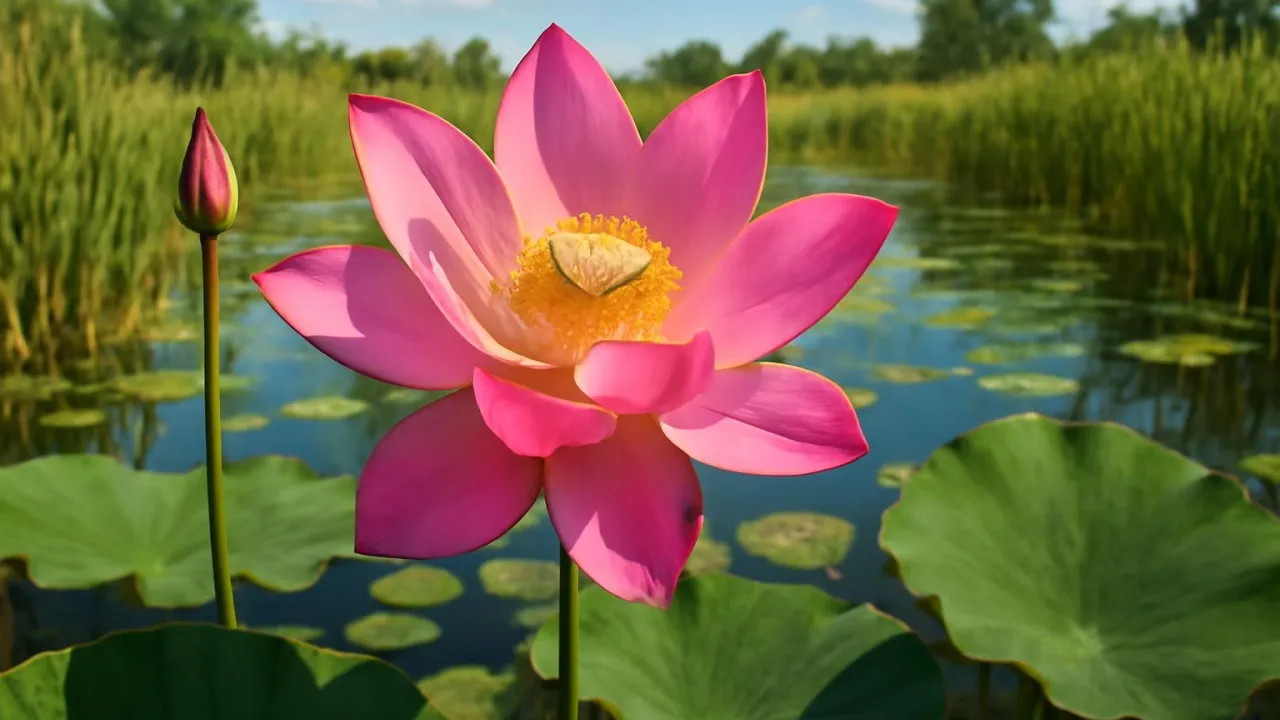
The sacred lotus leaf’s surface is so smooth that water beads up and rolls away!
✨ Word Sparks (Grade 2 Glossary)
Tap 🔊 to hear
nectar
Sweet juice inside flowers that bees drink.
wetland
A place where land is covered with water.
surface
The outside part of something.
🪝
Have you ever seen a flower that grows in muddy water and stays clean?
1
Big Leaves and Bright Flowers
The sacred lotus has large, round leaves that float on water. Its flowers are pink or white and smell sweet. Bees and insects visit the flowers to gather .
2
Where It Grows
This plant grows in warm ponds and with muddy bottoms. It needs plenty of sunlight and fresh water to grow well. Fish and frogs often live nearby in the same water.
3
Amazing Water-Repellent Leaves
The lotus leaves have a special that makes water roll off quickly. This keeps the leaves clean and dry even in muddy water. This helps the plant stay healthy and strong.
The lotus leaf’s water-repellent surface is so effective it is called the 'lotus effect' in science.
✨ Word Sparks (Grade 3 Glossary)
Tap 🔊 to hear
pollination
When pollen moves to help make new seeds.
hydrophobic
A surface that water cannot stick to.
photosynthesis
How plants use sunlight to make food.
🪝
Did you know the sacred lotus uses special adaptations to survive in muddy water?
1
Floating Leaves and Bright Flowers
The sacred lotus has large, round leaves that float on water surfaces. These leaves have a waxy coating that repels water and dirt. Its flowers bloom in pink or white and attract pollinators like bees. This helps the plant reproduce and spread its seeds.
2
Habitat and Growth
This flower grows in wetlands and shallow ponds where mud covers the bottom. The plant’s roots anchor in the mud while leaves float above water. It needs sunlight to make food through . The plant’s growth cycle includes flowering and seed production during warm seasons.
3
Water-Repellent Leaves
The lotus leaves have microscopic bumps that create a water-repellent surface called . This adaptation prevents dirt and water from sticking, keeping leaves clean. Clean leaves can absorb sunlight better for . This helps the lotus survive in muddy water environments.
4
Pollination and Seed Spread
Bees and insects visit lotus flowers to collect nectar and pollen. When they move between flowers, they help pollinate the plants. After , the lotus produces seeds inside a unique seed pod. These seeds can survive drying and grow new plants later.
1. What helps the lotus leaves stay clean in muddy water?
2. How do bees help the sacred lotus?
🤯 Mind-Blowing Fact • Grade 4
The sacred lotus’s 'lotus effect' inspired scientists to create water-repellent materials for human use.
✨ Word Sparks (Grade 4 Glossary)
Tap 🔊 to hear
ecosystem
A community of plants and animals living together.
erosion
When soil or land is worn away by water or wind.
pollinator
An animal that helps plants make seeds.
🪝
How does the sacred lotus thrive in muddy wetlands and help its ecosystem?
1
Special Leaf Adaptations
The sacred lotus has large leaves covered with microscopic bumps that create a hydrophobic surface, causing water and dirt to roll off easily. This adaptation, known as the 'lotus effect,' helps keep the leaves clean and maximizes sunlight absorption for photosynthesis. Clean leaves improve the plant’s ability to produce energy, which is vital in muddy, nutrient-rich wetlands.
2
Role in Wetland Ecosystems
Sacred lotus plants provide habitat and food for many wetland animals, including fish, frogs, and insects. Their flowers attract like bees, which help maintain biodiversity. The plant’s presence stabilizes muddy soil, reducing and improving water quality. This makes the lotus an important part of wetland food webs and health.
3
Growth and Geographic Range
Native to Asia, the sacred lotus thrives in warm, shallow ponds and wetlands with muddy bottoms. It requires full sunlight and fresh water for optimal growth. The plant’s roots anchor in the mud while its leaves and flowers float above water. It blooms during warm seasons, producing seeds that can survive dry conditions and germinate later.
4
Human Uses and Cultural Importance
Humans have long valued the sacred lotus for its beauty, edible seeds, and medicinal properties. It holds spiritual significance in many Asian cultures, symbolizing purity and rebirth. Lotus seeds and roots are used in cooking and traditional medicine. Protecting wetlands where lotus grows helps preserve both natural habitats and cultural heritage.
1. Why is the lotus leaf’s surface important for the plant?
2. How does the sacred lotus help wetland ecosystems?
🤯 Mind-Blowing Fact • Grade 5
Sacred lotus seeds have been found viable after more than 1,000 years, showing extraordinary longevity.
✨ Word Sparks (Grade 5 Glossary)
Tap 🔊 to hear
superhydrophobic
A surface that strongly repels water and dirt.
rhizome
A thick underground stem that stores nutrients.
pollinator
An animal that moves pollen to help plants reproduce.
🪝
What scientific secrets make the sacred lotus a symbol of purity and survival in muddy waters?
1
Taxonomy and Scientific Context
The sacred lotus, Nelumbo nucifera, belongs to the Nelumbonaceae family and is often confused with water lilies. Unlike water lilies, lotus leaves emerge above the water surface and have unique hydrophobic properties. This species is native to Asia and is widely cultivated for its cultural, medicinal, and ecological importance. Its botanical classification highlights its distinct evolutionary adaptations to aquatic environments.
2
Physiological Mechanics of Water Repellency
The lotus leaf’s surface contains microscopic papillae covered by a waxy cuticle, creating a effect known as the 'lotus effect.' This causes water droplets to bead and roll off, removing dirt and pathogens efficiently. This mechanism enhances photosynthetic efficiency by keeping leaves clean and dry. Scientists study this natural design to develop self-cleaning and water-repellent materials for human applications.
3
Growth, Reproduction, and Seed Longevity
Nelumbo nucifera grows in warm, shallow freshwater wetlands, anchoring roots in muddy sediment while leaves and flowers rise above water. Its flowers bloom during summer, attracting such as bees and beetles. The lotus produces large seed pods with seeds capable of surviving decades in dry conditions, a remarkable adaptation for species survival. This seed longevity supports natural regeneration even after harsh environmental changes.
4
Ecological and Cultural Significance
The sacred lotus plays a vital role in wetland ecosystems by stabilizing sediment, providing habitat, and supporting food webs through its flowers and seeds. It holds profound spiritual symbolism in Hinduism and Buddhism, representing purity and enlightenment. Humans utilize lotus seeds and in culinary dishes and traditional medicines across Asia. Conservation efforts focus on protecting wetland habitats to maintain this species’ ecological and cultural legacy.
5
Quantitative Comparisons and Conservation Challenges
Sacred lotus leaves can reach diameters up to 60 centimeters (2 feet), with flowers measuring 20 centimeters (8 inches) wide. The plant thrives in water temperatures between 20 and 30 degrees Celsius (68–86 degrees Fahrenheit). Despite its resilience, wetland drainage and pollution threaten lotus populations worldwide. Conservation programs emphasize wetland restoration and sustainable harvesting to preserve this iconic aquatic plant for future generations.