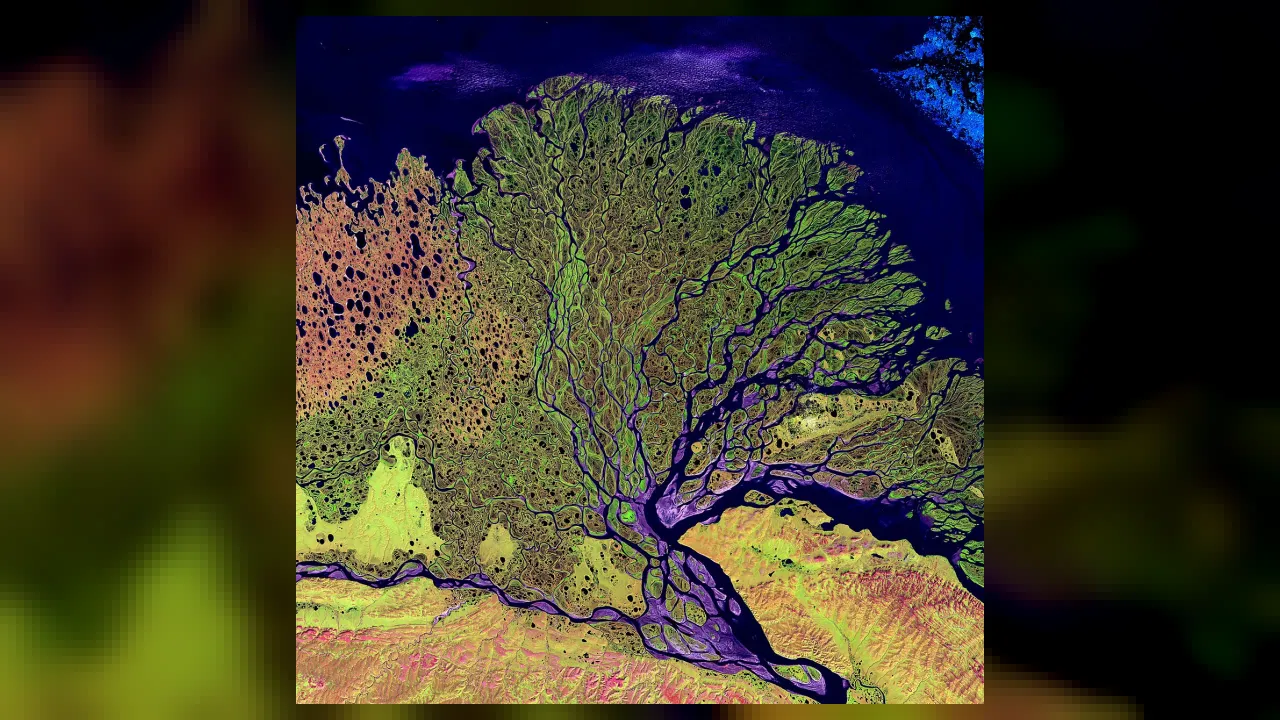
1. Why does a river drop its mud and sand when it reaches the sea?
2. What shape does a classic river delta often make?
🤯 Mind-Blowing Fact • Grade 2
The Ganges-Brahmaputra Delta in Asia is the largest delta on Earth, stretching more than two hundred miles wide!
✨ Word Sparks (Grade 2 Glossary)
Tap 🔊 to hear
Silt
Super fine soft dirt carried by flowing rivers
Channel
Path dug in the ground where water flows
Fertile
Full of plant food to help crops grow
🪝
Why did ancient explorers name river mouths after a Greek alphabet letter?
1
A Giant Triangle of Land
Zoom high above Egypt in an airplane and look down at the Nile River! Right where it meets the sea, green land spreads out like a triangle. Long ago, Greeks named it a delta because their letter Delta is a triangle.
2
How Sediment Builds Islands
Rivers carry tons of tiny dirt bits called and sand. When the river pours into calm ocean water, it loses speed and drops its heavy load. Soon, muddy islands poke above the waves.
3
Splitting Into Many Paths
Blocked by its own mud piles, the river splits into smaller finger-like streams. These rich, wet marshes grow amazing farm crops and shelter wading birds.
1. Why did ancient Greeks call the Nile River's mouth a delta?
2. Why does a river split into many smaller streams inside a delta?
🤯 Mind-Blowing Fact • Grade 3
Over the past seven thousand years, the Mississippi River has switched its main delta path at least six times, building most of coastal Louisiana!
✨ Word Sparks (Grade 3 Glossary)
Tap 🔊 to hear
Distributary
Stream branching away from a main river channel
Tributary
Smaller creek flowing into a larger main river
Wetland
Swampy or marshy land soaked with shallow water
🪝
Why does the Mississippi River Delta look like a giant bird's foot stretching into the Gulf?
1
From Mountain Pebbles to Coastal Mud
Every drop of rain washing down the middle of North America eventually funnels into the mighty Mississippi River. Along its two-thousand-mile journey, the current grinds pebbles into fine sand, silt, and clay.
2
Deposition at the Coast
When that muddy current collides with the gentle waters of the Gulf, friction slows the flow dramatically. Heavy sand grains sink first near the shore, while lighter silt and clay drift farther out before settling through deposition.
3
Distributaries Branch Outward
Upstream, smaller creeks join a main river as tributaries, but a delta works in reverse! Sediment bars force the main channel to split into branching streams called distributaries that spread water and mud outward.
4
Bird-Foot and Fan Shapes
Where ocean waves are weak, distributaries push long, narrow mud fingers far into the sea—forming the Mississippi's famous bird-foot delta. Where waves smooth the shoreline, deltas form neat curved fans like the Nile.
1. How is a distributary different from a tributary?
2. Which sediment particles settle first when a river slows down at its mouth?
🤯 Mind-Blowing Fact • Grade 4
More than five hundred million people—roughly one out of every sixteen humans on Earth—live directly on river deltas!
✨ Word Sparks (Grade 4 Glossary)
Tap 🔊 to hear
Brackish
Slightly salty mix of river and ocean water
Natural Levee
Low ridge of sand built beside flooded riverbanks
Storm Surge
Dome of ocean water pushed ashore by hurricanes
🪝
How do river deltas feed hundreds of millions of people while shielding cities from hurricanes?
1
Where Freshwater Meets Saltwater
Paddle a kayak through a coastal delta at dawn, and you glide through a labyrinth of winding bayous, cypress swamps, and grassy mudflats. Deltas form wherever a river delivers sediment to a standing body of water faster than ocean waves, tides, and currents can sweep that sediment away. Mixing freshwater and seawater also creates estuaries teeming with crabs, shrimp, and juvenile fish.
2
Sorting Sediment Layer by Layer
As river velocity drops at the coast, nature sorts sediment by weight and chemistry. Coarse sand settles near channel mouths to build and sandbars. Even more remarkably, electrically charged microscopic clay particles clump together when they touch salty seawater, sinking to build flat, nutrient-packed mudflats.
3
Cradles of Human Civilization
Because seasonal floods blanket deltas with fresh mineral silt and organic humus, delta soils rank among the richest farmland on Earth. Ancient civilizations flourished on the Nile, Tigris-Euphrates, Indus, and Yellow River deltas, and modern deltas still grow vital harvests of rice, grain, and vegetables.
4
Sponges Against Coastal Storms
Healthy delta wetlands act like giant speed bumps against hurricanes, absorbing before waves reach inland towns. When upstream dams trap sediment before it reaches the coast, however, deltas slowly sink beneath rising seas—prompting engineers to reconnect rivers to starved marshes.
1. Under what condition can a river successfully build a delta at the coast?
2. Why can building large dams far upstream accidentally shrink a coastal delta?
🤯 Mind-Blowing Fact • Grade 5
NASA's Perseverance rover landed directly beside a 3.5-billion-year-old fossilized river delta in Mars's Jezero Crater to search its fine clay bottomset beds for signs of ancient microbial life!
✨ Word Sparks (Grade 5 Glossary)
Tap 🔊 to hear
Flocculation
Tiny clay specks clumping together in salty water
Avulsion
Sudden flood switch carving a brand-new river path
Subsidence
Gradual sinking of land as wet mud compacts
🪝
Why do some rivers build curved fans, others sculpt jagged teeth, and still others stretch out like bird claws?
1
A Three-Way Tug-of-War at the Coast
Hover via satellite 700 kilometers above Earth's coastlines, and every major river delta reveals its own signature geometry. Geomorphologists classify deltas through a three-way balance of power among river sediment supply, ocean wave energy, and tidal range. Whenever a river enters a standing basin—whether an ocean, inland sea, or lake—its hydraulic gradient flattens, velocity plummets, and sediment transport capacity collapses.
2
Topset, Foreset, and Bottomset Beds
Slice vertically through a delta and three distinct sedimentary layers appear, first explained by geologist Grove Karl Gilbert. Gently sloping topset beds of coarse sand cap the delta plain; angled foreset beds cascade down the advancing underwater delta front like giant conveyor ramps; and horizontal bottomset beds of fine clay blanket the deeper seafloor ahead, aided by —where salt ions bind tiny clay flakes into heavier clumps.
3
River-, Wave-, and Tide-Dominated Shapes
In sheltered basins with weak waves and small tides, river-dominated systems like the Mississippi extend long levee-lined distributaries into digitate, or bird-foot, deltas. Moderate waves rework sediment alongshore into smooth, curved arcuate fans like the Nile, while powerful surf sculpts pointed cuspate deltas like Italy's Tiber. Where massive tides surge in and out twice daily, tide-dominated deltas like the Ganges-Brahmaputra carve parallel ribbon islands separated by funnel-shaped channels.
4
Avulsion and Shifting Delta Lobes
As a delta progrades seaward, its channel lengthens and loses slope until a major flood breaches a natural levee, carving a steeper shortcut to the sea. This sudden channel-switching process, called , abandons old marsh lobes and begins building a fresh delta lobe tens of kilometers away.
5
Subsidence and Ancient Rock Records
Because thick wet mud naturally compacts under its own weight—a sinking process called —deltas must constantly receive fresh flood silt to stay above rising seas. Preserved in stone as sandstone-shale sequences, ancient deltas also allow planetary geologists to prove that Jezero Crater on Mars once held a deep, quiet lake.