1. How many ribs do almost all boys and girls have in their rib cage?
2. Which two super-important chest organs hide safely inside your rib cage?
🤯 Mind-Blowing Fact • Grade 2
Your rib cage gently lifts outward and settles back down more than twenty thousand times every single day without you even thinking about it!
✨ Word Sparks (Grade 2 Glossary)
Tap 🔊 to hear
Breastbone
Everyday name for the flat middle sternum
Costal
Science word meaning related to your ribs
Flexible
Able to bend smoothly without snapping apart
🪝
Why couldn't you take a single deep breath if your rib cage were built like a solid metal barrel?
1
Armor That Moves!
Imagine a knight's chest armor made from one stiff piece of iron—you could barely puff your chest out to run! Instead, nature built your rib cage out of twenty-four curved ribs hinged to your backbone in the back and linked by bendy cartilage in the front.
2
The Breastbone Shield
Right down the center of your chest sits a flat, necktie-shaped bone called the sternum, or . cartilage bridges attach your upper ribs to the sternum so your chest lifts smoothly over twenty thousand times a day!
3
Little Muscles Between Ribs
Thin sheets of muscle tucked right between your ribs pull the cage upward and outward whenever your lungs drink in fresh air.
1. What connects the front ends of your ribs to your flat sternum so your chest can expand?
2. What everyday shape does your flat middle sternum look like?
🤯 Mind-Blowing Fact • Grade 3
Even when you grow old, the spongy red marrow inside your ribs and breastbone remains one of your body's busiest factories for fresh red and white blood cells!
✨ Word Sparks (Grade 3 Glossary)
Tap 🔊 to hear
Intercostal
Breathing muscles tucked neatly between neighboring ribs
Diaphragm
Dome muscle under ribs driving every breath
Marrow
Soft inner bone tissue making blood cells
🪝
Why are your bottom four ribs nicknamed 'floating ribs'—do they really float around inside you?
1
True, False, and Floating Ribs!
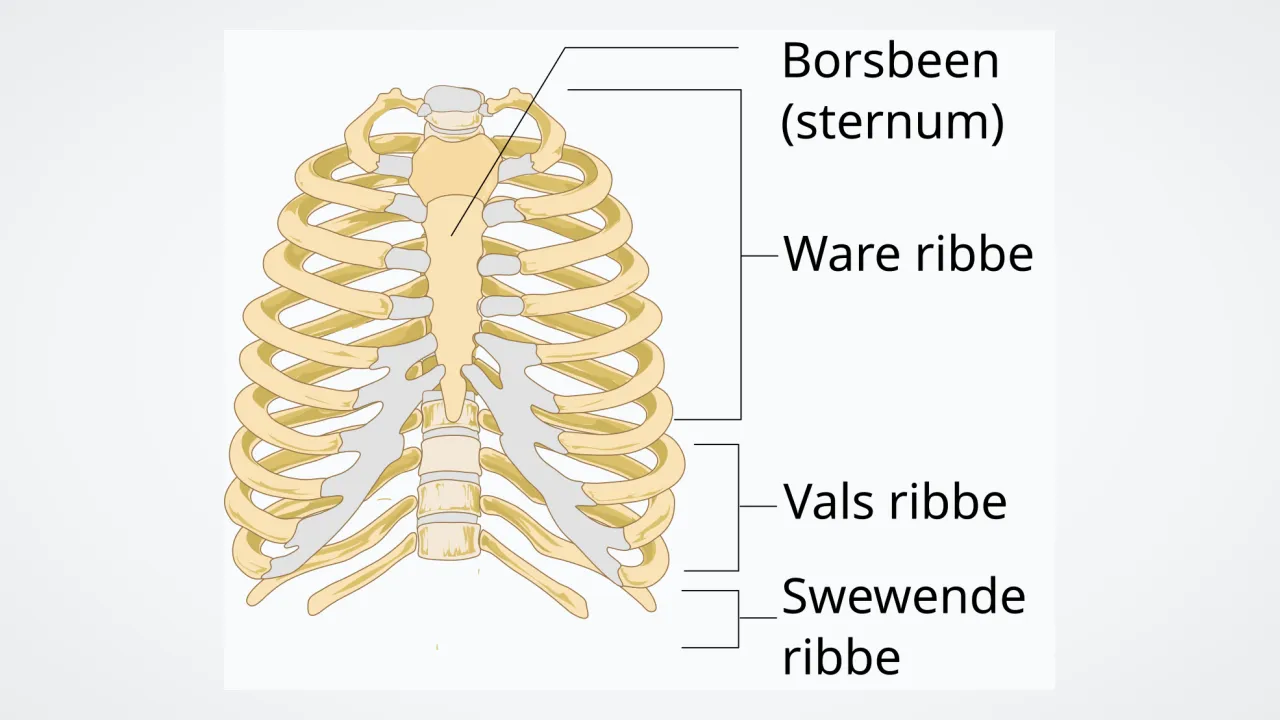
Count down the twelve pairs of ribs on a skeleton model, and you will discover three clever designs! Pairs 1 through 7 are called 'true ribs' because each one has its own strip of costal cartilage plugging directly into the sternum. Pairs 8, 9, and 10 are called 'false ribs' because their cartilage hitches a ride onto rib 7's cartilage above them!
2
The Mystery of Floating Ribs
Down at the bottom, pairs 11 and 12 are called 'floating ribs.' Do not worry—they are anchored tightly to your thoracic spine in the back! They get that nickname simply because their front tips stay open in muscle without touching the sternum, shielding your kidneys while leaving room for your belly to bend.
3
Bucket-Handle Breathing
Between every rib sit muscles. Teamed up with the dome-shaped below, they swing your ribs upward like lifting the handle on a beach bucket!
4
Hidden Blood Factories
Inside your flat ribs and sternum sits spongy red bone that manufactures millions of fresh blood cells every second.
1. Why are rib pairs 11 and 12 called 'floating ribs'?
2. What important job happens inside the spongy core of your ribs and sternum?
🤯 Mind-Blowing Fact • Grade 4
About one in every two hundred people is born with a harmless extra neck rib above their first pair, called a cervical rib!
✨ Word Sparks (Grade 4 Glossary)
Tap 🔊 to hear
Manubrium
Top handle-shaped piece of the sternum bone
Xiphoid
Small pointed lower tip of the breastbone
Thorax
Anatomical name for chest between neck and belly
🪝
How do bucket handles and pump handles explain the exact geometry of your rib cage expanding in three dimensions?
1
Pump Handles and Bucket Handles
Watch your chest in a mirror during a sprint breath, and notice that it expands both forward AND sideways at the exact same moment! Biomechanists compare this 3D motion to two classic farm tools. Because upper ribs angle downward from spine to sternum, lifting them swings the breastbone forward and up like raising an old-fashioned water-pump handle. Meanwhile, curved middle ribs pivot at both ends, swinging outward to the sides just like lifting the wire handle on a water bucket!
2
Creating Negative Pressure
Why does chest expansion pull air into your nose? Physics! According to Boyle's law, when external intercostal muscles lift the rib cage and the diaphragm flattens downward, chest volume increases—causing air pressure inside your lungs to dip slightly below outside room air so fresh oxygen rushes effortlessly inward.
3
Three Parts of the Sternum
Feel the top notch of your breastbone: the sternum itself fuses from three segments—the shield-like upper , the long central body, and a tiny lower cartilage tip called the process where abdominal muscles anchor.
4
Protected Grooves Underneath
Along the sheltered bottom inner edge of each rib runs a neat costal groove, tucking delicate intercostal nerves, arteries, and veins safely out of harm's way!
1. How does expanding the volume of your rib cage make fresh air rush into your lungs?
2. Where do delicate chest nerves and blood vessels hide along each rib for protection?
🤯 Mind-Blowing Fact • Grade 5
When you breathe in quietly, twisting your springy costal cartilages stores elastic energy—so breathing back out while resting costs your muscles almost zero energy!
✨ Word Sparks (Grade 5 Glossary)
Tap 🔊 to hear
Hyaline
Smooth, glassy, springy cartilage linking front ribs
Hematopoiesis
Production of fresh blood cells inside marrow
Viscoelastic
Stretching smoothly under force and springing back
🪝
How do twenty-four twisted bone arcs, viscoelastic hyaline cartilage, and synovial spinal joints convert muscular force into effortless ventilation?
1
Osteology of the Thoracic Cage
Enclosing the conical thoracic cavity, the human rib cage (cavea thoracis) integrates 12 thoracic vertebrae posteriorly, 12 paired ribs laterally, and the tripartite sternum—manubrium, gladiolus (body), and xiphoid process—anteriorly. Pairs 1–7 (vertebrosternal 'true' ribs) articulate directly with sternal facets via individual bars of costal cartilage; pairs 8–10 (vertebrochondral 'false' ribs) merge into the costal arch of rib 7; and pairs 11–12 (vertebral 'floating' ribs) terminate freely within the abdominal musculature, shielding the superior poles of both kidneys and the spleen.
2
Dual Synovial Articulations and Rib Torsion
Posteriorly, a typical rib forms two distinct synovial gliding joints with the spine: the rib head articulates across adjacent vertebral bodies (costovertebral joint), while the rib tubercle articulates with the transverse process (costotransverse joint). Because the axis passing through these two joints angles obliquely outward and backward, elevating the ribs simultaneously expands anteroposterior diameter ('pump-handle' motion of ribs 1–6) and transverse diameter ('bucket-handle' motion of ribs 7–10).
3
Elastic Recoil and Quiet Expiration
During quiet inhalation, contraction of the diaphragm and obliquely angled external intercostal muscles lifts the cage and slightly twists the costal cartilages, storing elastic potential energy! Consequently, quiet exhalation requires zero muscle energy: relaxing the inspiratory muscles allows lung elastin and untwisting costal cartilages to recoil passively, while internal intercostals engage only during forceful coughing, singing, or sprinting.
4
Hematopoietic Haven and Cardiopulmonary Resuscitation
Throughout adult life, trabecular diploë within the ribs and sternum retains active red bone marrow for . Moreover, the sternum's resilient costal-cartilage suspension makes chest compressions during lifesaving CPR possible—allowing rescuers to depress the adult sternum 5 centimeters to circulate blood without fracturing rigid bone when performed properly!
5
Evolutionary Adaptation
Compared to the funnel-shaped rib cages of tree-climbing apes, the barrel-shaped human thorax optimizes endurance breathing for upright running.