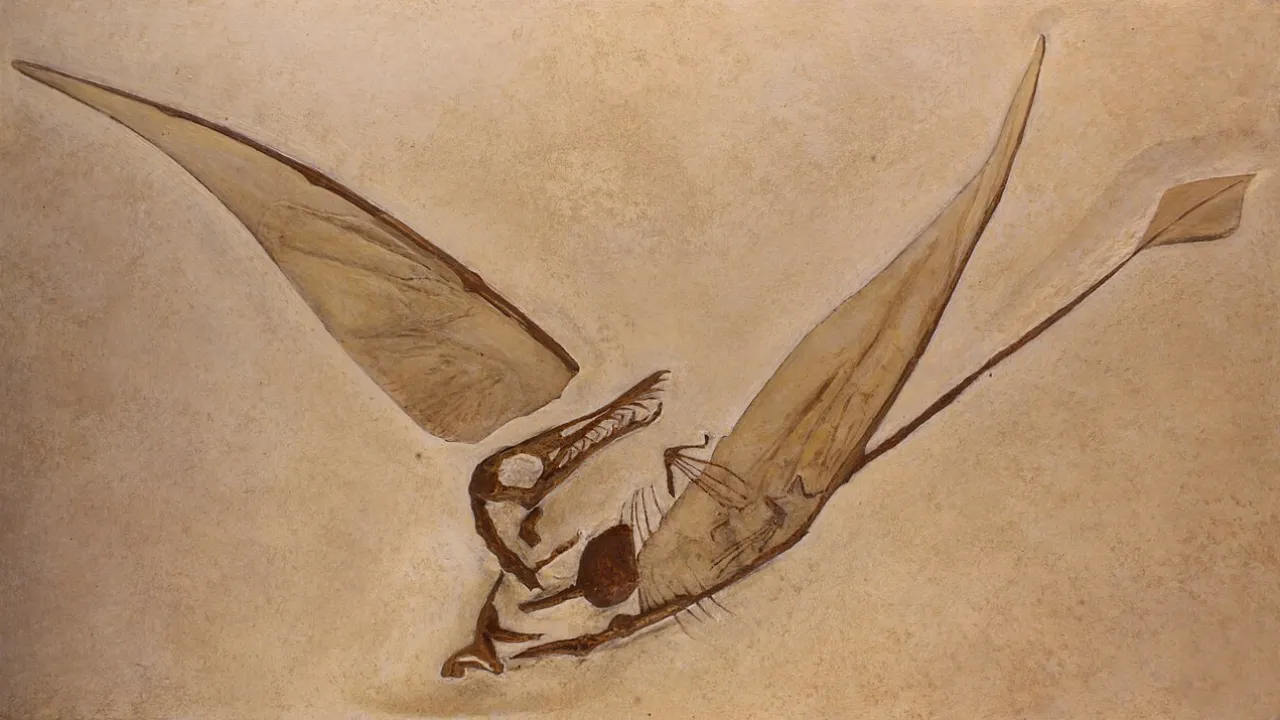
1. What shape sat at the very tip of Rhamphorhynchus's long tail?
2. Why did Rhamphorhynchus's teeth slant forward?
🤯 Mind-Blowing Fact • Grade 2
Scientists call young pterosaurs 'flaplings,' and fossil hatchlings of Rhamphorhynchus were no bigger than a modern sparrow!
✨ Word Sparks (Grade 2 Glossary)
Tap 🔊 to hear
Flapling
Nickname for a baby flying pterosaur
Limestone
Fine pale rock formed on sea floors
Squid
Fast sea animal with tentacles and ink
🪝
Could baby flying reptiles really flap into the sky soon after hatching from their eggs?
1
Neighbours of Archaeopteryx
Visit the tropical island lagoons of southern Germany 150 million years ago! Sharing the breezy skies with early feathered bird Archaeopteryx was Rhamphorhynchus, a sleek flying reptile with a six-foot wingspan and a beak tipped with curved, toothless hook jaws.
2
Growing Up Airborne
Fine slabs preserved Rhamphorhynchus fossils of every age, from tiny hatchlings with ten-inch wingspans to six-foot adults! Because even the smallest youngsters already had strong, full-sized wing proportions, many scientists think young ‘’ could fly early in life while hunting small insects before switching to fish.
3
Night and Twilight Hunter
Rings of small bones inside its large eyes suggest Rhamphorhynchus spotted shimmering and fish clearly at dusk!
1. What nickname do paleontologists use for young baby pterosaurs like tiny Rhamphorhynchus?
2. In which European country were the most famous Rhamphorhynchus fossils discovered?
🤯 Mind-Blowing Fact • Grade 3
One incredible fossil from Germany preserves a Rhamphorhynchus with a tiny fish still in its throat while a bigger predatory fish is biting its wing!
✨ Word Sparks (Grade 3 Glossary)
Tap 🔊 to hear
Predatory
Living by hunting and catching other animals
Cephalopod
Group of ocean mollusks including squid
Mature
Fully grown into an adult form
🪝
What dramatic three-animal food-chain moment got frozen forever in a single slab of German stone?
1
Frozen in Solnhofen Stone
One hundred fifty million years ago during the Late Jurassic Period, calm salty lagoons sat behind coral reefs in Bavaria, Germany. Because the deep lagoon mud held almost no oxygen, animals that sank there fossilized in breathtaking detail—showing Rhamphorhynchus muensteri right down to its wing skin and diamond tail vane!
2
A Stiffened Rudder Tail
Unlike later giant pterosaurs such as Pteranodon that had tiny stubby tails, earlier pterosaurs like Rhamphorhynchus trailed a long tail stiffened by criss-crossing bony rods. As the animal matured from youngster to adult, the soft skin vane at the tail tip widened from a slender leaf shape into a bold triangle or diamond.
3
Caught in the Act!
One world-famous 2012 fossil slab captures an unforgettable lagoon drama! Inside Rhamphorhynchus's throat sits a freshly swallowed Leptolepides fish—while a two-foot sword-snouted fish named Aspidorhynchus has its jaws clamped right onto the pterosaur's wing!
4
One Species, Many Ages
Comparing over a hundred skeletons proved that smaller specimens once thought to be separate species were actually growing Rhamphorhynchus youngsters!
1. How did the skin vane on Rhamphorhynchus's tail tip change as it grew from baby to adult?
2. What happened in the famous three-animal Solnhofen fossil slab?
🤯 Mind-Blowing Fact • Grade 4
Fossilized stomach contents inside Rhamphorhynchus preserve tiny curved arm hooks from prehistoric squid-like cephalopods called Plesioteuthis!
✨ Word Sparks (Grade 4 Glossary)
Tap 🔊 to hear
Hypersaline
Water much saltier than normal seawater
Belemnite
Extinct squid-like sea creature with internal shell
Lattice
Crisscrossing framework giving light strong support
🪝
How did ultraviolet and laser light reveal hidden structural secrets inside Rhamphorhynchus's diamond tail vane?
1
Window Into a Jurassic Lagoon
Step back 150 million years to the Tithonian archipelago of southern Germany, where warm lagoons collected whisper-fine carbonate muds. Soaring above these turquoise waters on 1.8-meter (5.9-foot) wings was Rhamphorhynchus muensteri, a one-kilogram piscivorous pterosaur first studied by German paleontologist Hermann von Meyer in the 1840s.
2
Anatomy of a Fish-Snaring Specialist
Rhamphorhynchus belonged to the older 'rhamphorhynchoid' grade of long-tailed pterosaurs. Its narrow skull ended in a sharp, toothless, upward-curving keratinous prow, behind which twenty upper and fourteen lower needle-like teeth splayed forward and outward. When its jaws snapped shut while dipping low over water, those procumbent teeth formed an inescapable basket around slippery fish and soft-bodied cephalopods.
3
Laser Scans of the Tail Vane
For generations, researchers wondered how Rhamphorhynchus's thin tail vane stayed stiff in crosswinds without folding like wet cloth. In 2024, Natalia Jagielska and colleagues illuminated Solnhofen fossils with ultraviolet and laser-stimulated fluorescence, discovering hollow vertical tubes crossed by thicker central rods inside the diamond vane—an inflatable- design that prevented flutter while flashing bold silhouettes!
4
Fossilized Squid Hooks and Growth Curves
Fossilized stomach contents and regurgitated pellets confirm Rhamphorhynchus dined on fish and hook-armed squid. Even more remarkably, isometric wing proportions across more than a hundred fossils indicate hatchlings launched into flight early while growing nearly tenfold in wingspan.
1. What did 2024 laser fluorescence scans discover inside Rhamphorhynchus's diamond-shaped tail vane?
2. How do scientists know Rhamphorhynchus hunted squid relatives as well as fish?
🤯 Mind-Blowing Fact • Grade 5
Measurements of the tiny bony eye rings (scleral rings) inside Rhamphorhynchus skulls suggest it had night-vision eyes tuned for hunting fish and squid after sunset!
✨ Word Sparks (Grade 5 Glossary)
Tap 🔊 to hear
Ontogeny
How an organism grows from hatchling to adult
Precocial
Born active and independent right after hatching
Scleral Ring
Circle of small bones supporting reptile eyeballs
🪝
Why does Rhamphorhynchus provide our clearest fossil portrait of how early long-tailed pterosaurs grew, flew, and hunted?
1
Star of the Solnhofen Plattenkalk
Approximately 150 to 148 million years ago during the Late Jurassic (early Tithonian), stagnant, hypersaline back-reef basins across Bavaria, Germany, deposited the lithographic limestones of the Solnhofen Plattenkalk. Alongside iconic Archaeopteryx, these anoxic muds preserved over one hundred complete skeletons and soft-tissue impressions of Rhamphorhynchus muensteri, established as a distinct genus by Hermann von Meyer in 1847.
2
Ontogeny and Precocial 'Flaplings'
For decades, paleontologists split Solnhofen specimens into five separate Rhamphorhynchus species ranging from 29-centimeter wingspans to 1.8-meter adults. In a landmark 1995 statistical study, S. Christopher Bennett proved all represented a single ontogenetic growth series of R. muensteri! Bone histology and proportional wing-area scaling by Elizabeth Prondvai and Hone et al. (2020) show hatchlings possessed well-ossified humeri and flight membranes capable of early powered flight—foraging for forest insects as tiny juveniles before shifting to marine piscivory as adults.
3
Scleral Rings and Sensory Ecology
Comparisons of Rhamphorhynchus's eye bones and inner-ear semicircular canals by Lars Schmitz and Ryosuke Motani indicate adaptation to scotopic (low-light) or nocturnal foraging, reducing competition with diurnal lagoon flyers while targeting bioluminescent or surface-rising squid and teleost fish.
4
Caudal Rod Bundle and Lattice Vane
Up to forty elongated caudal vertebrae were encased in filiform ossified zygapophyses and chevrons, transforming the tail into a stiff lever arm. Laser-stimulated fluorescence imaging in 2024 revealed that its terminal soft-tissue vane housed hollow perpendicular rods anchoring tensioned skin, functioning simultaneously as an aerodynamic yaw stabilizer and ontogenetic display badge.
5
Taphonomic Snapshot of Predation
Spectacularly, specimen WDC CSG 255 preserves an Aspidorhynchus ganoid fish entangled by the snout in Rhamphorhynchus's patagium—moments after the pterosaur itself swallowed a Leptolepides fish—immortalizing multi-trophic Jurassic lagoon ecology in stone.