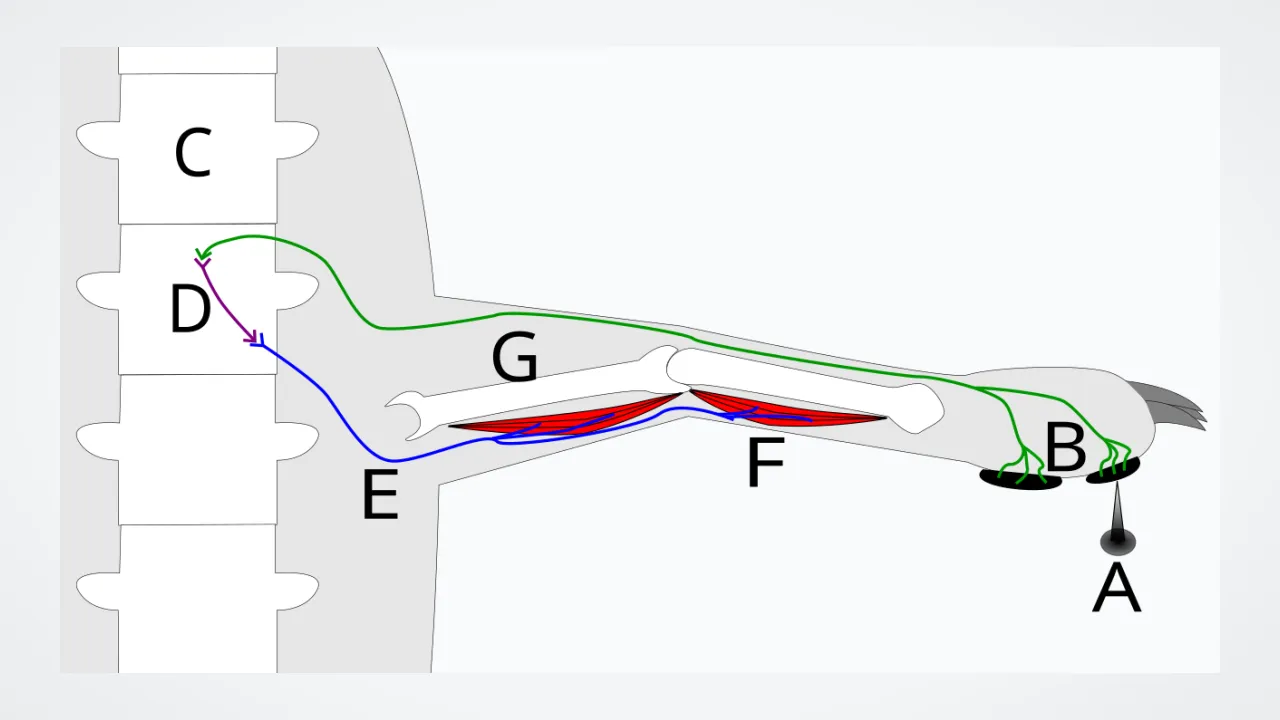
1. Where does a hand-pulling reflex message make its super-fast U-turn?
2. Why does a doctor gently tap below your knee during a checkup?
🤯 Mind-Blowing Fact • Grade 2
A knee-jerk reflex takes only about thirty-five thousandths of a second from tap to kick—three times faster than an average eyeblink!
✨ Word Sparks (Grade 2 Glossary)
Tap 🔊 to hear
sensor
A tiny detector noticing touch, heat, or stretch
alert
A quick warning message about danger
instant
Happening right away with zero waiting
🪝
How can your leg kick all by itself when a doctor taps your knee with a rubber triangle?
1
Faster Than Thinking
Blink when a puff of wind blows toward your eyelashes! Pull your bare foot back from a sharp seashell on the beach! Both moves use a lightning-fast nerve shortcut called a reflex arc to protect your body before harm happens.
2
Three Quick Steps
First, tiny in your skin or muscle spot a surprise and fire an inward. Next, your spinal cord flips an switch without waiting for your thinking brain! Finally, a motor nerve tells your muscle to move.
3
Brain Hears the News Next
A copy of the message still rides up to your brain a split second later—just in time for you to look down and say, 'Whoa, close call!'
1. Why doesn't a reflex arc wait for your thinking brain to decide what to do?
2. When does your brain find out that you touched a sharp seashell?
🤯 Mind-Blowing Fact • Grade 3
The patellar knee-jerk is the fastest kind of human reflex because its entire loop uses just ONE single synapse inside your spinal cord!
✨ Word Sparks (Grade 3 Glossary)
Tap 🔊 to hear
involuntary
Happening automatically without you choosing it
effector
The muscle or gland carrying out action
tendon
Tough cord attaching muscle firmly to bone
🪝
How do five teamwork stations turn a warm-pan touch into a lifesaving pull-back in milliseconds?
1
Built-In Emergency Autopilot
Imagine touching a mug of hot cocoa that is way warmer than you expected. Before your brain can think 'Hmm, that mug feels hot, maybe I should open my fingers,' your hand has already let go! That built-in autopilot is a reflex arc, an neural loop wired for instant protection and balance.
2
Five Stations in the Loop
Most withdrawal reflexes pass through five teamwork stations in order. First, a sensory receptor in your skin detects intense heat. Second, a sensory neuron races that alarm inward. Third, an interneuron inside your spinal cord's gray matter makes the instant U-turn decision. Fourth, a motor neuron zooms outward, and fifth, an muscle contracts to pull your hand away!
3
The Two-Neuron Knee Jerk
Even simpler is the doctor's knee-jerk test! Tapping the below your kneecap stretches your thigh muscle, and the sensory neuron plugs straight into the motor neuron with zero interneuron in between.
4
Everyday Balance Helper
Stretch reflexes don't just show off at checkups—they quietly fire every second to keep your knees steady whenever you stand or ride a bumpy bus!
1. In a five-part hand withdrawal reflex, which neuron makes the instant U-turn inside the spinal cord?
2. How do stretch reflexes help you outside the doctor's office every single day?
🤯 Mind-Blowing Fact • Grade 4
If you clench your hands tightly together and pull outward during a doctor's knee-tap test—a trick called the Jendrassik maneuver—your knee kicks noticeably higher because your busy brain stops dampening the spinal loop!
✨ Word Sparks (Grade 4 Glossary)
Tap 🔊 to hear
monosynaptic
Using only one synapse between two neurons
polysynaptic
Using interneurons and multiple synapses together
inhibition
A calming signal telling muscles to relax
🪝
When one foot steps on a sharp LEGO brick, how does your OTHER leg instantly stiffen so you don't topple over?
1
Monosynaptic Versus Polysynaptic Loops
Not all reflex arcs are wired alike! Neuroscientists sort them by how many synapses sit inside the central nervous system. When a reflex hammer taps your patellar tendon, microscopic stretch sensors called muscle spindles fire down a sensory neuron that synapses directly onto a quadriceps motor neuron—a '' (one-synapse) loop taking roughly thirty milliseconds. Pulling away from a sharp tack, however, uses a '' (many-synapse) loop with spinal interneurons coordinating whole groups of muscles at once.
2
Reciprocal Inhibition: Teamwork Across Antagonists
Watch closely when your knee kicks forward: for your front thigh muscle (quadriceps) to extend smoothly, your back thigh muscle (hamstring) must relax at the exact same instant so the two muscles don't tug-of-war! A clever branch of the incoming sensory neuron activates an inhibitory interneuron that briefly quiets the hamstring—a rule called reciprocal .
3
The Crossed-Extensor Balancing Act
Step barefoot on a pointy LEGO brick and an even smarter circuit fires! While flexor reflexes lift your startled right foot into the air, spinal interneurons zip across the midline of your spinal cord to stiffen your left leg's extensor muscles—catching your full body weight before gravity can tip you over!
4
Cranial Reflexes Upstairs
Not every reflex uses the spine: brainstem reflex arcs shrink your pupils in bright sunlight, trigger protective coughs, and blink your eyelids in a flash.
1. Why is reciprocal inhibition essential during a knee-jerk reflex?
2. What does the crossed-extensor reflex do the instant one bare foot lifts off a sharp object?
🤯 Mind-Blowing Fact • Grade 5
Newborn babies arrive with temporary survival reflexes—like the palmar grasp reflex so strong a newborn's fingers curl tightly around a parent's thumb—that naturally fade as higher brain cortex circuits mature!
Operating independently without needing step-by-step direction
🪝
How can your conscious brain override a burning-dish reflex just long enough to set Grandma's ceramic casserole safely on the counter?
1
Descartes, Sherrington, and the Integrative Spine
In the seventeenth century, French philosopher René Descartes sketched one of science's earliest diagrams of an automatic withdrawal response, imagining hollow nerve tubes reflecting heat like light bouncing off a mirror—giving us the word 'reflex.' Two centuries later, Nobel laureate Charles Sherrington transformed physiology by proving that reflex arcs are precision neural circuits built from discrete receptors, afferent fibers, central synapses, and efferent motor units working in seamless harmony.
2
Millisecond Math of the Stretch Reflex
Follow the numbers of a patellar stretch reflex to appreciate why spinal integration matters. Stretching intrafusal muscle fibers fires giant Ia afferent axons conducting at roughly 100 meters per second. Traveling 0.7 meters from thigh to lumbar segments L2–L4 takes just seven milliseconds; crossing a single glutamate synapse takes less than one millisecond; and racing back down alpha motor axons to neuromuscular junctions takes another eight milliseconds—initiating muscle tension long before cortical awareness arrives nearly a tenth of a second later!
3
Golgi Tendon Organs: Preventing Overload
Complementing stretch-sensing , microscopic tension gauges called Golgi tendon organs weave inside tendons where muscle meets bone. If a weight lifter hoists an unsafe load that threatens to tear tissue, Ib sensory fibers excite inhibitory spinal interneurons to dial back muscle contraction automatically.
4
Top-Down Cortical Override
Even though spinal arcs run autonomously, descending corticospinal pathways from your brain can them! If you realize a cherished ceramic dish is hotter than expected, your cerebral cortex can fire inhibitory signals down to spinal interneurons—suppressing the drop reflex for two heroic seconds until the dish rests safely on a trivet.
5
Diagnostic Windows for Neurologists
Because specific reflexes map to exact spinal levels—C5–C6 at the biceps, L3–L4 at the knee, S1 at the Achilles ankle tendon—neurologists test them with a simple percussion hammer to pinpoint nerve health noninvasively.