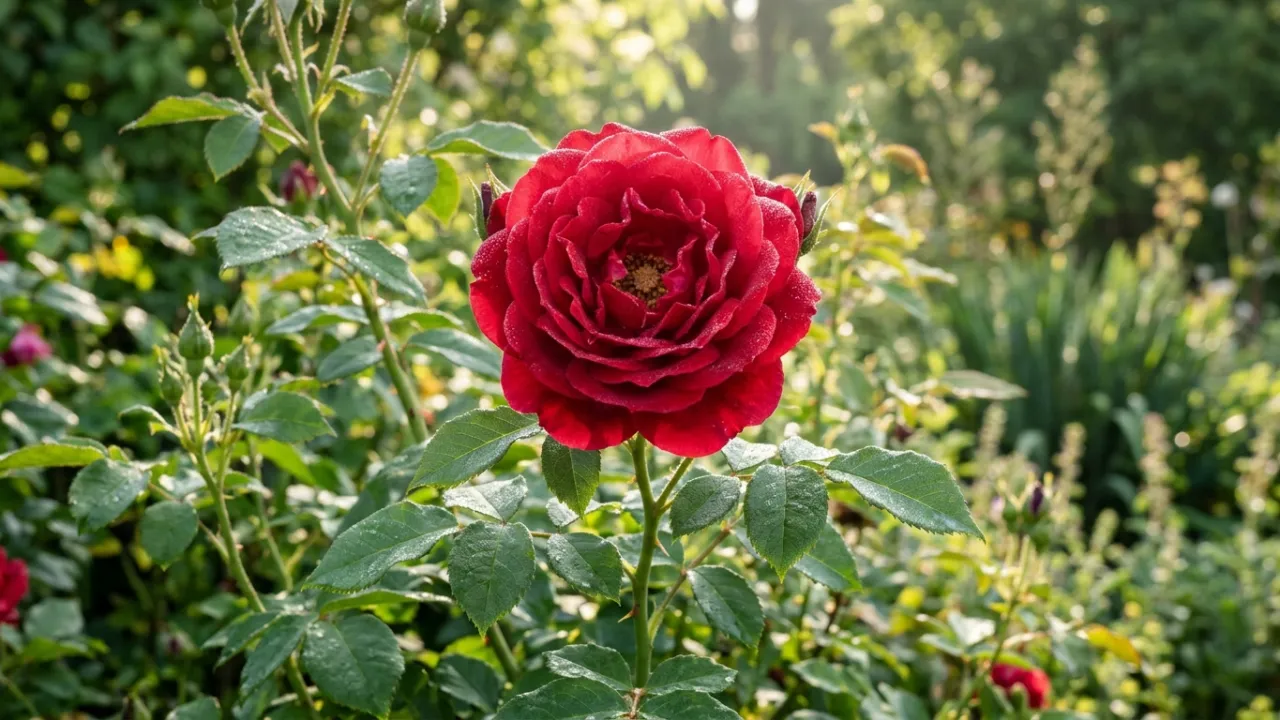
1. How do sharp points on a Red Rose stem help the plant?
2. What insects love to visit a sweet-smelling Red Rose?
🤯 Mind-Blowing Fact • Grade 2
Every autumn, rose bushes grow bright red seed pods called rose hips that hold more Vitamin C per bite than oranges!
✨ Word Sparks (Grade 2 Glossary)
Tap 🔊 to hear
bud
Closed young flower ready to open
pollen
Fine yellow dust helping plants make seeds
shrub
Woody plant with many low stems
🪝
How does a tightly closed green bud unfold into a fragrant crimson bowl for hungry bees?
1
Sunny Garden Shrubs
Step into a sunny summer garden and follow your nose! Red Roses grow on woody, branching that love six hours of bright sunshine each day and deep drinks of rainwater around their roots.
2
From Tight Bud to Open Bloom
Each flower begins life wrapped inside five tough green leaves called sepals that protect the tender . When warm spring days arrive, layers of crimson petals unfurl in a spiral and release sweet perfume.
3
Autumn Berry Treasures
After bees carry golden from bloom to bloom, the petals fall away and the flower base swells into a bright red pod called a rose hip, keeping seeds safe for winter birds!
1. What protects a young Red Rose bud before its red petals open?
2. What grows on a rose bush after petals fall and seeds form?
🤯 Mind-Blowing Fact • Grade 3
It takes roughly 10,000 pounds of freshly picked rose petals to steam-distill just one single pound of pure rose oil!
✨ Word Sparks (Grade 3 Glossary)
Tap 🔊 to hear
pollination
Moving pollen so flowers make seeds
prickle
Sharp hook growing from stem skin
photosynthesis
How green plants make food from sunlight
🪝
Wait—what if those sharp hooks on a rose stem aren't real botanical thorns after all?
1
Scent Beacons for Pollination
Close your eyes near a blooming Red Rose and breathe in deeply—that sweet scent is actually a clever survival signal! Microscopic oil glands on the velvety crimson petals release fragrance strongest in warm morning sunlight, guiding busy bees straight to the golden pollen center for .
2
Surprise: Prickles, Not True Thorns!
Here is a fun botany mystery: roses do not actually have true thorns! Botanists explain that true thorns grow deep inside a plant as pointed woody branches, whereas rose 'thorns' are really —curved hooks growing right out of the stem's outer skin, much like your fingernails.
3
Climbing and Defending
Those downward-pointing do double duty: they discourage leaf-munching herbivores like deer and rabbits while helping long rose canes hook onto neighboring branches so leaves reach bright sunlight for .
4
Serrated Solar Panels
Along each sturdy stem, five toothed green leaflets catch golden sunshine to make sugary plant food while shedding heavy summer raindrops quickly so dampness does not harm the leaves or encourage leaf mold. Together, sweet morning fragrance, hooked , and sunlit green leaves help the rose bush thrive year after year.
1. Why do botanists call a rose's sharp stem points 'prickles' instead of true thorns?
2. Why does a Red Rose release its strongest fragrance on warm, sunny mornings?
🤯 Mind-Blowing Fact • Grade 4
Apples, strawberries, peaches, raspberries, and almonds are all members of the Rose family (Rosaceae)!
✨ Word Sparks (Grade 4 Glossary)
Tap 🔊 to hear
stamen
Pollen-making part inside a flower's center
ultraviolet
Light waves invisible to human eyes
aphid
Tiny insect that sucks plant sap
🪝
If honeybees cannot see the color red the way humans do, how do Red Roses still attract eager pollinators?
1
The Bee-Vision Color Puzzle
Here is an astonishing eyesight twist: honeybees cannot see pure red wavelengths of light, so a crimson petal looks shadowy to a bee—yet bees still flock to Rosa gallica! Why? Wild and heirloom Red Roses reflect subtle bullseye patterns near their bright yellow while broadcasting over 300 fragrant scent molecules that foraging bees detect from yards away.
2
Ancient Roots Across Eurasia
Native to sunny meadows and woodland edges across central and southern Europe into western Asia, the Apothecary's Rose (Rosa gallica) thrived for thousands of years before medieval herbalists and Silk Road travelers carried prized cuttings across continents. Crossing hardy European shrubs with repeat-blooming Chinese roses in the late 1700s eventually produced the year-round garden roses grown from Virginia to Japan today!
3
Partnerships With Birds and Beneficial Bugs
In backyard and meadow food webs, rose shrubs support bustling wildlife neighborhoods: spotted ladybugs and lacewings patrol rose stems to gobble up sap-sucking green , native bumblebees gather protein-rich pollen, and winter songbirds feast on scarlet rose hips—dispersing tough seeds across new habitats.
4
Surprise Botanical Cousins on Your Plate!
Believe it or not, Red Roses belong to the exact same botanical family—Rosaceae—as apples, strawberries, peaches, pears, cherries, blackberries, and almonds! Examine an apple or strawberry blossom closely in spring, and you will spot the unmistakable five-petaled wild-rose blueprint shared by some of humanity's favorite orchard harvests around the world. Next time you bite into a crisp autumn apple or sweet summer strawberry, remember you are tasting a cousin of the garden rose!
1. Since bees do not see red the way humans do, how do heirloom Red Roses guide them in?
2. Which surprising everyday fruits belong to the exact same botanical family (Rosaceae) as the Red Rose?
🤯 Mind-Blowing Fact • Grade 5
The oldest living rose bush in the world—growing against Hildesheim Cathedral in Germany—has bloomed for over 1,000 years!
✨ Word Sparks (Grade 5 Glossary)
Tap 🔊 to hear
anthocyanin
Natural plant pigment making red-purple colors
hypanthium
Cup-shaped flower base swelling into fruit
epidermis
Protective outer layer of cells
🪝
What microscopic cone-shaped cells make a Red Rose petal shimmer like velvet—and how did crossing two continents' roses revolutionize botany?
1
Taxonomy and Conical Petal Optics
Peer through a scanning microscope across a crimson petal of Rosa gallica—the historic French or Apothecary's Rose within the dicot family Rosaceae—and you will discover thousands of dome-shaped epidermal cells called conical papillae. Acting like miniature optical lenses, these cones focus sunlight deep into cellular vacuoles packed with crimson pigments (chiefly cyanidin glycosides), producing a rich velvety sheen while warming the bloom by several degrees Celsius and giving bumblebees a slip-free landing pad. Each velvety bloom unites ancient evolutionary chemistry with centuries of careful human cultivation across continents.
2
Epidermal Prickles Versus Vascular Thorns
In precise botanical anatomy, Rosa species carry neither true thorns (modified woody stem branches containing internal xylem and phloem bundles, as seen on hawthorns and citrus trees) nor spines (modified leaves, as on desert cacti). Instead, rose prickles develop solely from outer cortical and epidermal cell layers without vascular tissue, snapping off cleanly while serving as both anti-herbivore armor and climbing hooks.
3
Botanical Mystery of the Scarlet Rose Hip
Even the bright red 'berry' ripening in crisp autumn weather conceals an anatomical twist! What appears to be a single fruit—the rose hip—is actually a swollen, urn-shaped floral cup called a rich in ascorbic acid (Vitamin C), enclosing dozens of tiny, hard-shelled, one-seeded true fruits known botanically as achenes.
4
Volatile Terpenes and Pollinator Ecology
Plant biochemists have cataloged more than 300 volatile aromatic compounds—including citronellol, geraniol, nerol, and rose oxide—evaporating from specialized petal glands called osmophores. Because modern breeding for ultra-dense, hundred-petal exhibition blooms often converts fertile stamens into sterile petals, ecologists recommend planting open-centered species and heirloom roses so native pollinators can access abundant pollen.
5
Two Continents Unite in Horticultural History
Before the late eighteenth century, European Rosa gallica shrubs bloomed gloriously only once each June, prized in monastic gardens for medicinal petal infusions and fragrant rosewater. Introducing Rosa chinensis from Chinese imperial gardens around 1790 contributed a natural mutation in a floral-repressor gene (`KSN`) that unlocked continuous flowering from spring until autumn frost—forever reshaping horticulture across every temperate continent, while Bulgaria's Rose Valley still harvests tons of dawn-picked petals for essential oil today. Modern botanical gardens preserve historic Rosa gallica collections alongside wild species so scientists can study fragrance genetics, pollinator health, and natural plant resilience.